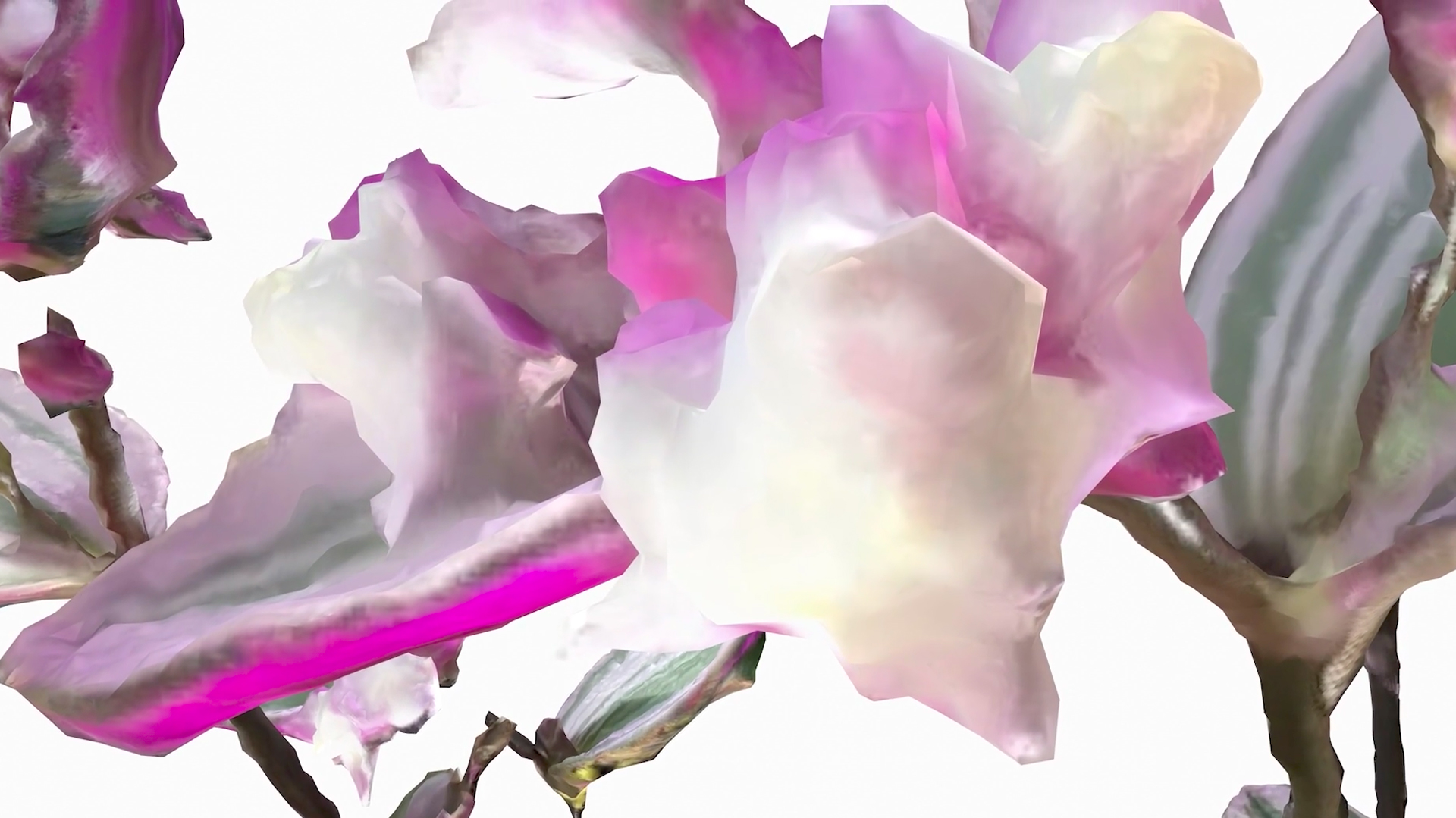
4K video, 10’25, 40-inch screen, music and direction by Thierry Fournier, 2025.
Lacunes, video, 4K, 2025 (excerpt)
Representations of plants are most often two-dimensional: herbariums, botanical drawings, photographs, etc. The Lacunes project proposes to approach the representation of flowers as organisms, considering their space and physicality.
The flowers are scanned in 3D using a photogrammetry device: around 200 photographs are taken of each flower, from which a program reconstructs a 3D model, from which the Lacunes images are then extracted without retouching. These images are also flat, but they can be viewed from any angle in the 3D model.
However, the inability of this device to reproduce all the details of the flowers, particularly the areas hidden from the lens, generates gaps, which the program compensates for by creating interpolations of shape and color. A pictorial gesture then appears, in the signature of the algorithm and its own limitations in representing reality. This is where the “gaps” that give the project its title appear: the limits of the machine’s vision, which are also those of human vision. These flowers become three-dimensional organisms, in a vision that is both highly detailed and uncertain, raising the question of their corporeality.
The film Lacunes re-enacts the non-human nature of this vision, creating an automated journey through a program within a 3D model of a mass of flowers (a spider plant, Tradescantia zebrina). The organic plant body becomes a landscape: space no longer has scale, movement is not human. The music, meanwhile, unfolds an inner universe, made up of breaths, creaks, and resistance, which extends the organic nature of what is filmed.