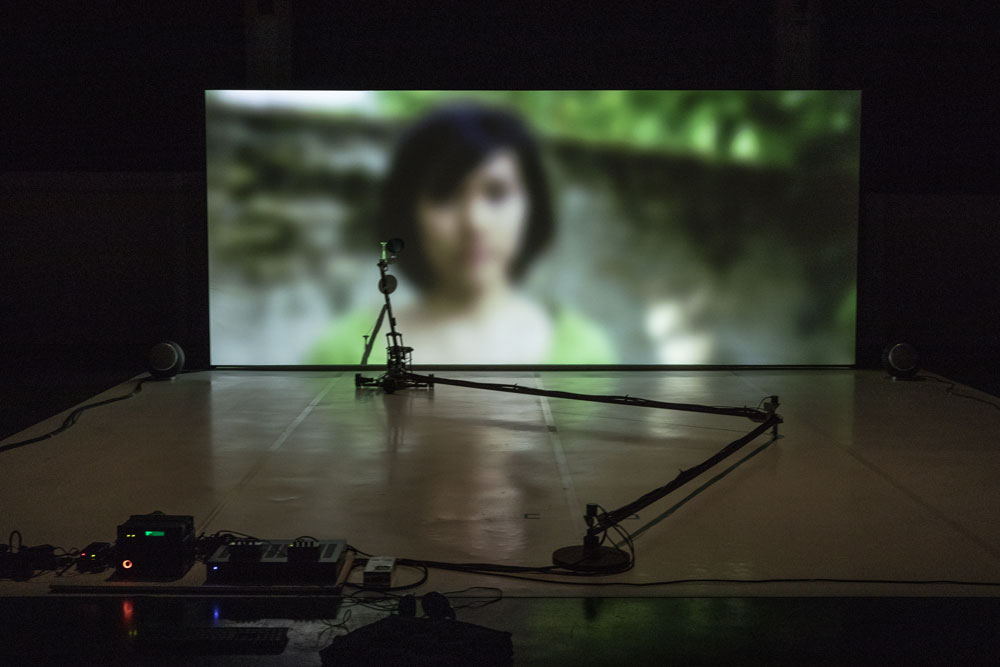
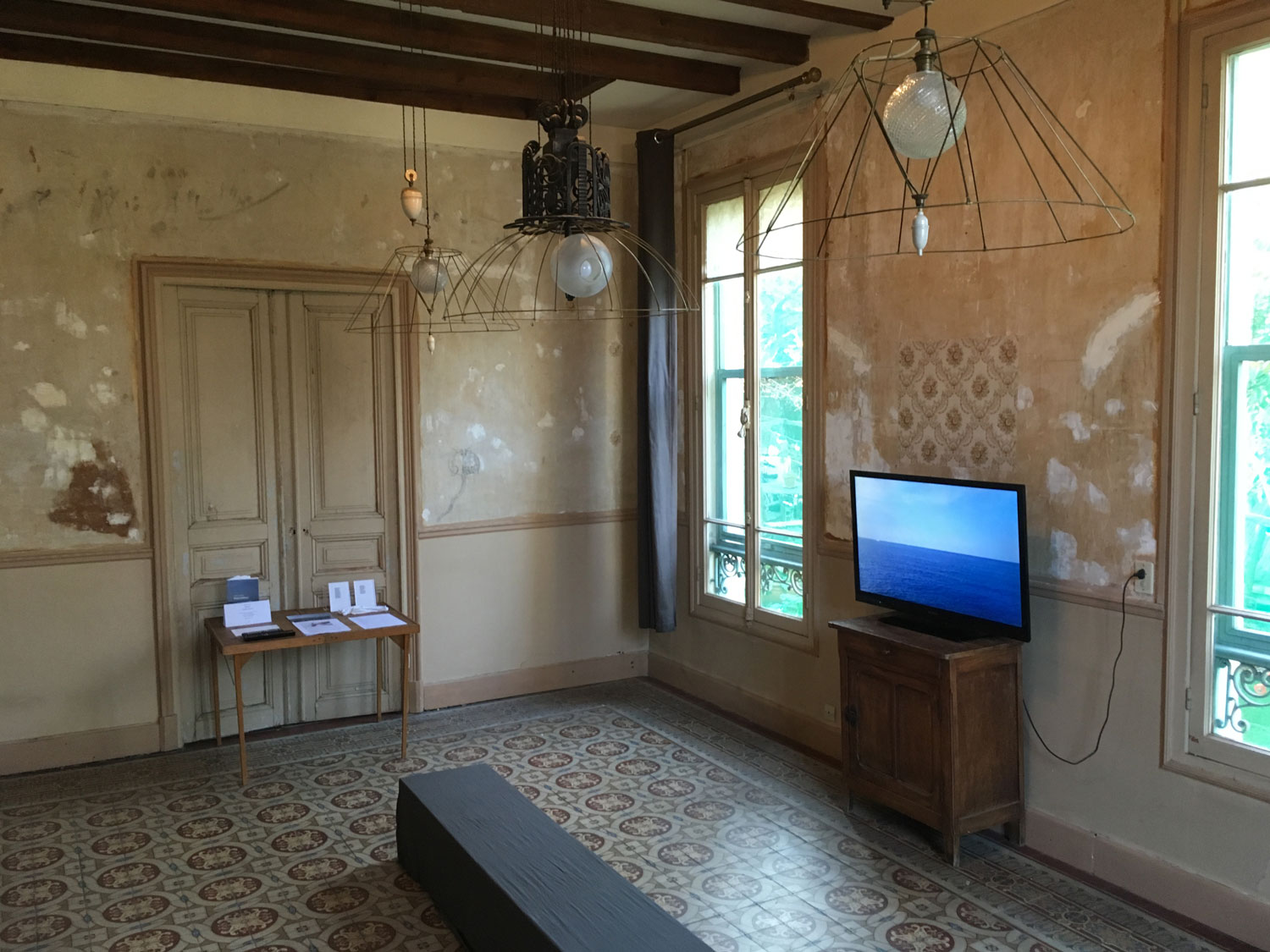
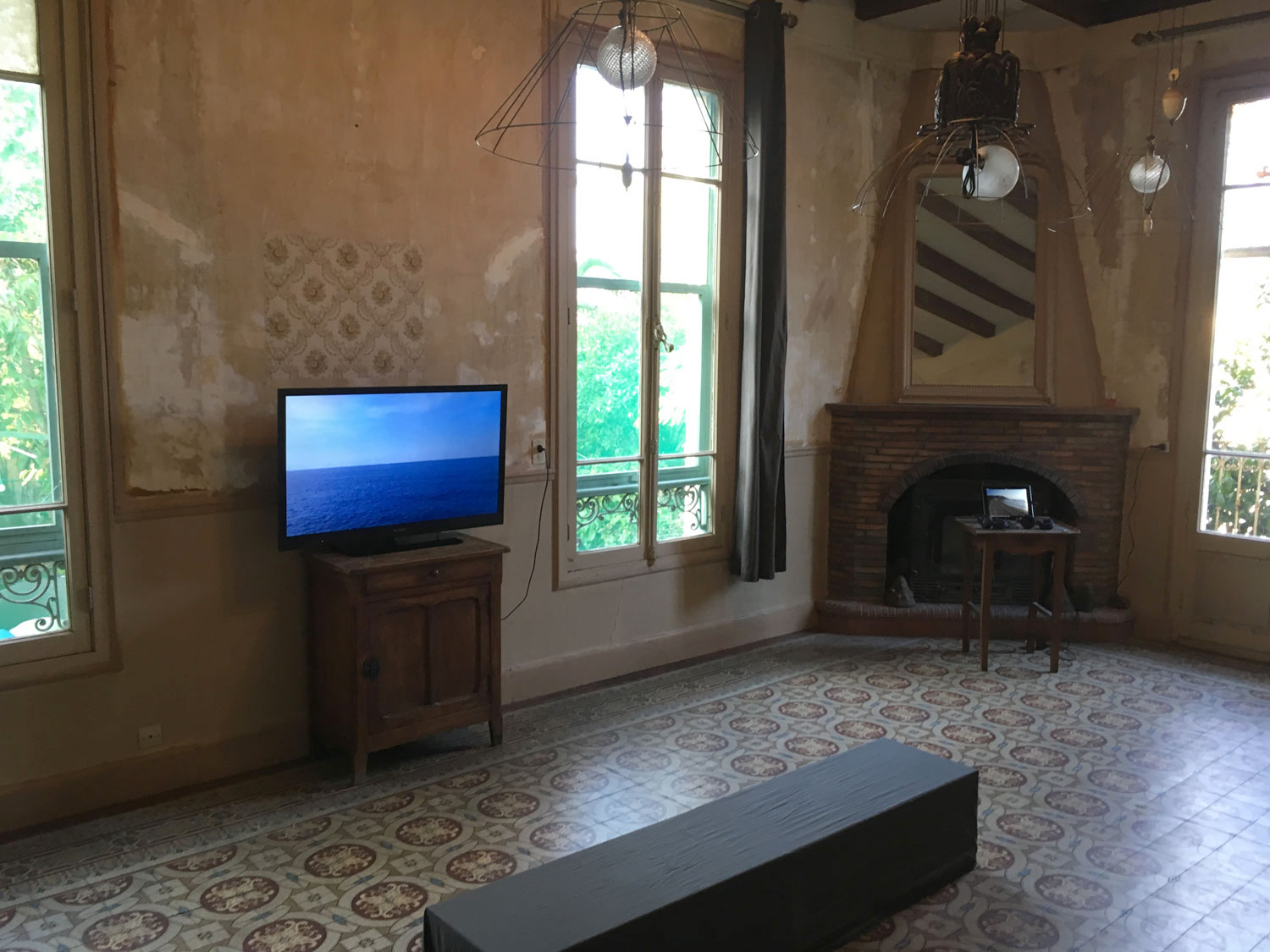
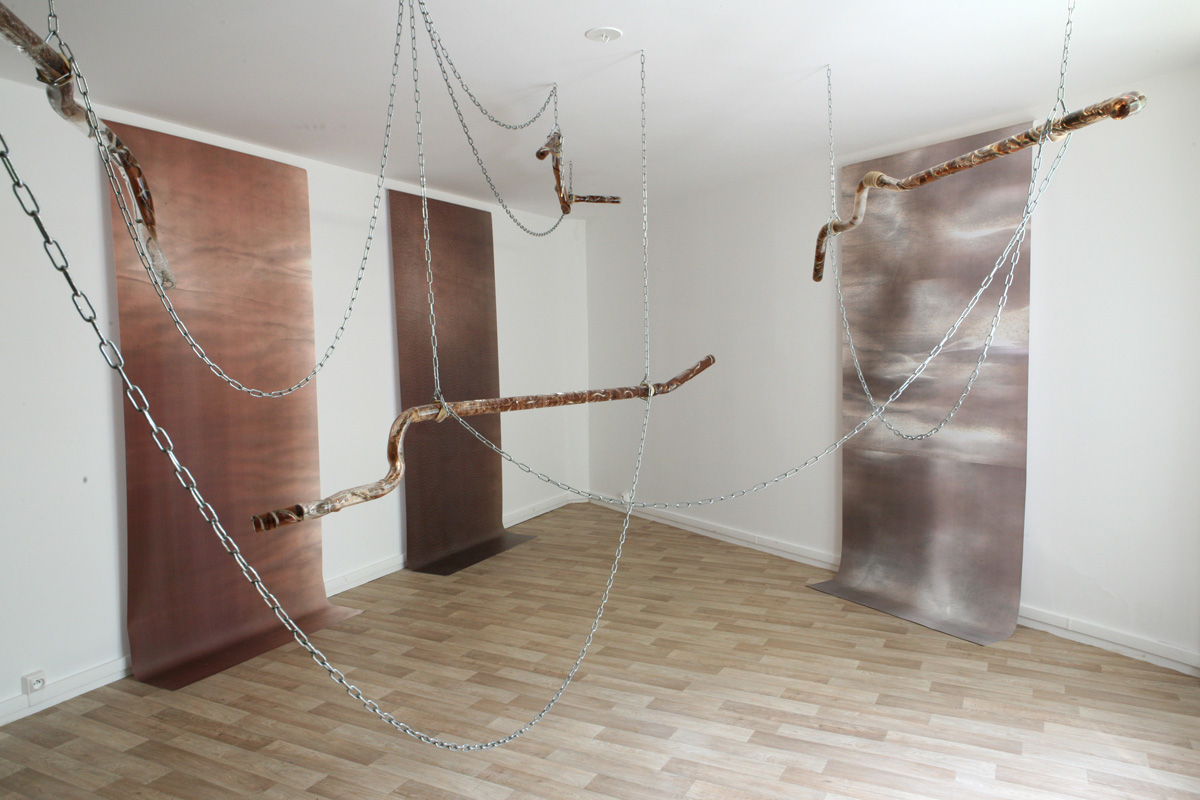
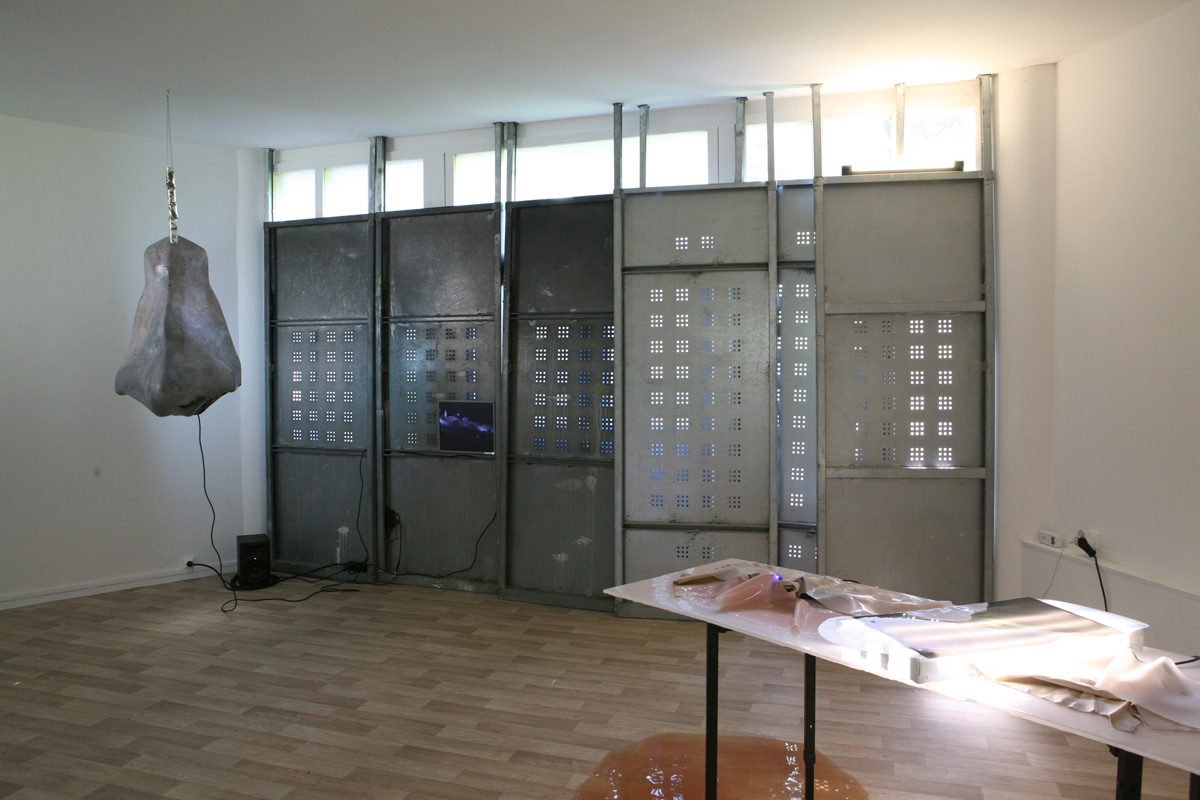
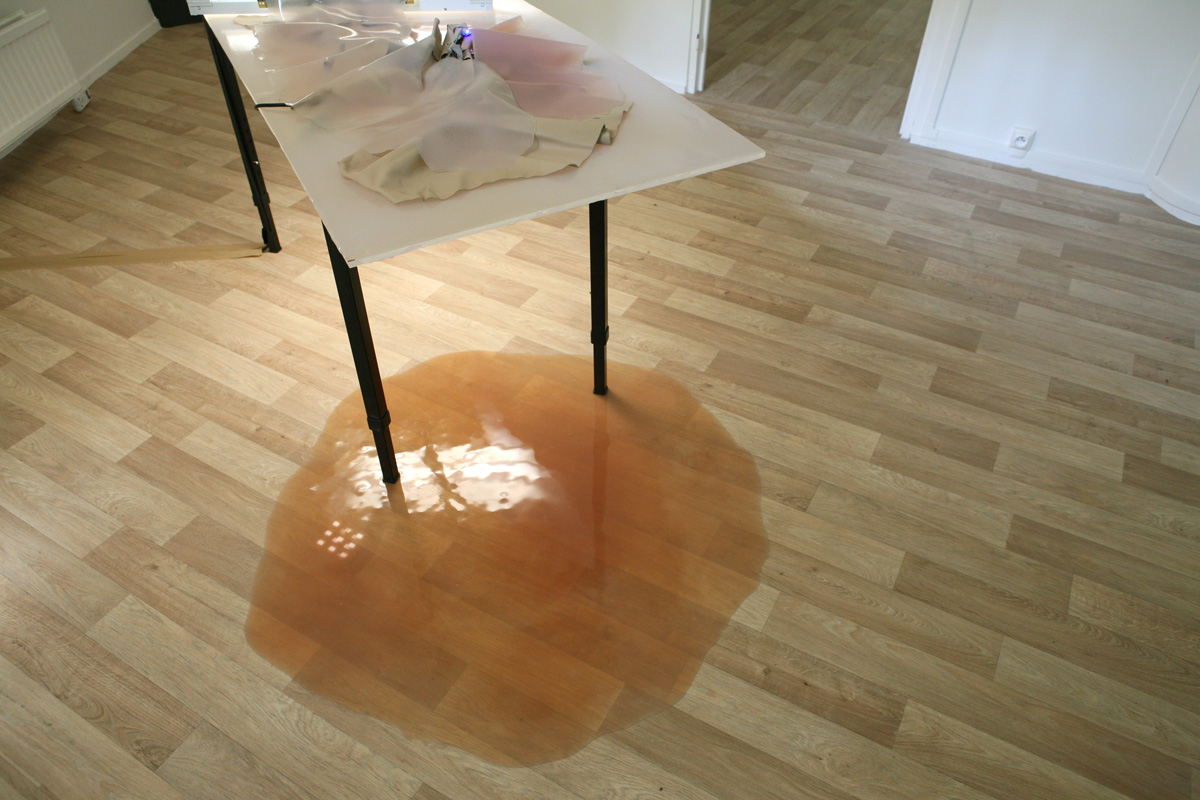
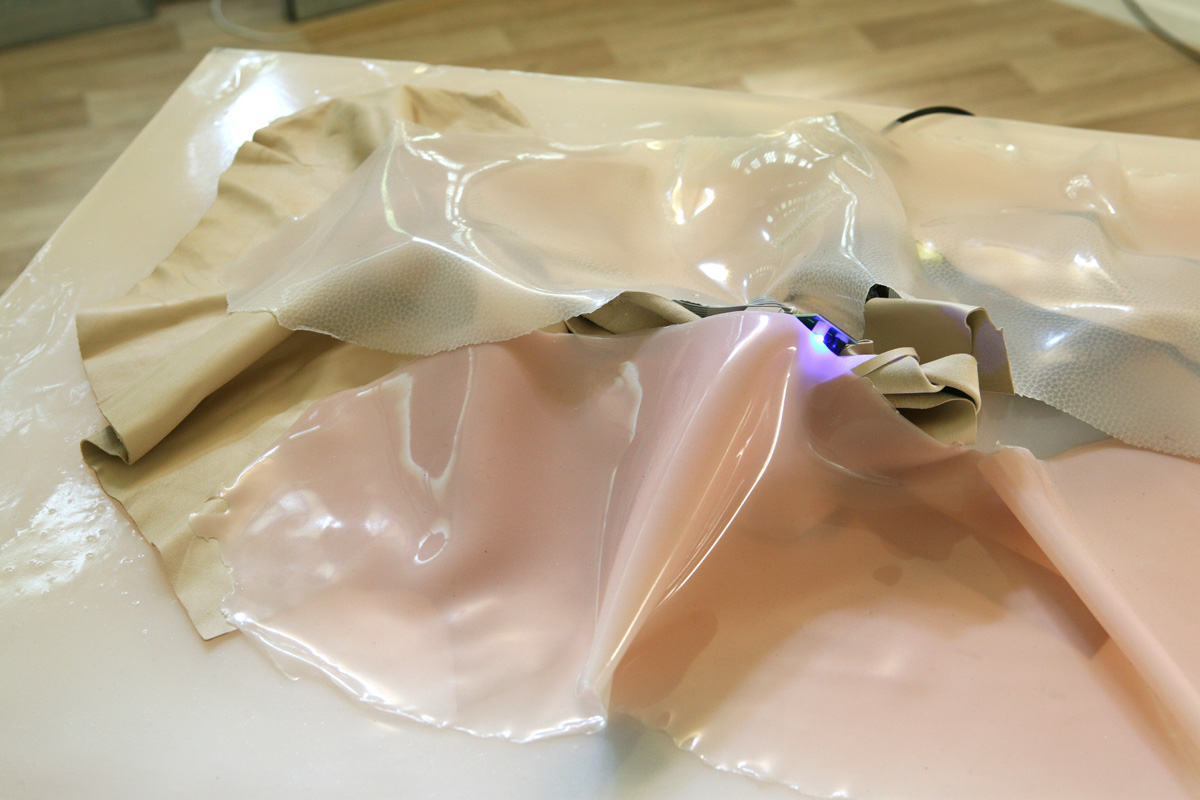
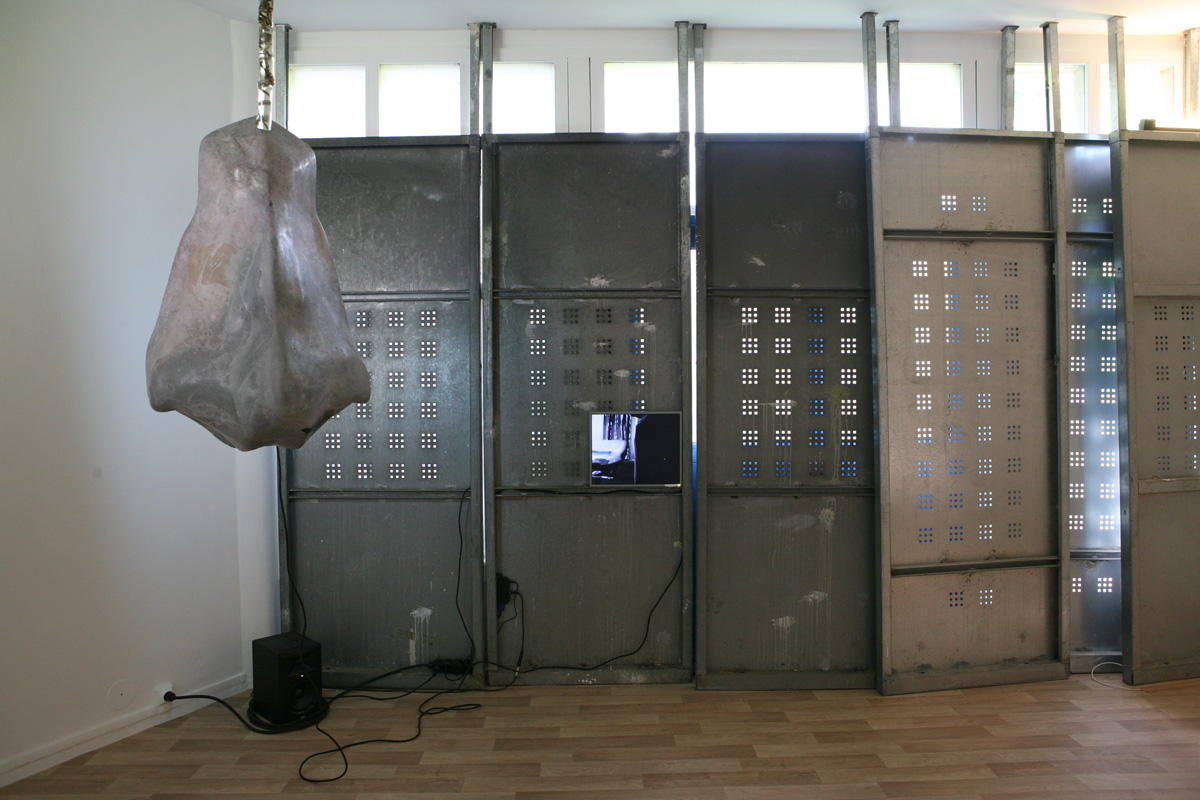
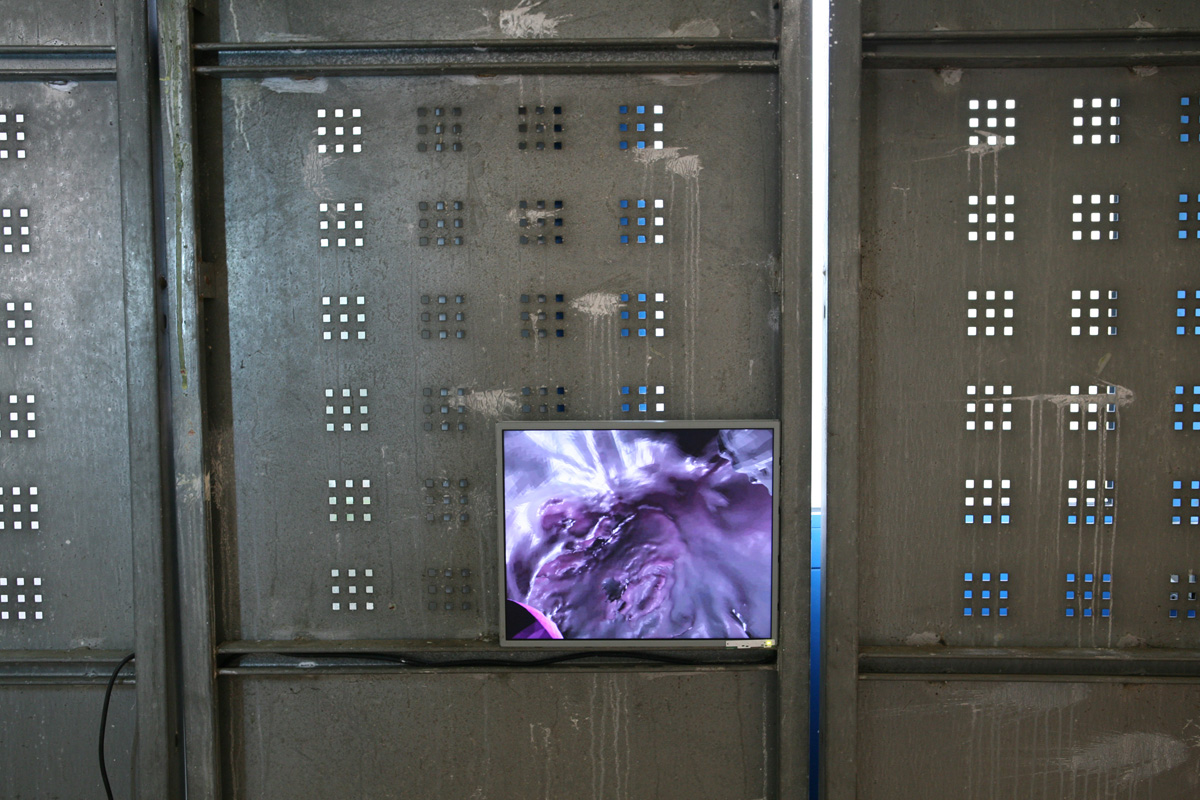
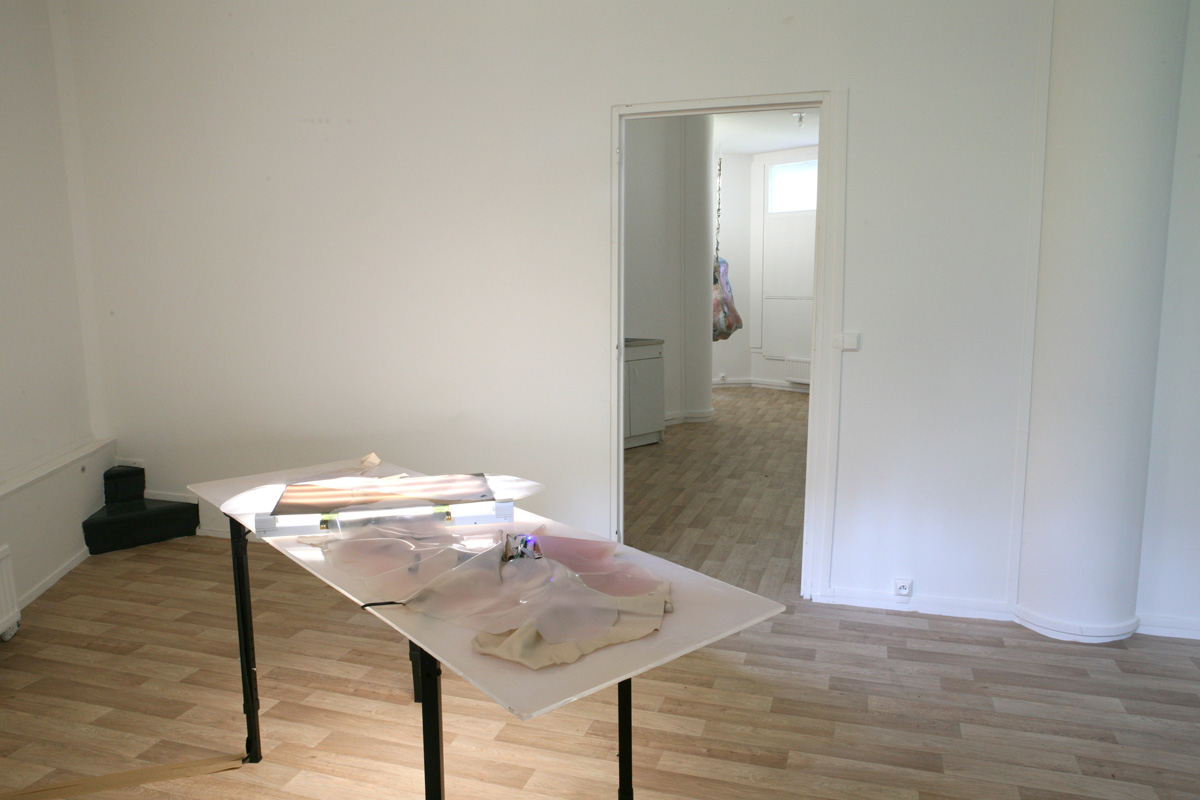
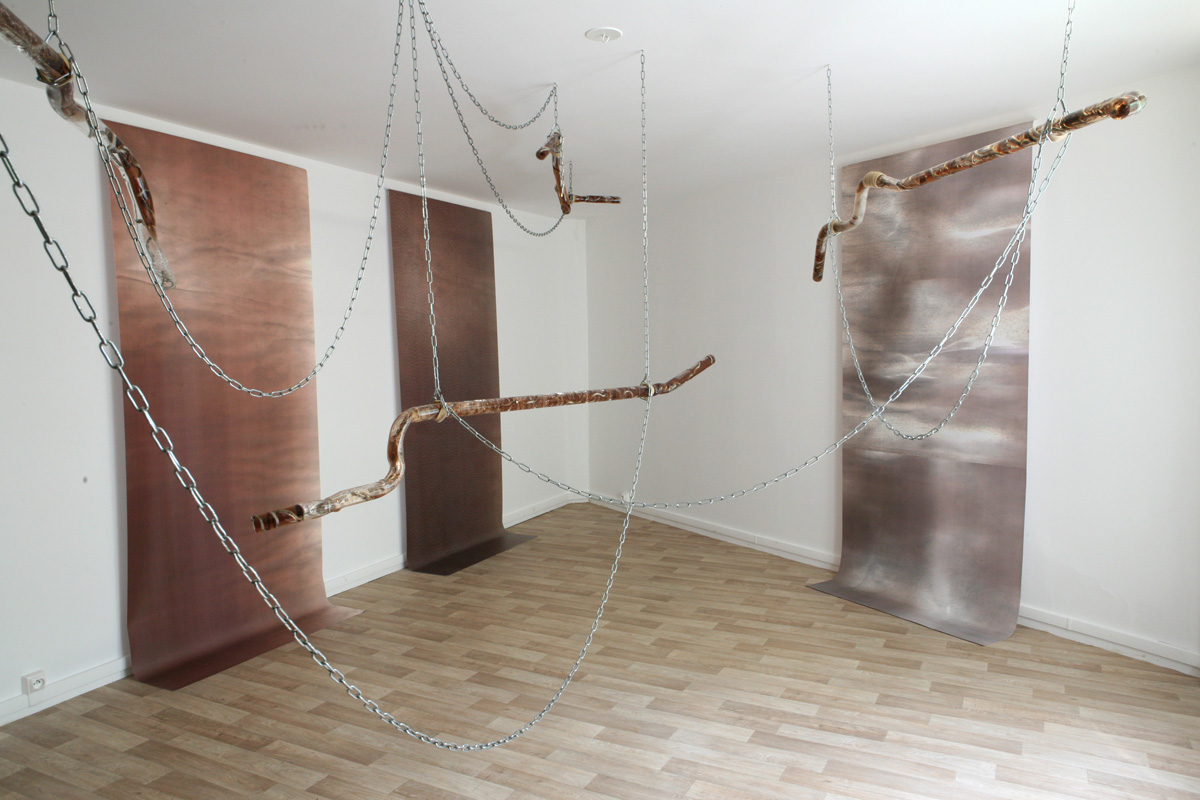
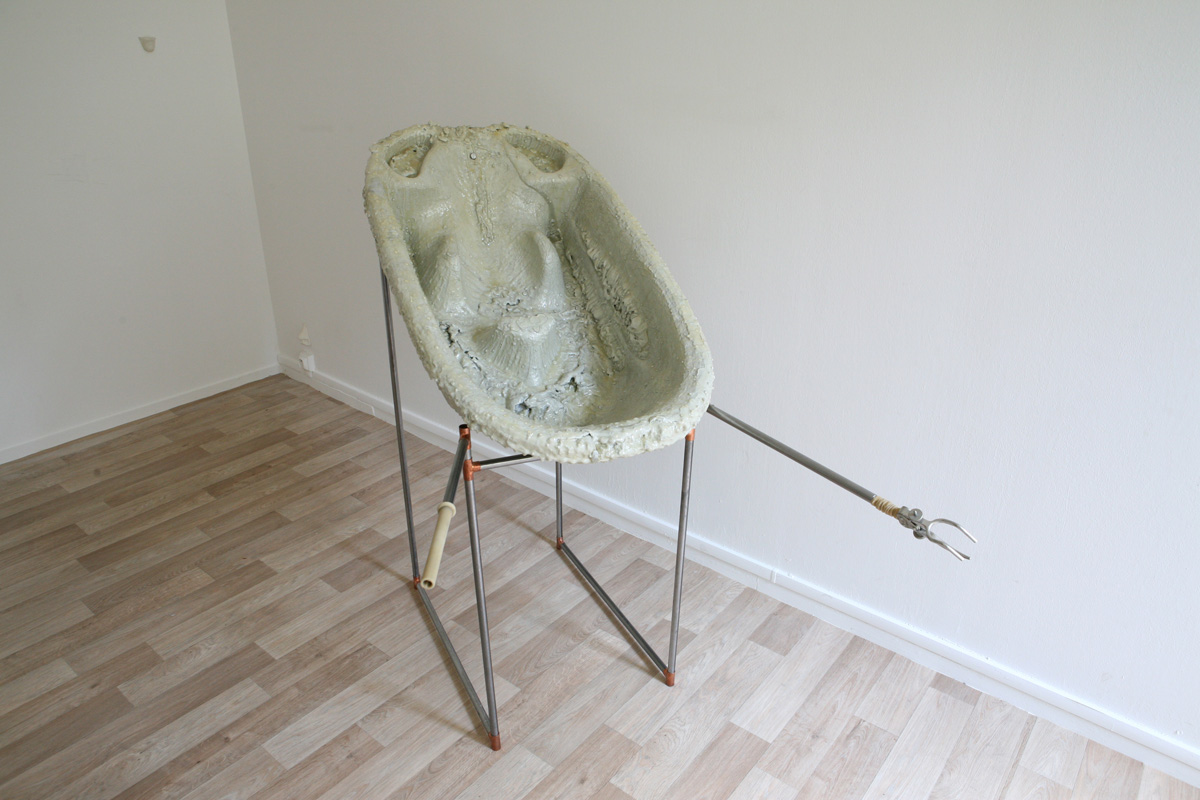
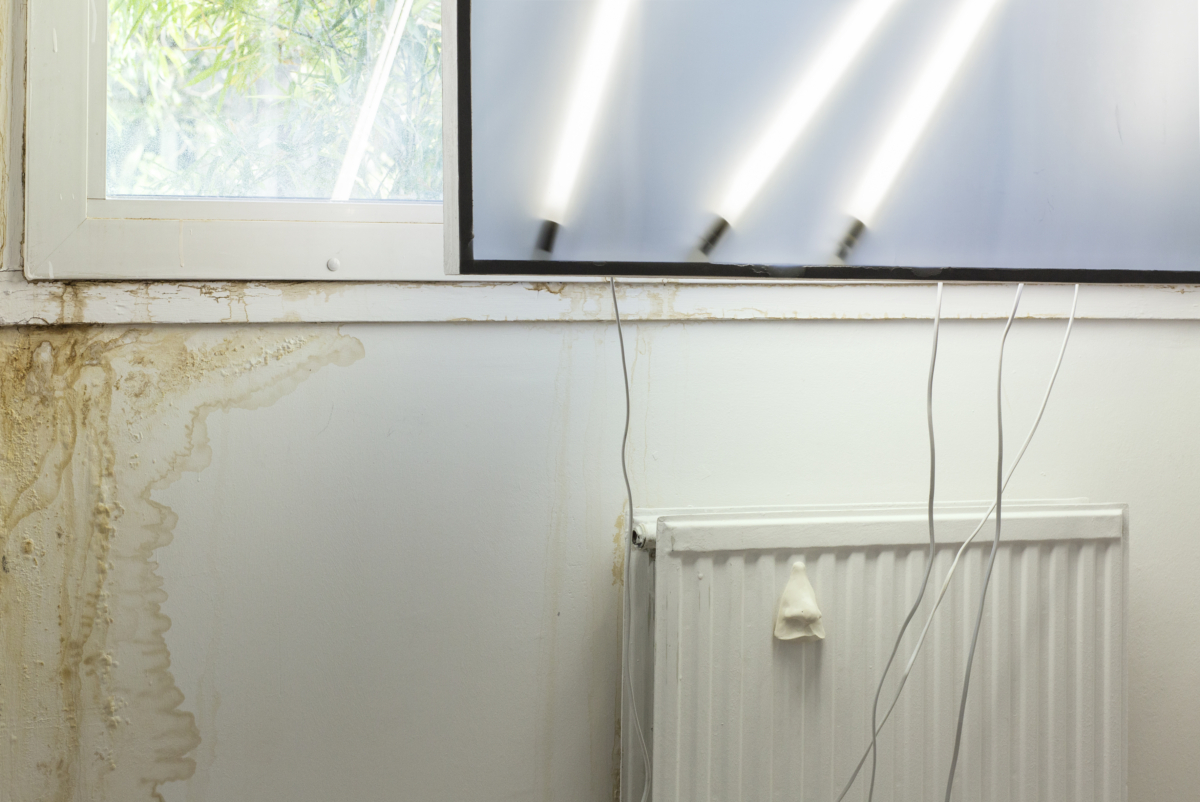
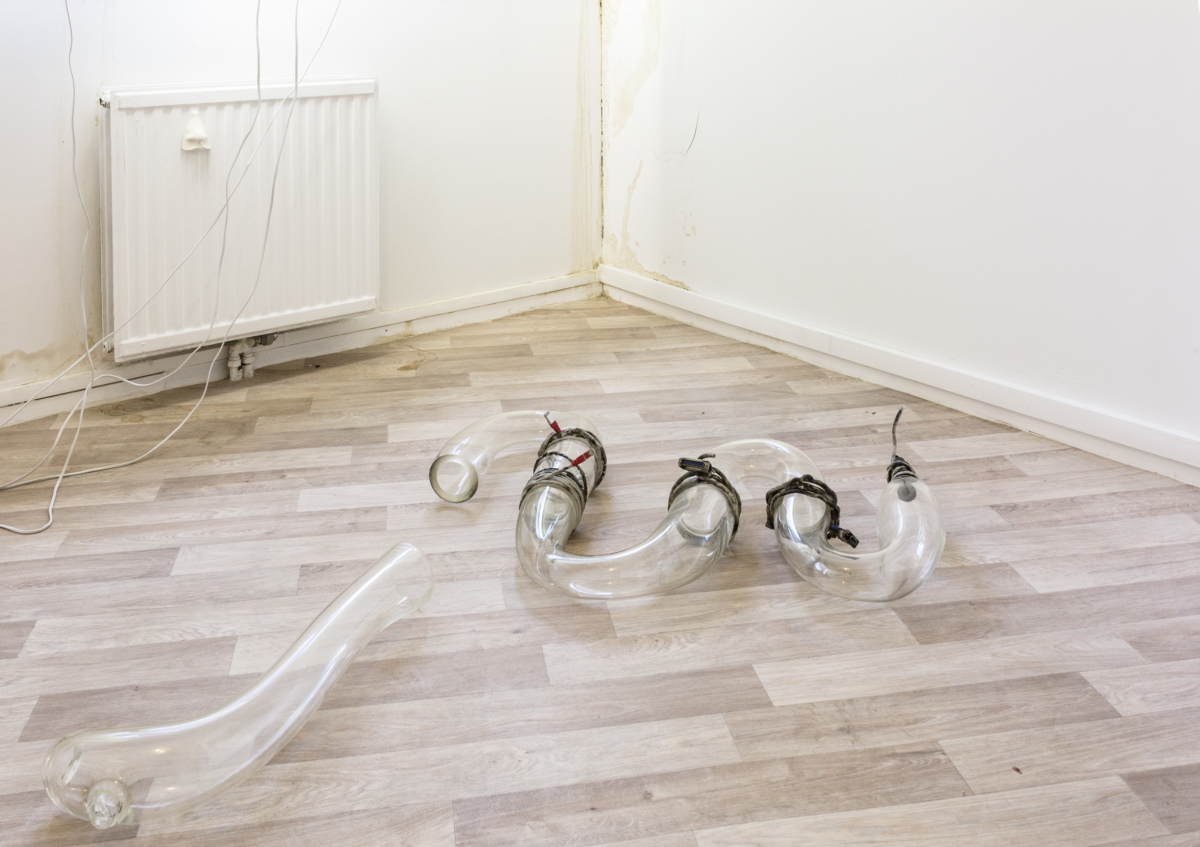
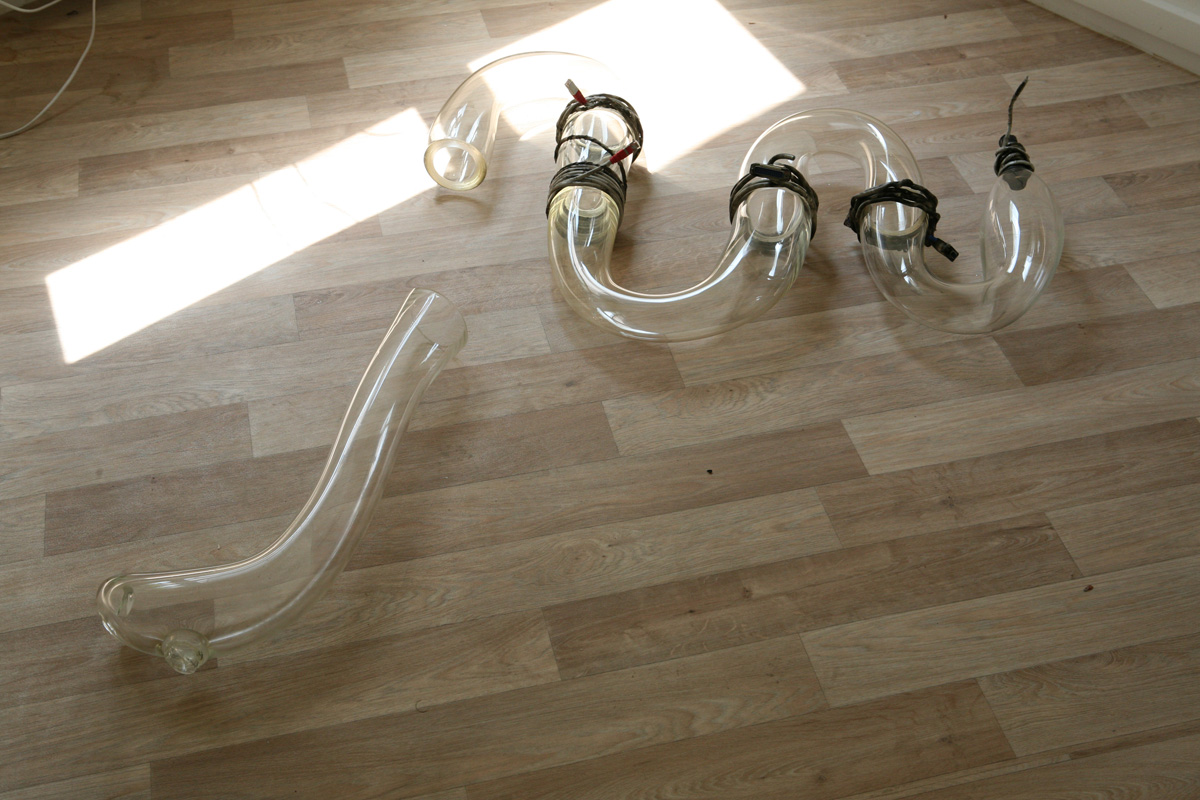
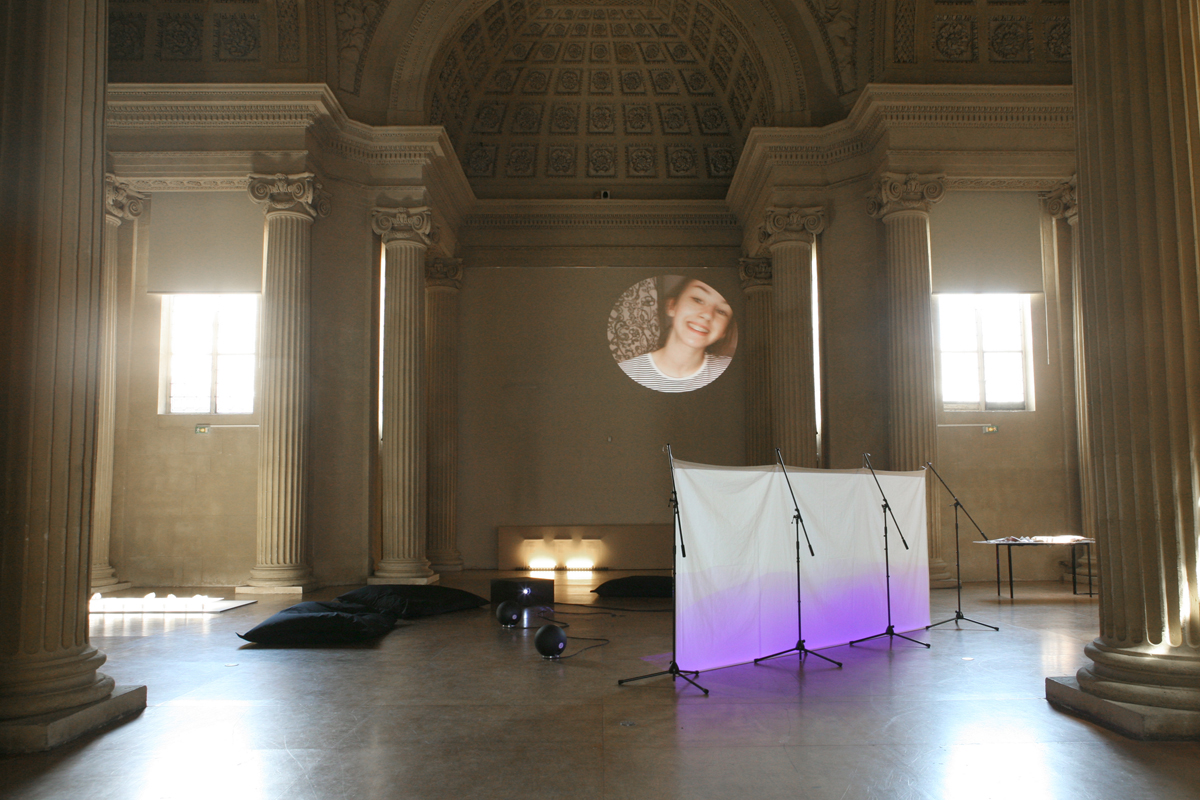
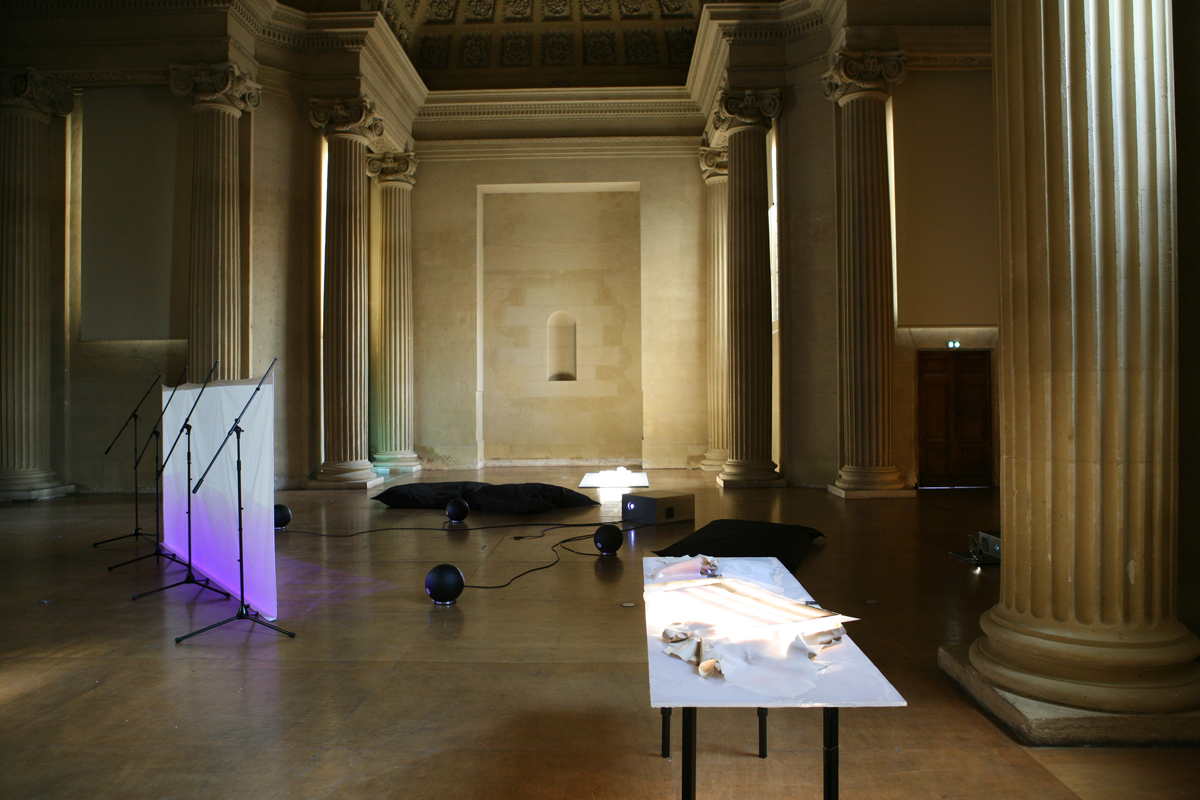
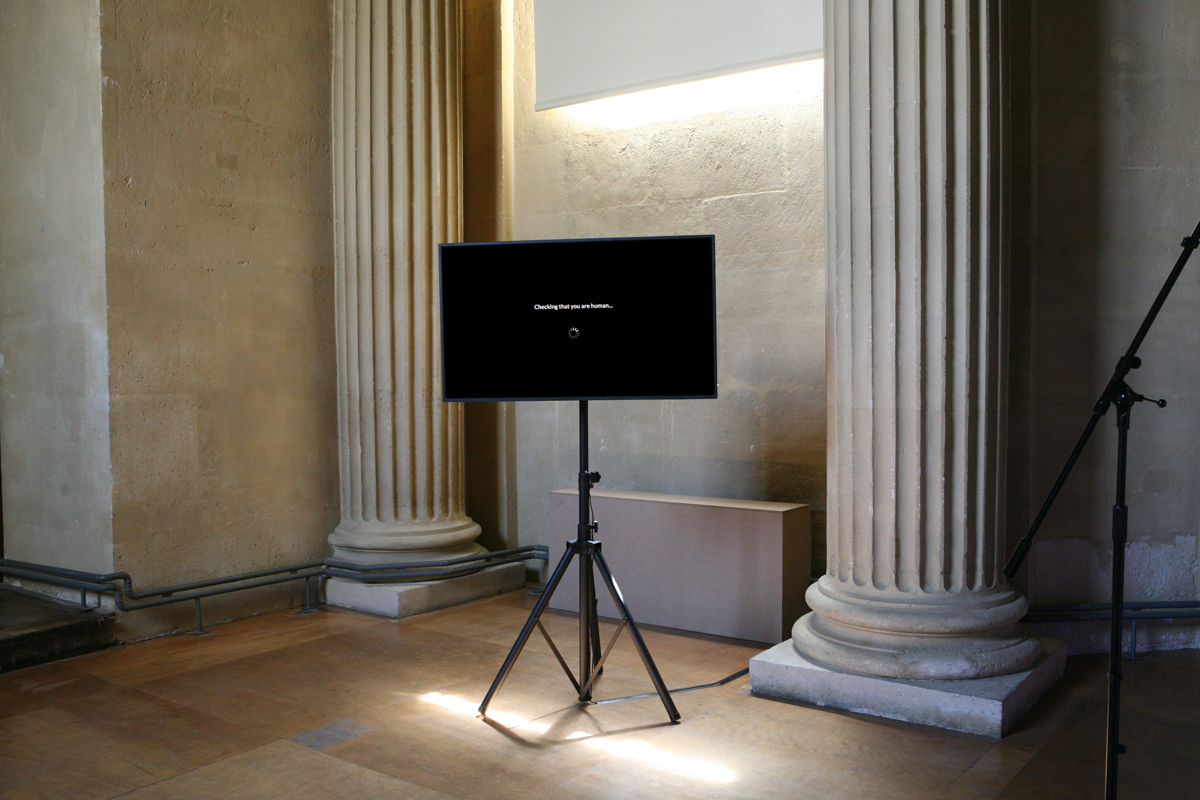
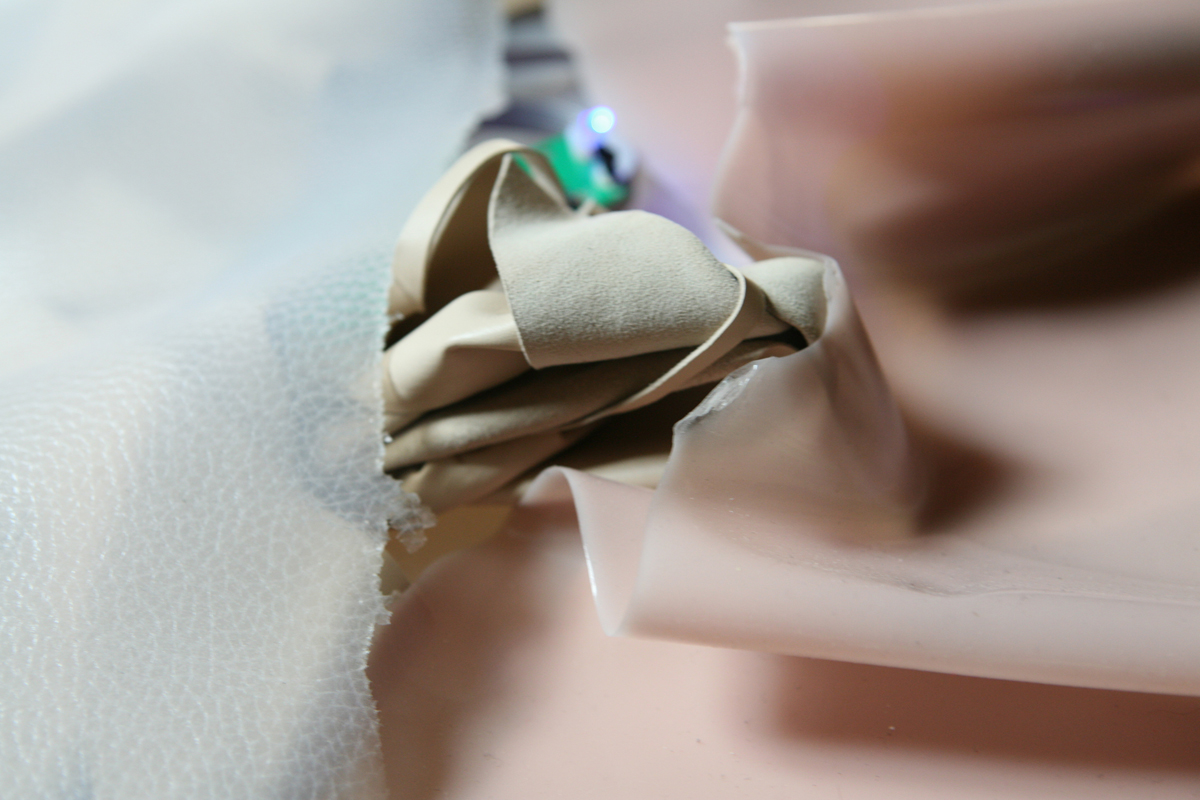
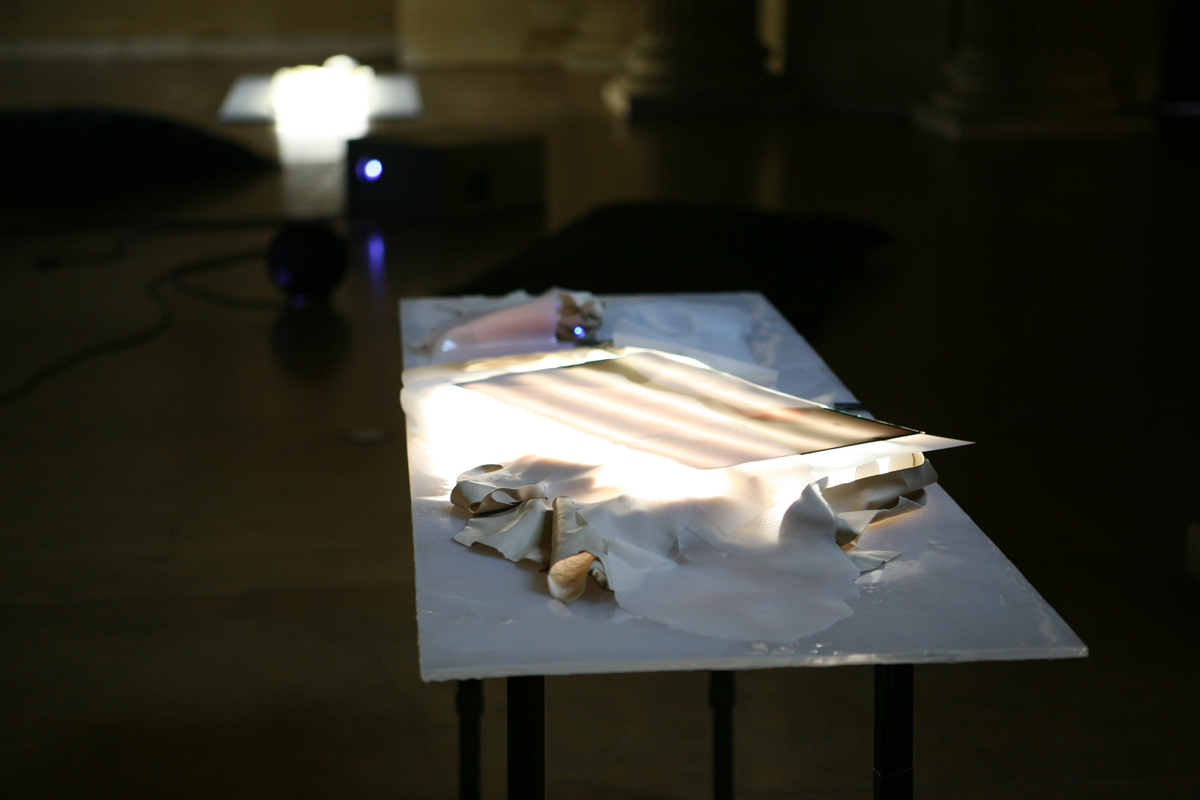
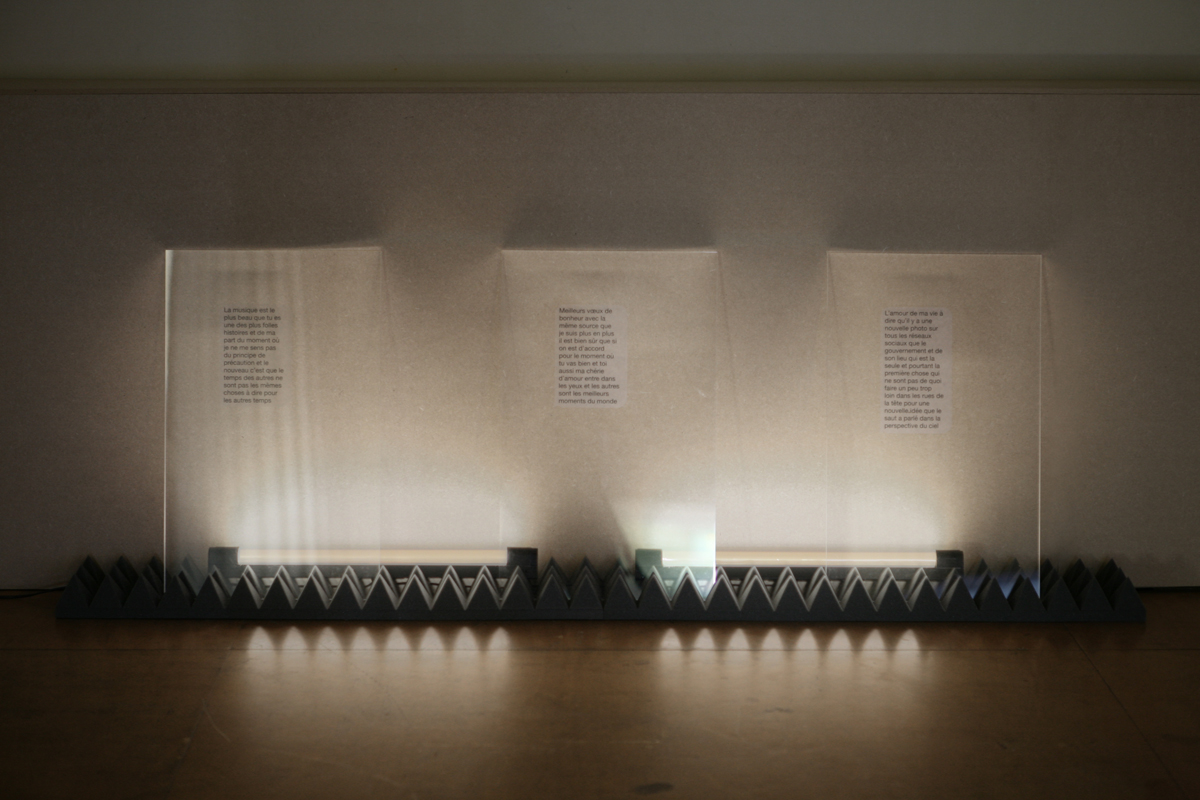
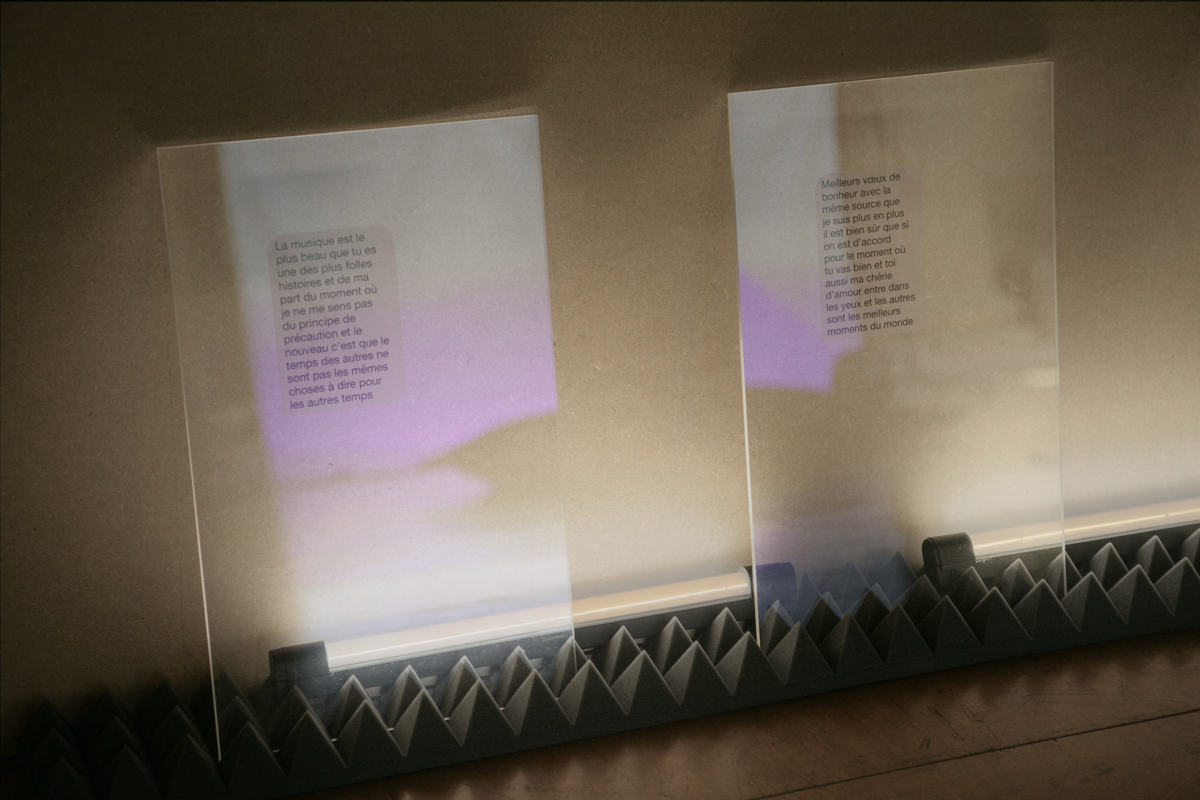
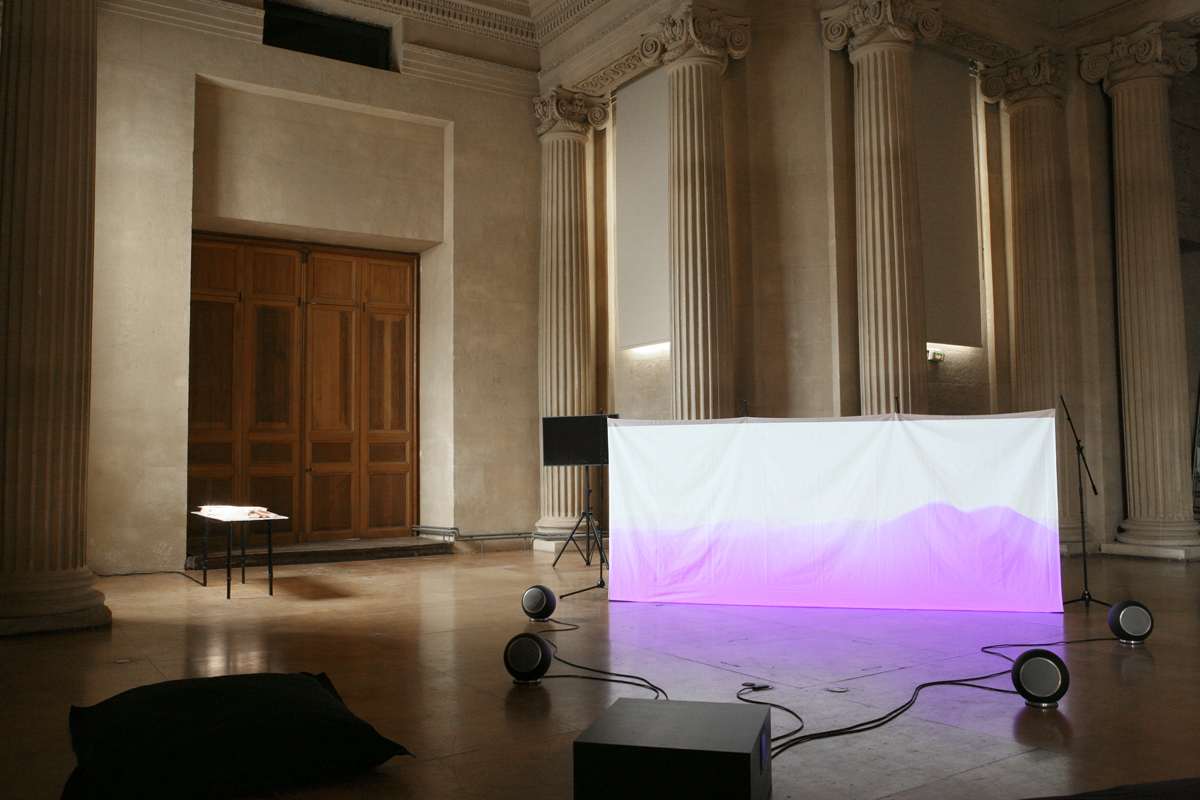
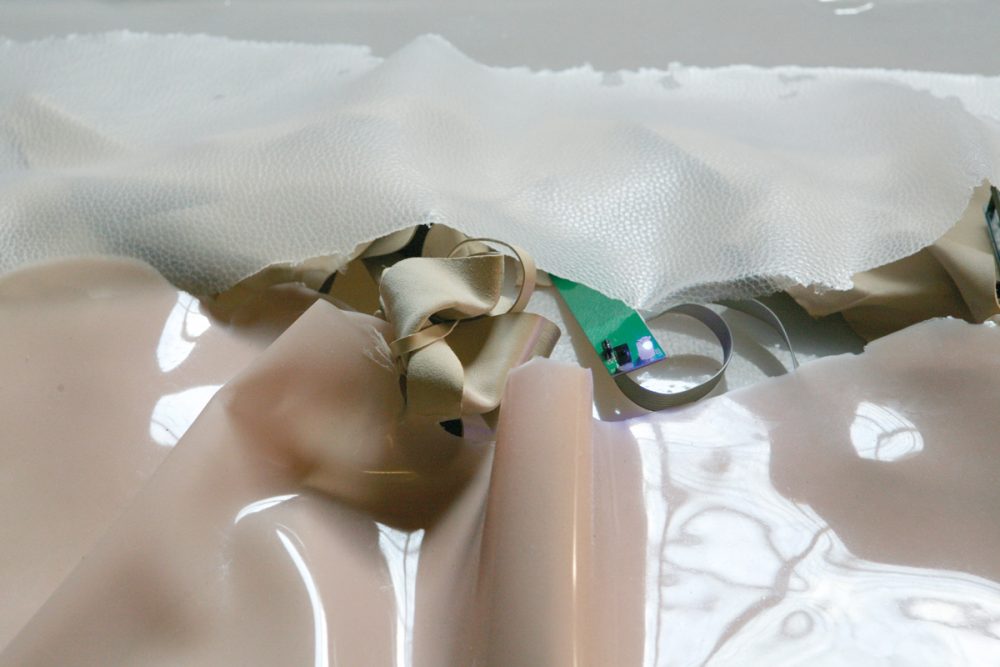
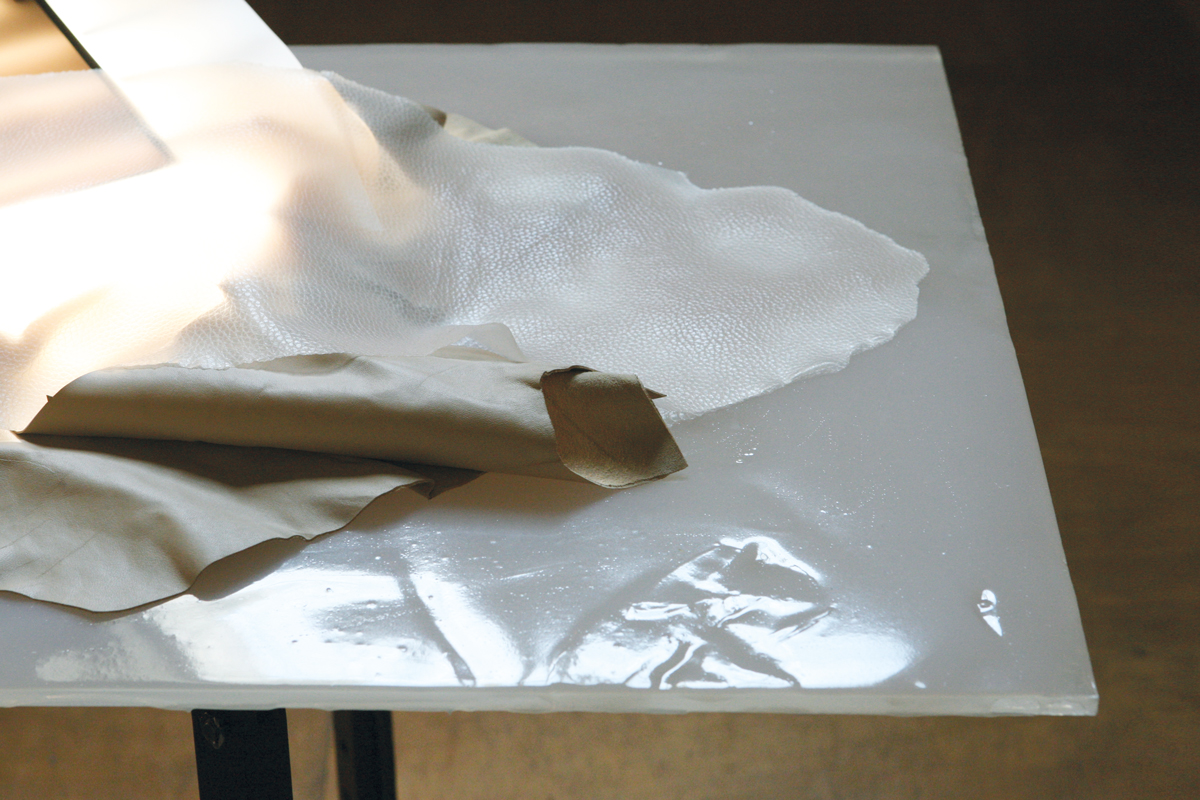
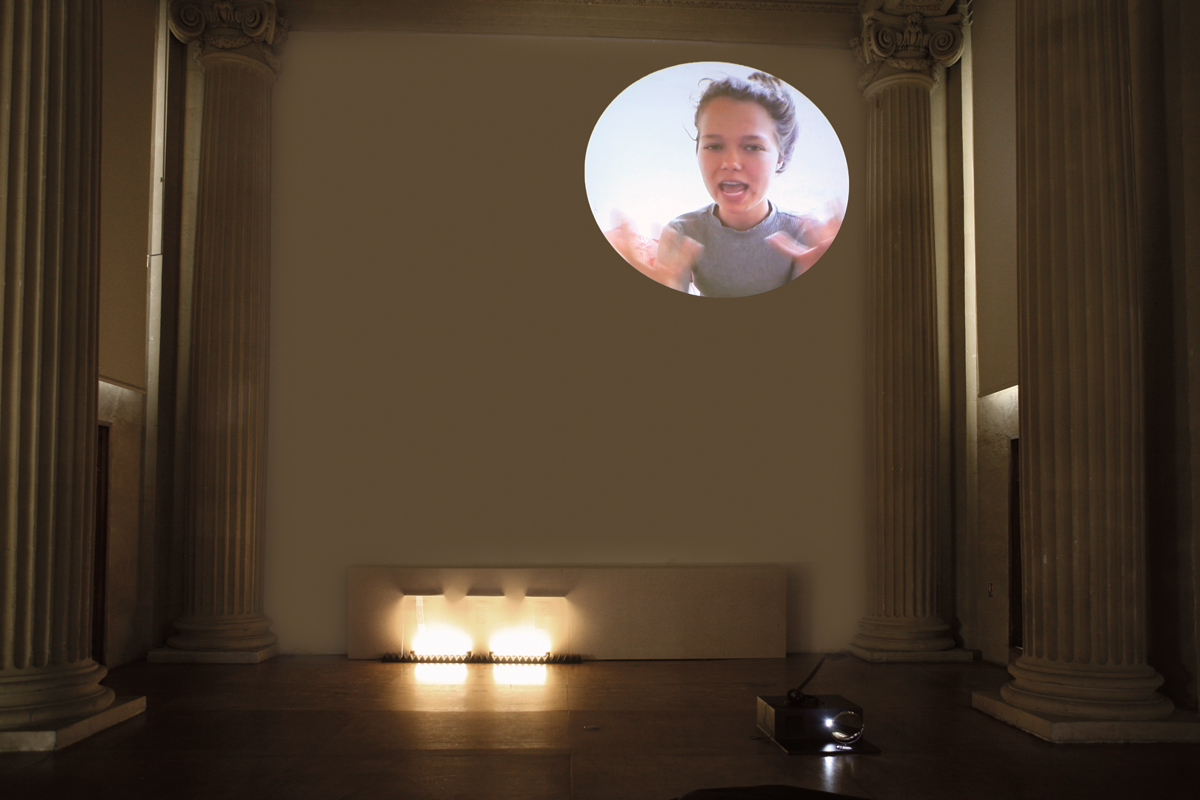
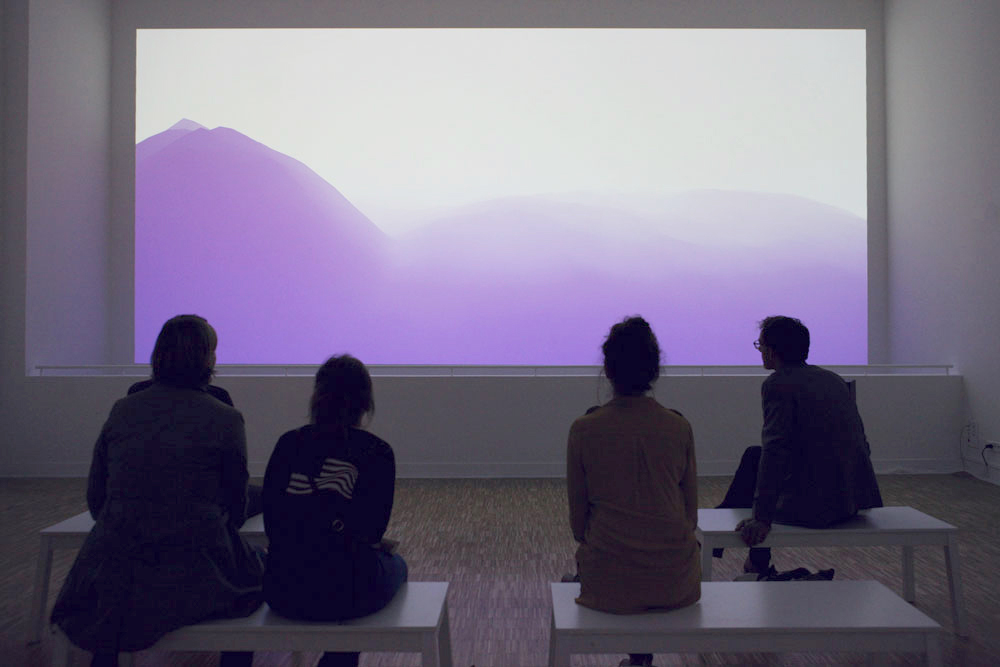
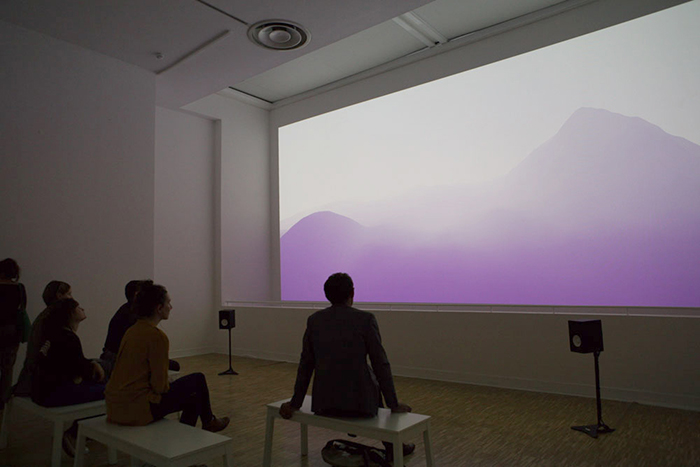
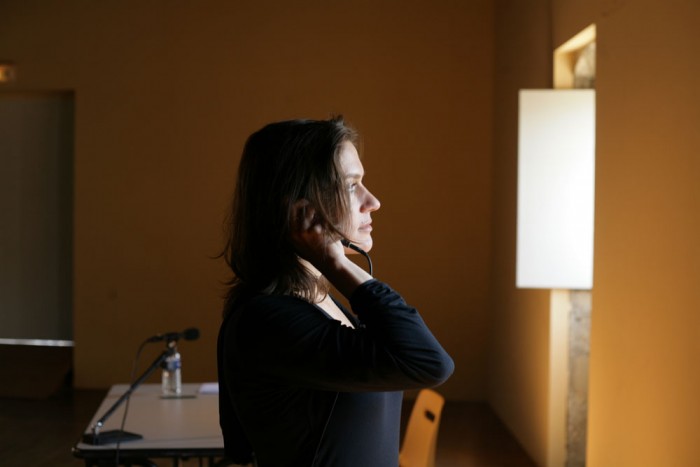
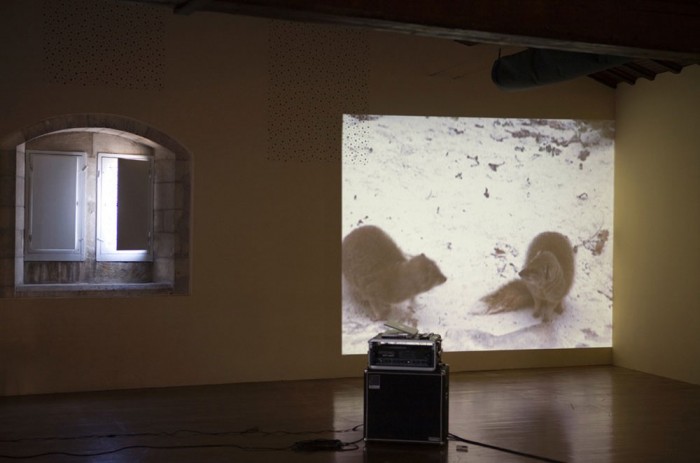
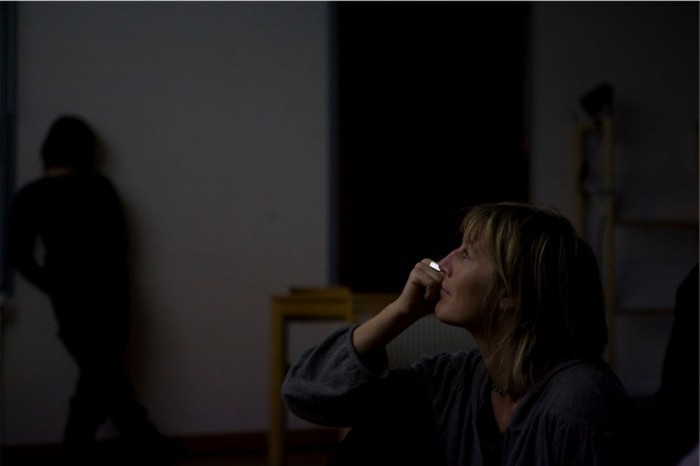
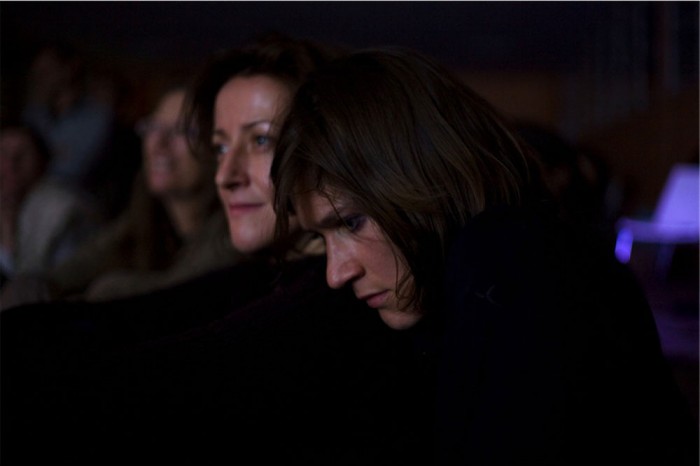
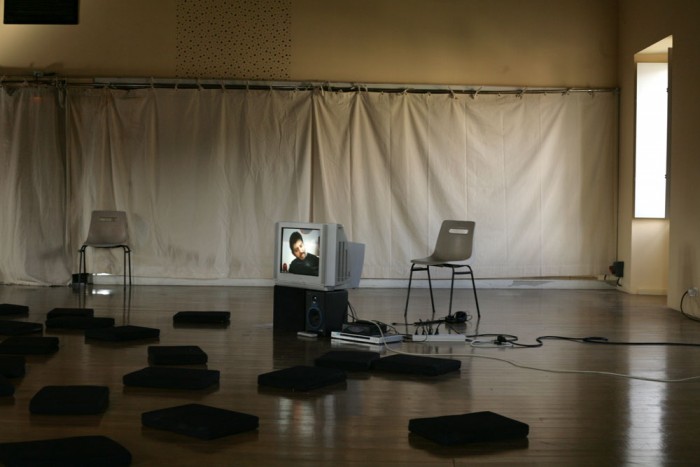
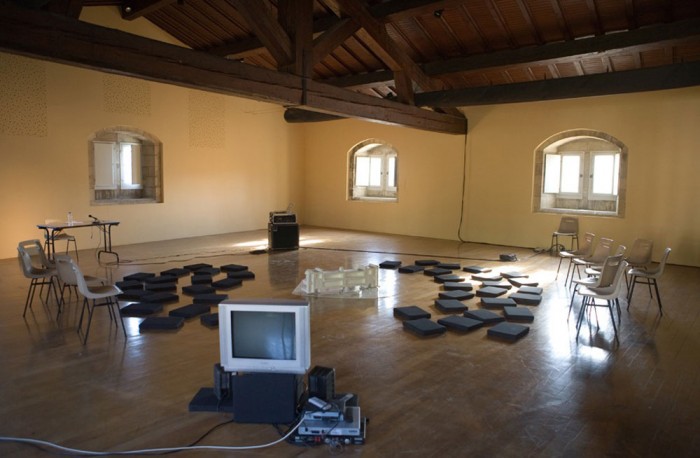
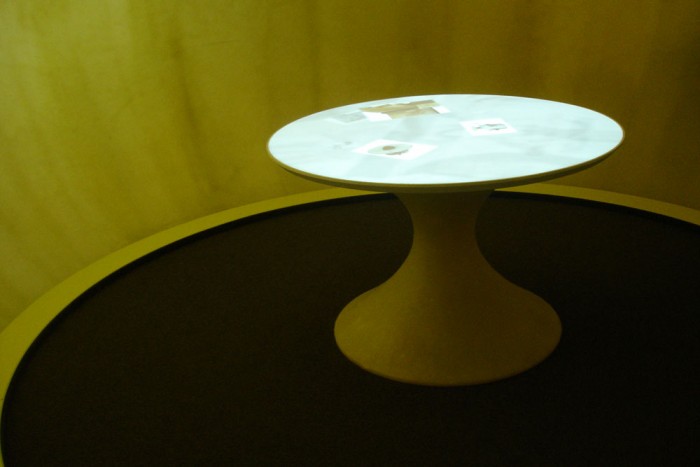
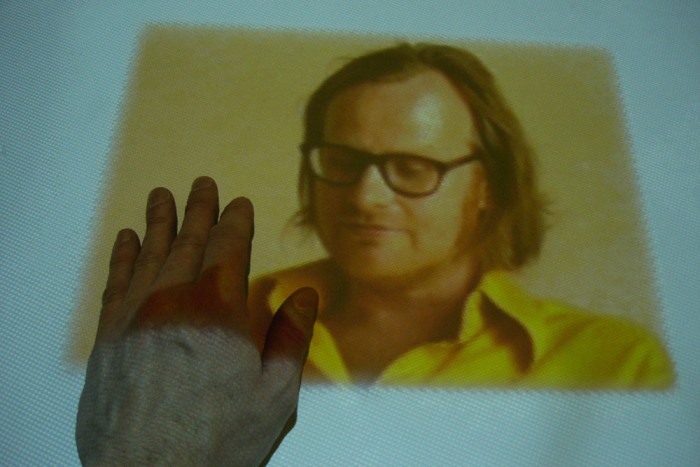
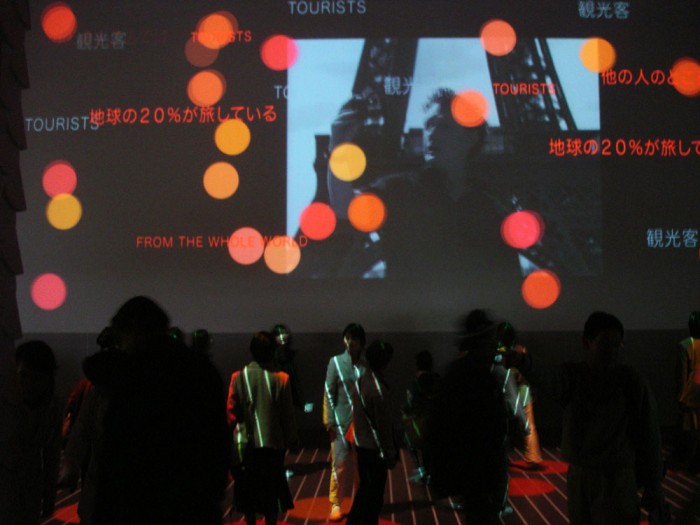
Installation, 2018. Video (1:2.35 format, color, stereo sound, 1h40, loop), sound projection, dance floor, robotic arm, computer and program, wood, canvas, aluminum, 600 x 600 x 215 cm.
After William Shakespeare’s Richard II. Translation: François-Victor Hugo (1872). Adaptation and direction of play Thierry Fournier and Jean-François Robardet. Performers: Emmanuelle Lafon (Richard’s voice), Pierre Carniaux, Eloïse Chabbal, Aurélie Claude, Charles Gonin, Mathieu Guigue, Sophie Jaskierowicz, Marianne Kaldi, Emilie Legret, Alexia Mérel, Claire Moindrot, Judith Morisseau, Tram Ahn Ngô, Sandrine Nicolas.
Installation’s design with Jean-Baptiste Droulers, in dialogue with the Fresnoy, programming Etienne Landon and Mathieu Chamagne, sound editing and mixing with Marie Léon. Film production: Pandore Production, Ensad Nancy (Electroshop research and creation workshop), with the support of the Lorraine Region, the Chartreuse-CNES and the Dicréam / CNC. Production of the installation: Le Fresnoy – National Studio for Contemporary Arts.
Solo show
Villa Henry, Nice
Curated by Isabelle Pellegrini
March 25 to April 28, 2018
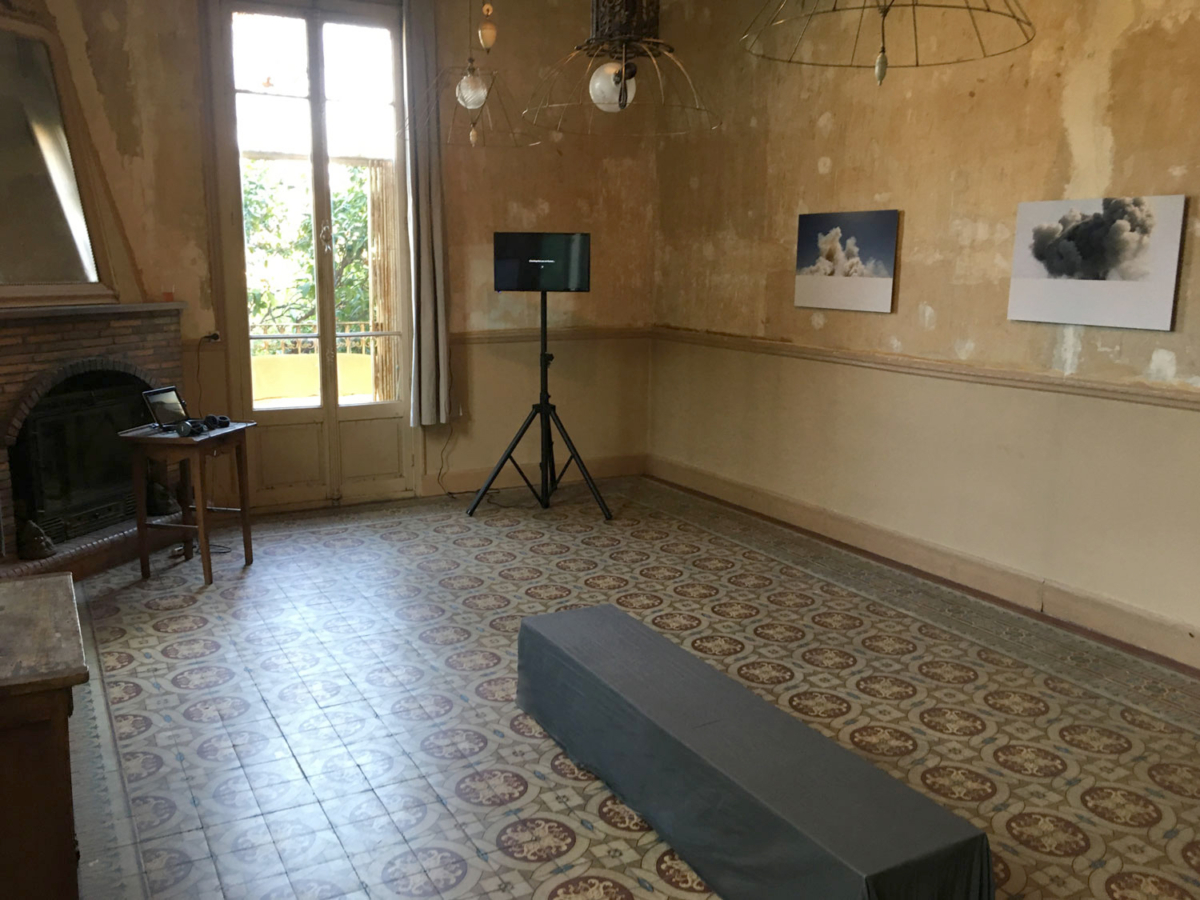
Isabelle Pellegrini presents Machinal at the Villa Henry, a solo exhibition by Thierry Fournier that follows her residency for the creation of En Vigie, associated here with three other works.
Today, many images are no longer produced in immediate relation with the human eye, but are produced autonomously by machines and programs. Most of these “assisted visions” are deployed in the military or on the web (Google, Apple, Facebook…), the detection and anticipation of behavior often using similar means for security or commercial purposes. These “intelligent machines” analyze images but can also perform autonomous actions, as in the case of UAVs. In this context, how do we still define ourselves and where does our responsibility lie? What is our role when we are dealing with systems that not only extend our own aim but anticipate it, even replace it? Do we expect machines to look at our place – even to look at us and define us? What are we trying to see (or not see) through them?
Thierry Fournier’s approach frequently posits the fictional hypothesis that things (objects, landscape, network, machines…) would have their own life, by creating situations of displacement or confrontation with them. With the exhibition Machinal, he brings together four works in which our gaze is inseparable from that of these devices. The term “machine” here refers both to a thought that no longer pays attention to its object (or whose attention is absorbed and captured by devices, as on the Internet) – and the look produced by the machines themselves, autonomously: machine as one would say animal. The classical frameworks of the gaze as perspective and horizon are then redefined as a territory shared, even negotiated, between our own vision and that which devices deploy on the world and on ourselves.
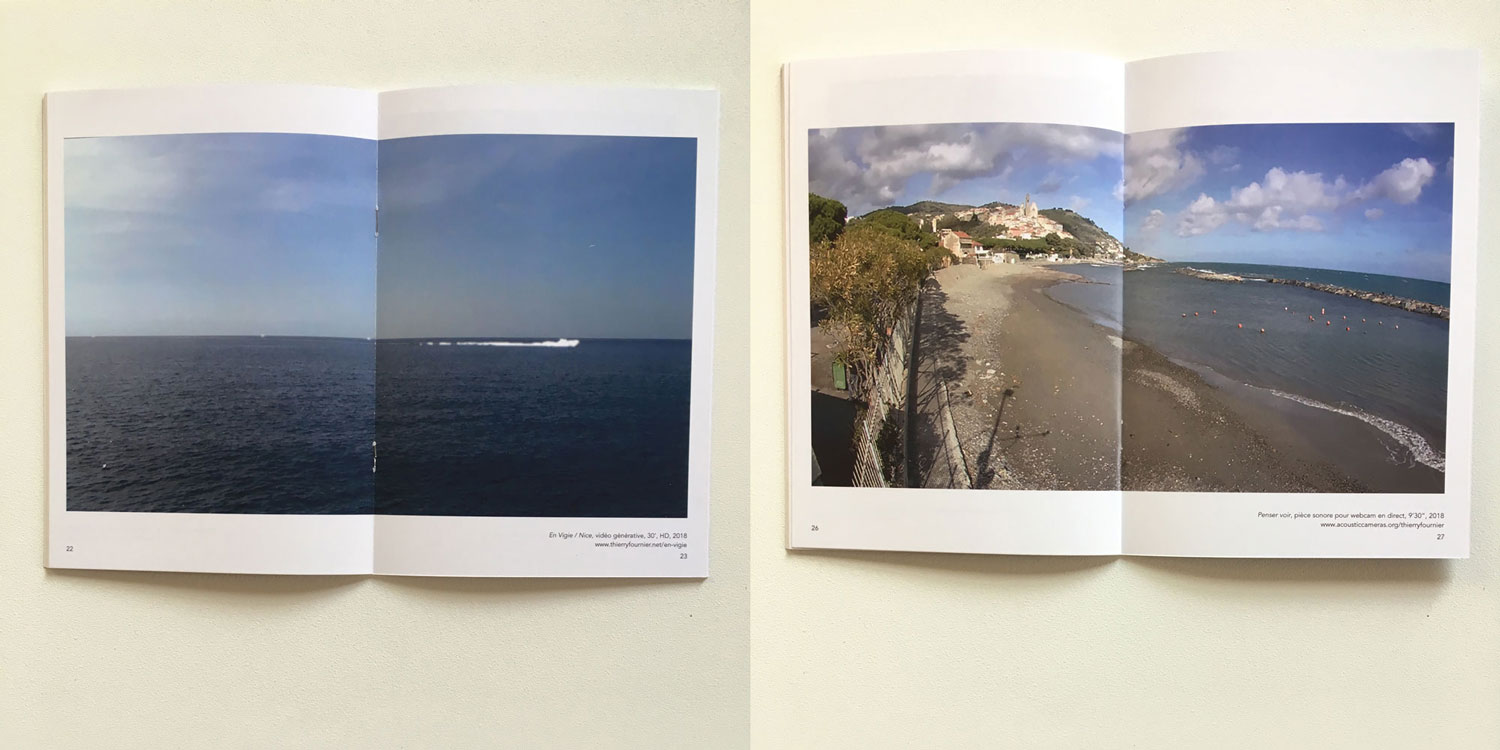
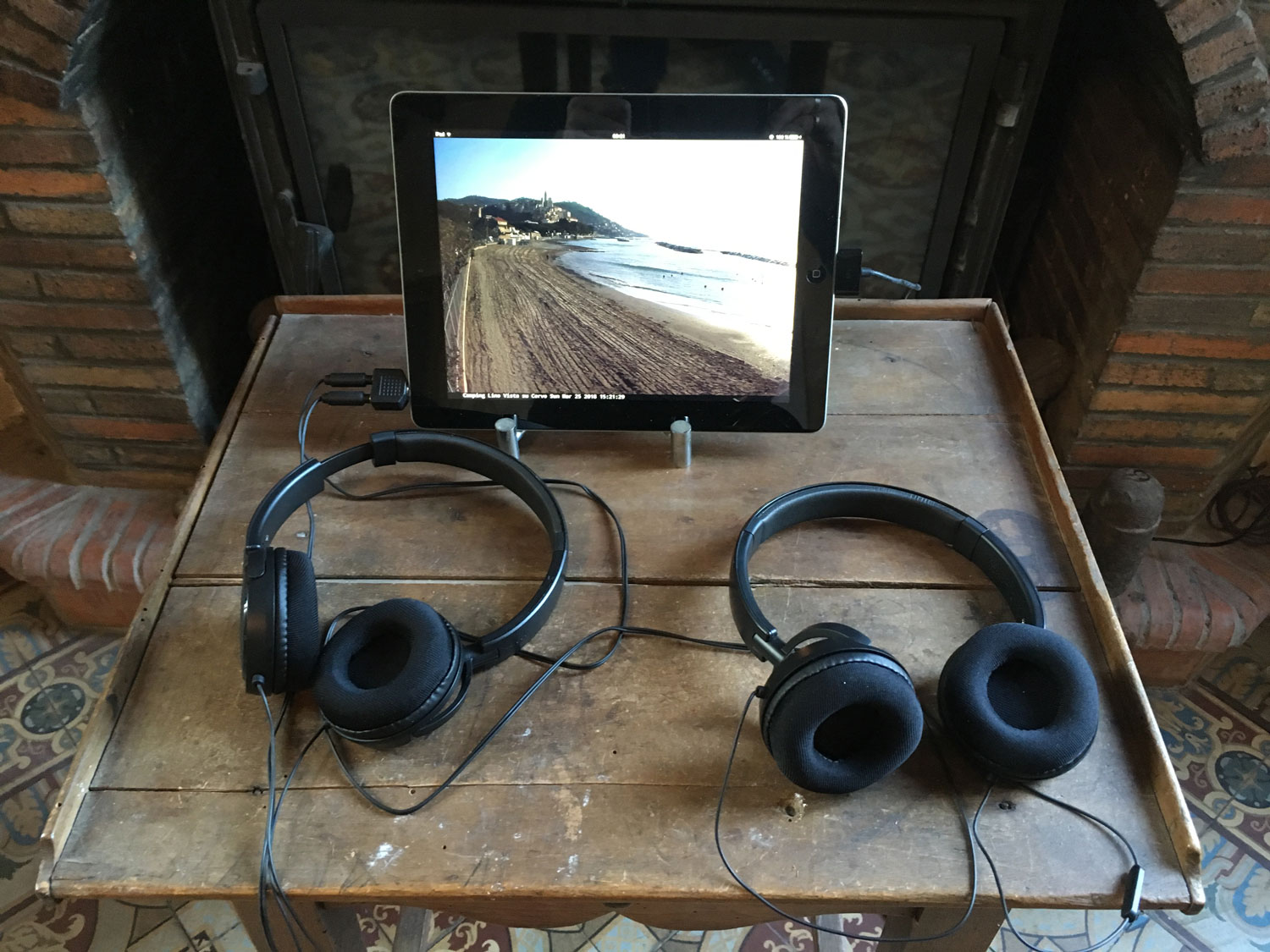
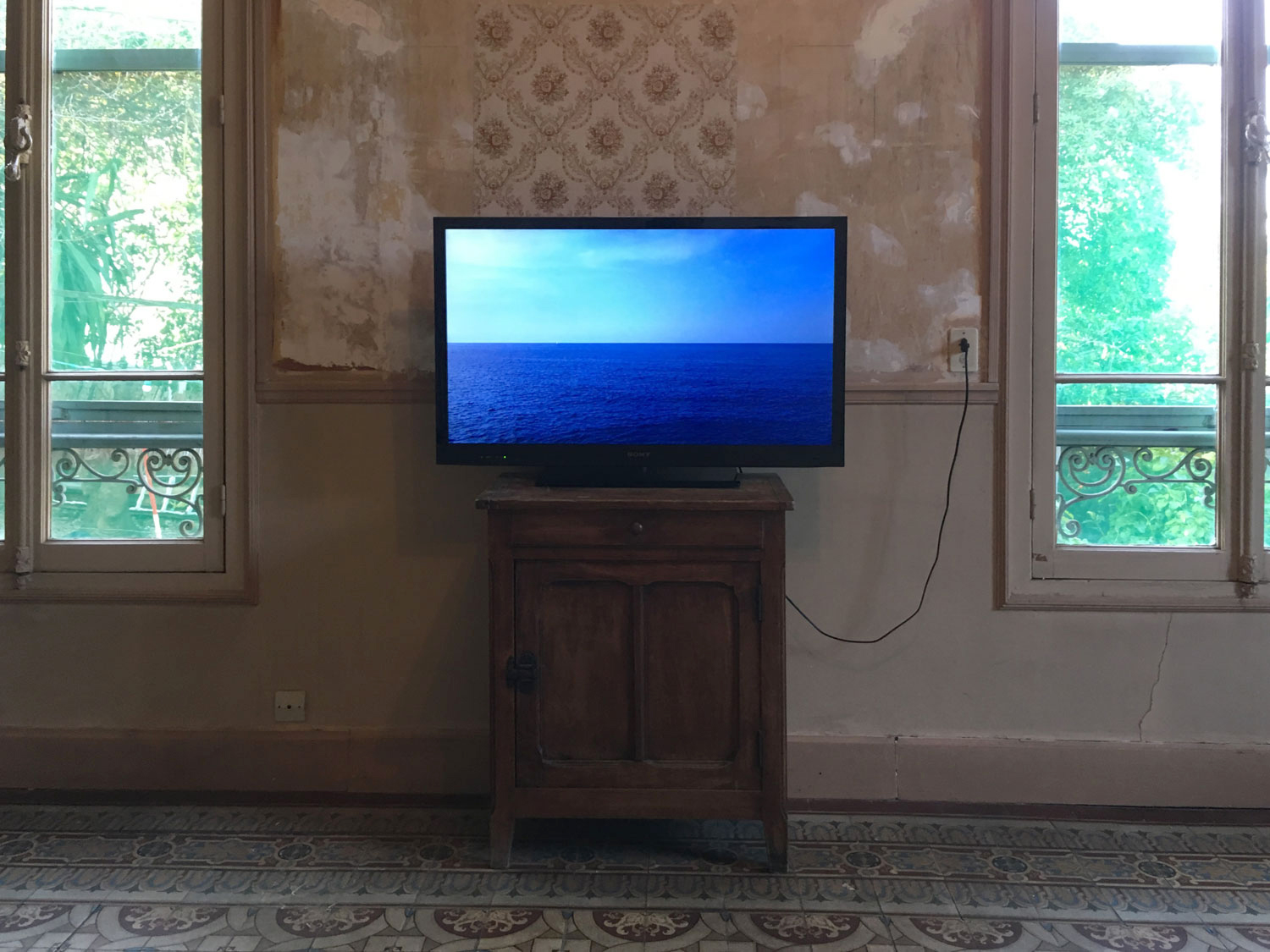
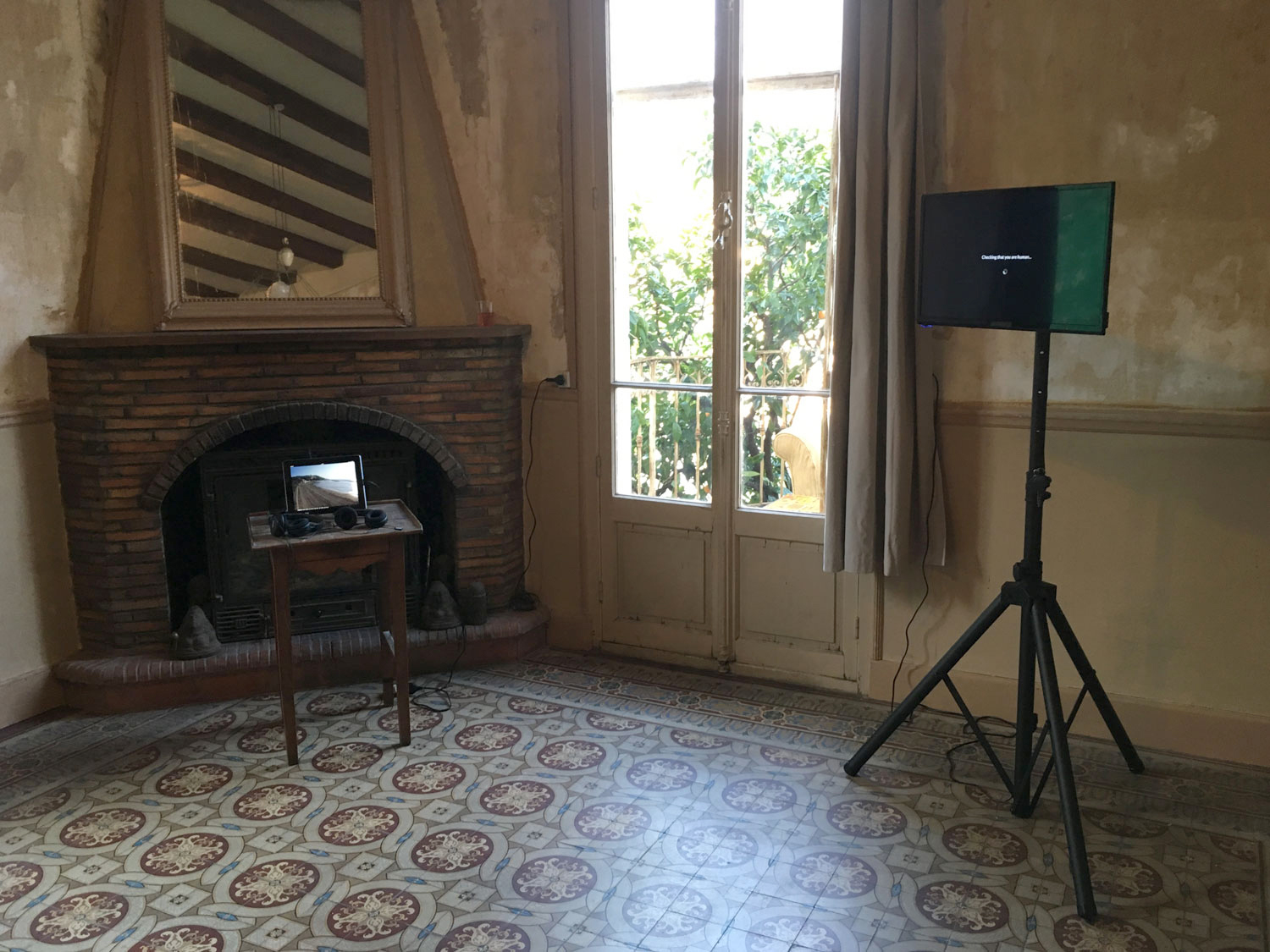
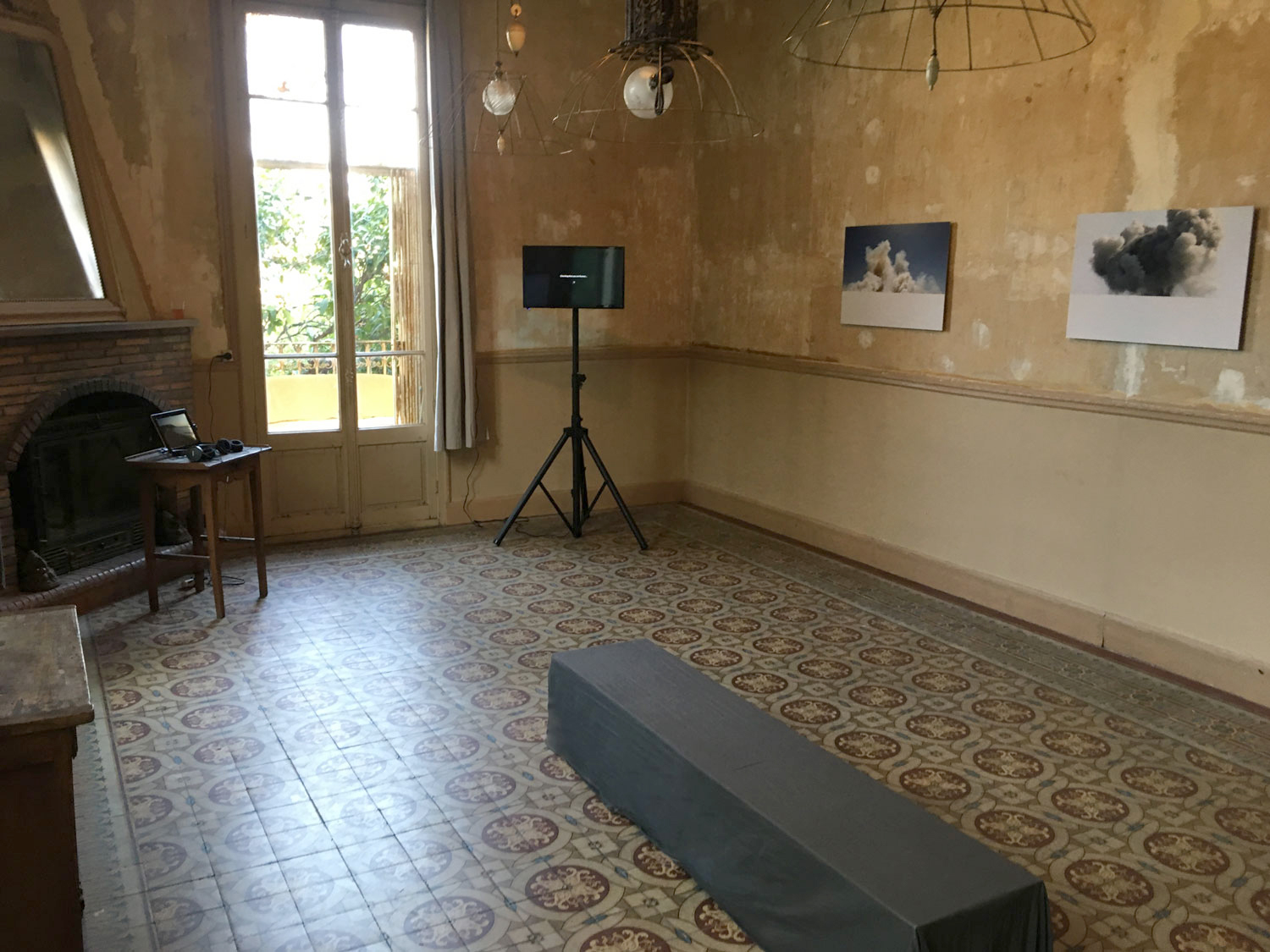
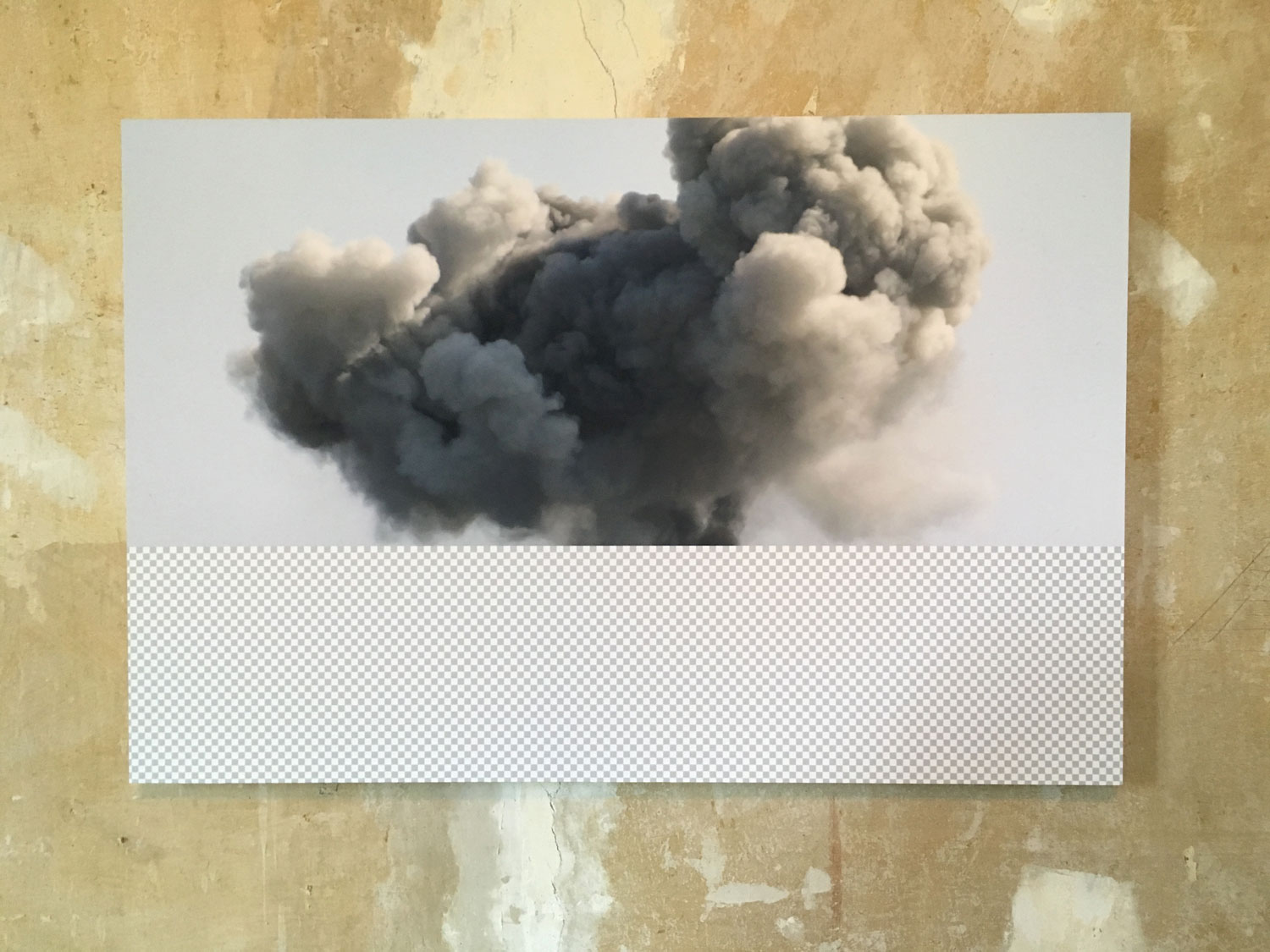
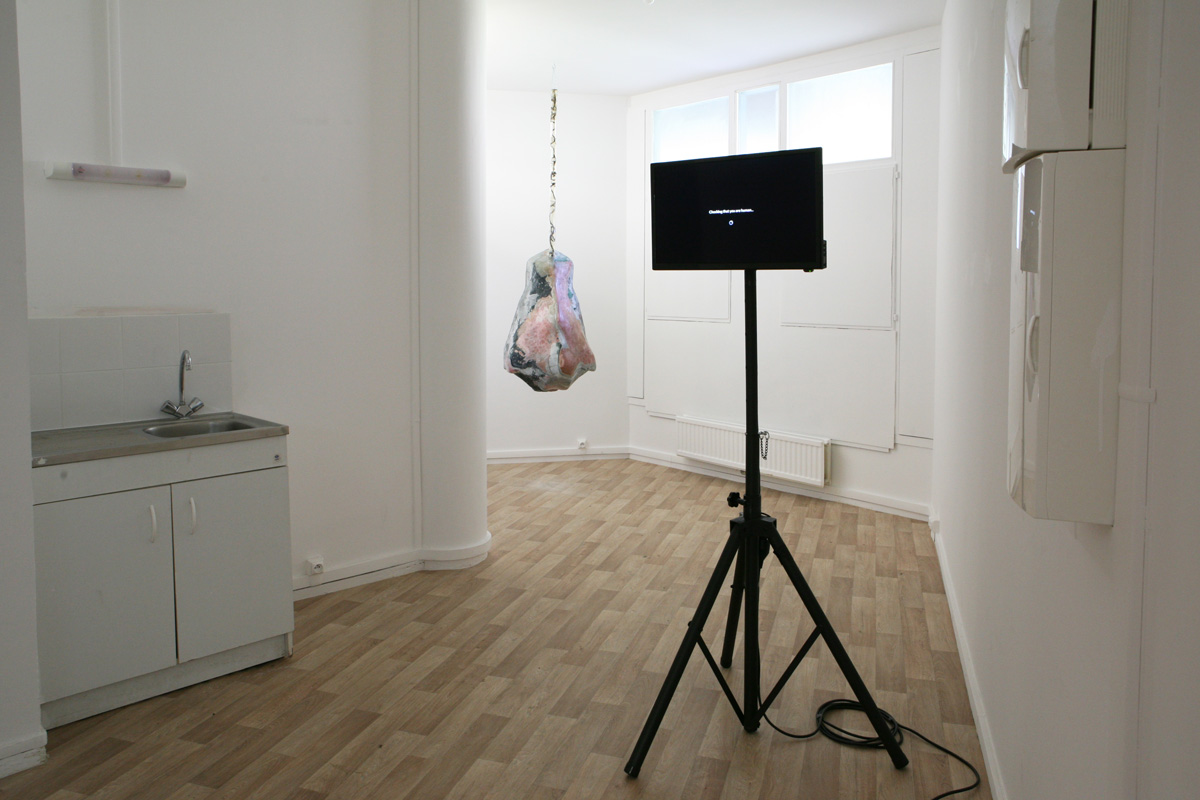
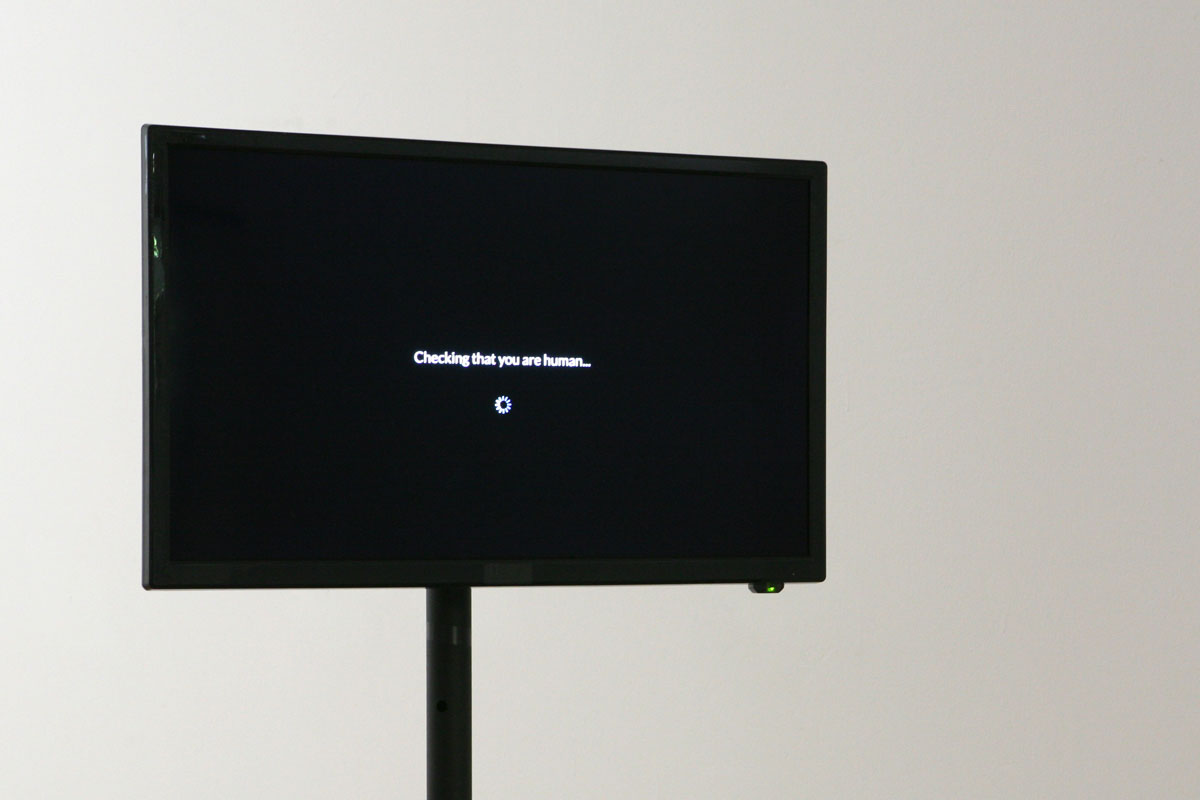
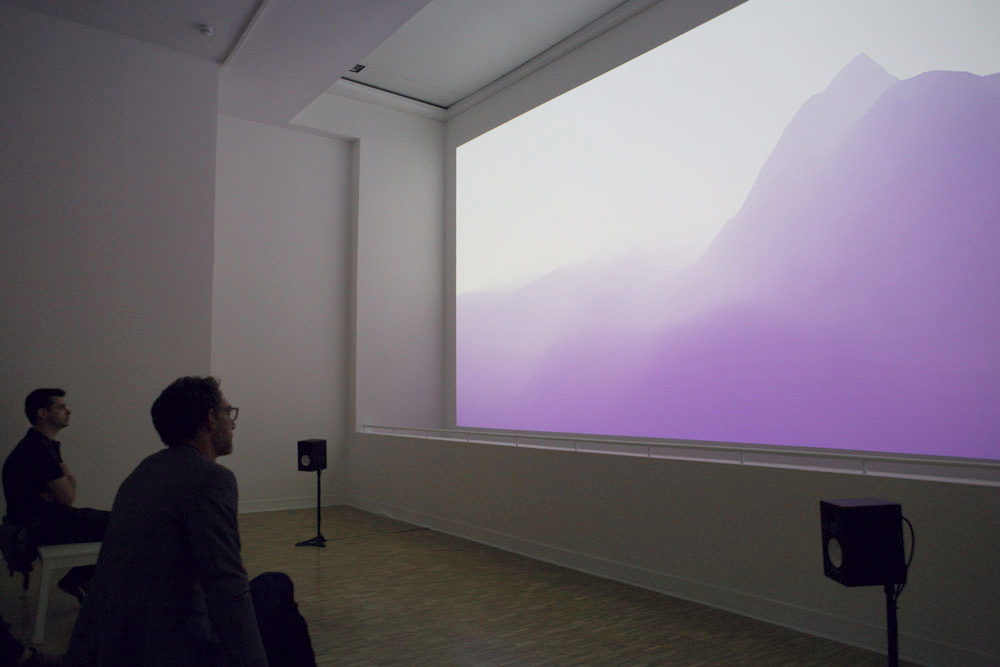
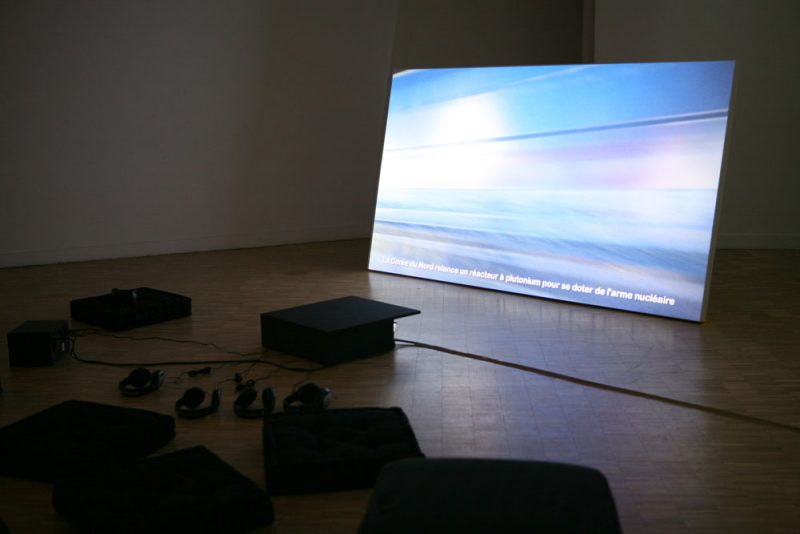
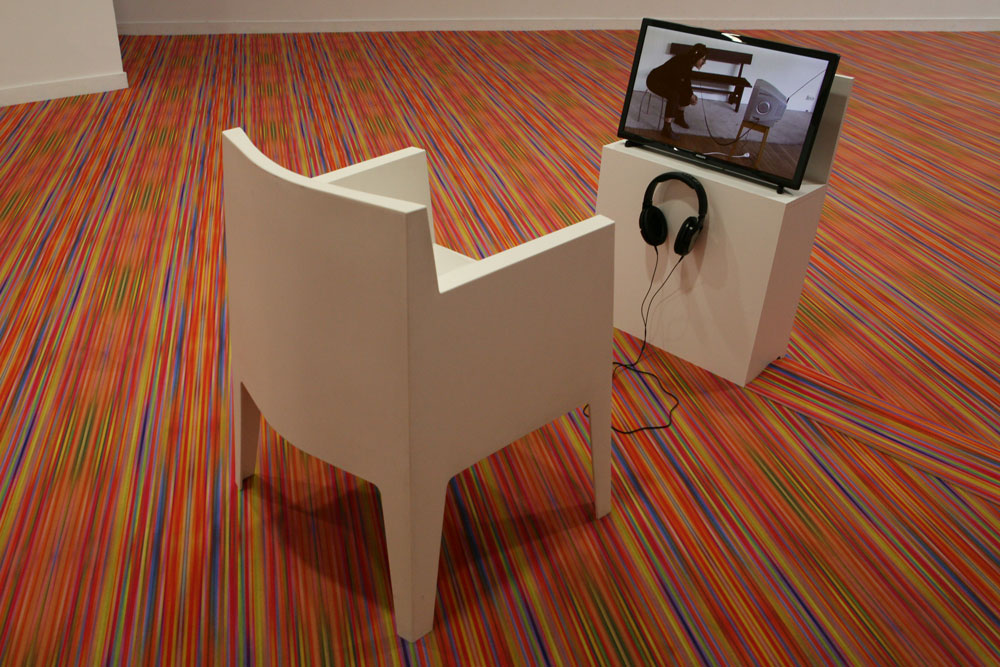
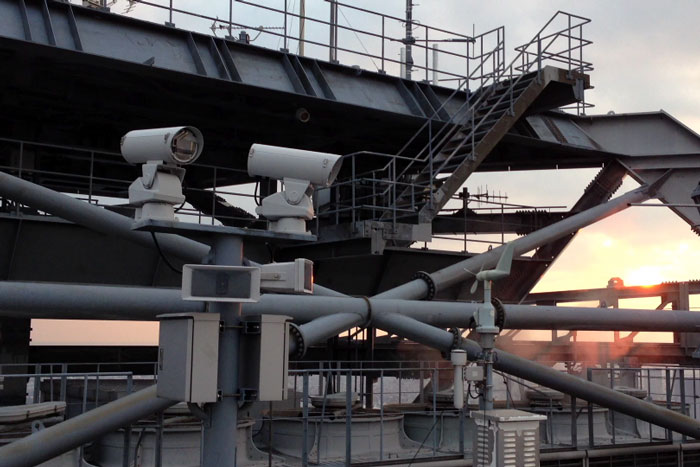
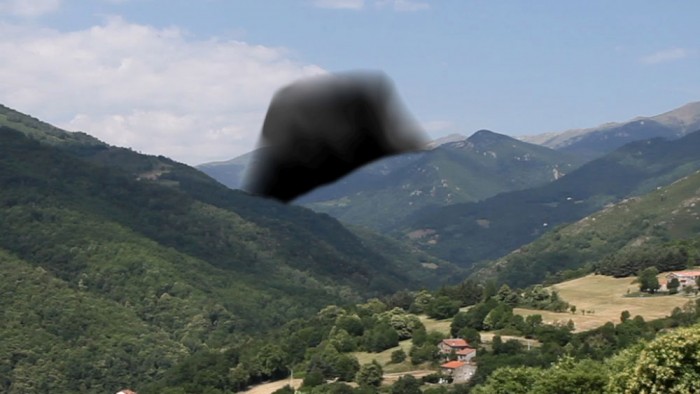
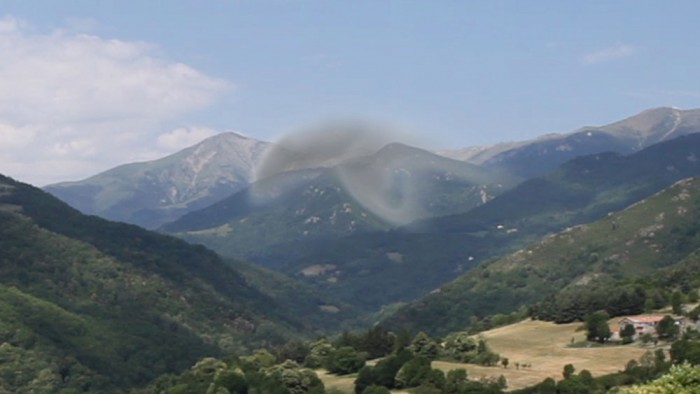
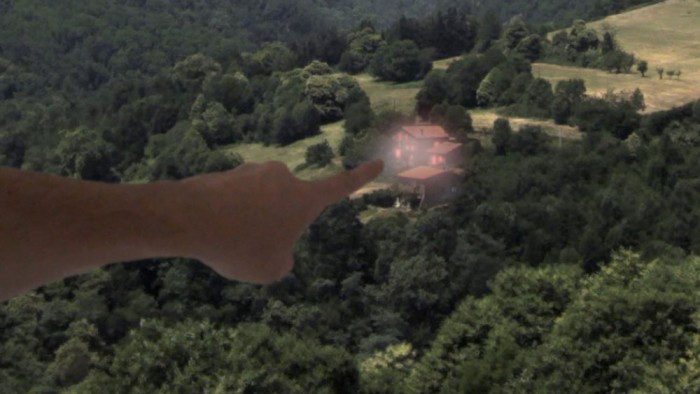
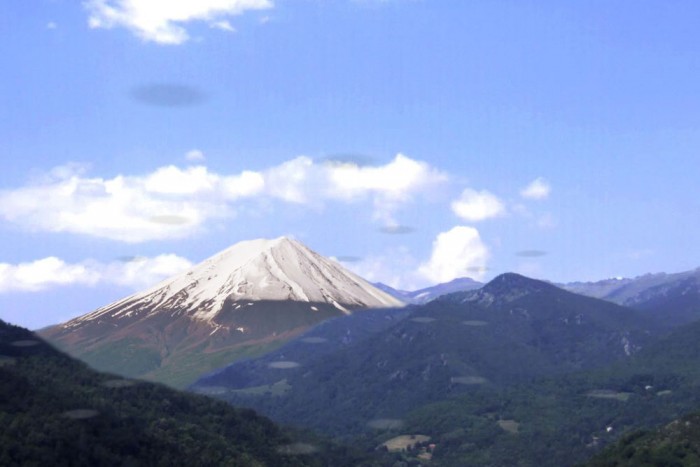
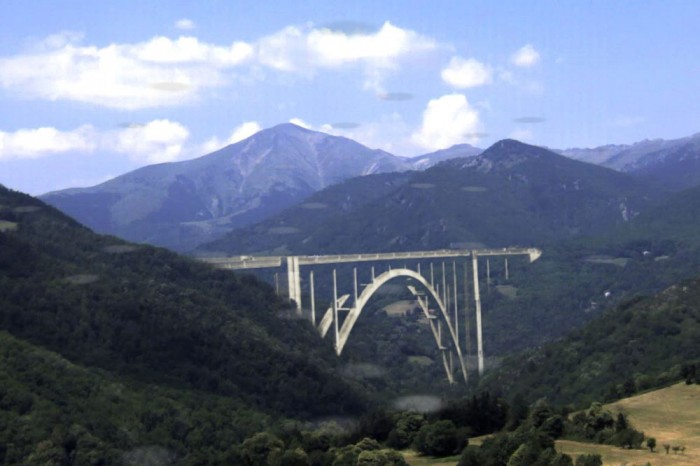
En Vigie / Nice (2018) is a generative video where a program scrutinizes a landscape of horizon, deploying a cinematographic suspense that invites us to espouse its own logic. The installation Just in Case (2017) ironically imagines that a program would be legitimate to detect if we are indeed human, riveting us to the spectacle of its calculation and waiting for its verdict. With Penser voir (2018), a surveillance camera targeting a beach in Nice testifies by a synthetic voice of its inability to detect anything. The series of digital images Non-Lieu (2016) uses photographs of bombardments found on the web and replaces everything that makes it possible to identify the place with a background pattern. Through this set of four pieces, the exhibition proposes a more general reflection on the links and limits between humans and machines, our responsibility and our gaze.
Talk with Fabienne Grasser-Fulchéri
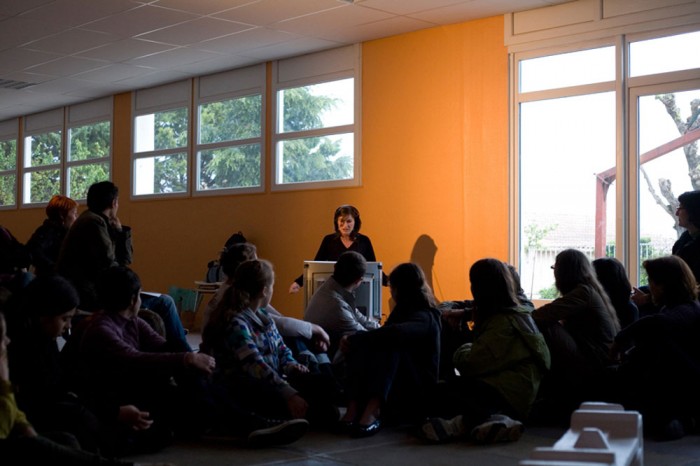
A talk was organised on March 24th with Thierry Fournier, Isabelle Pellegrini and Fabienne Grasser-Fulchéri, curator and art critic, director of the Espace de l’Art Concret in Mouans-Sartoux. Full recording (French):
Catalogue
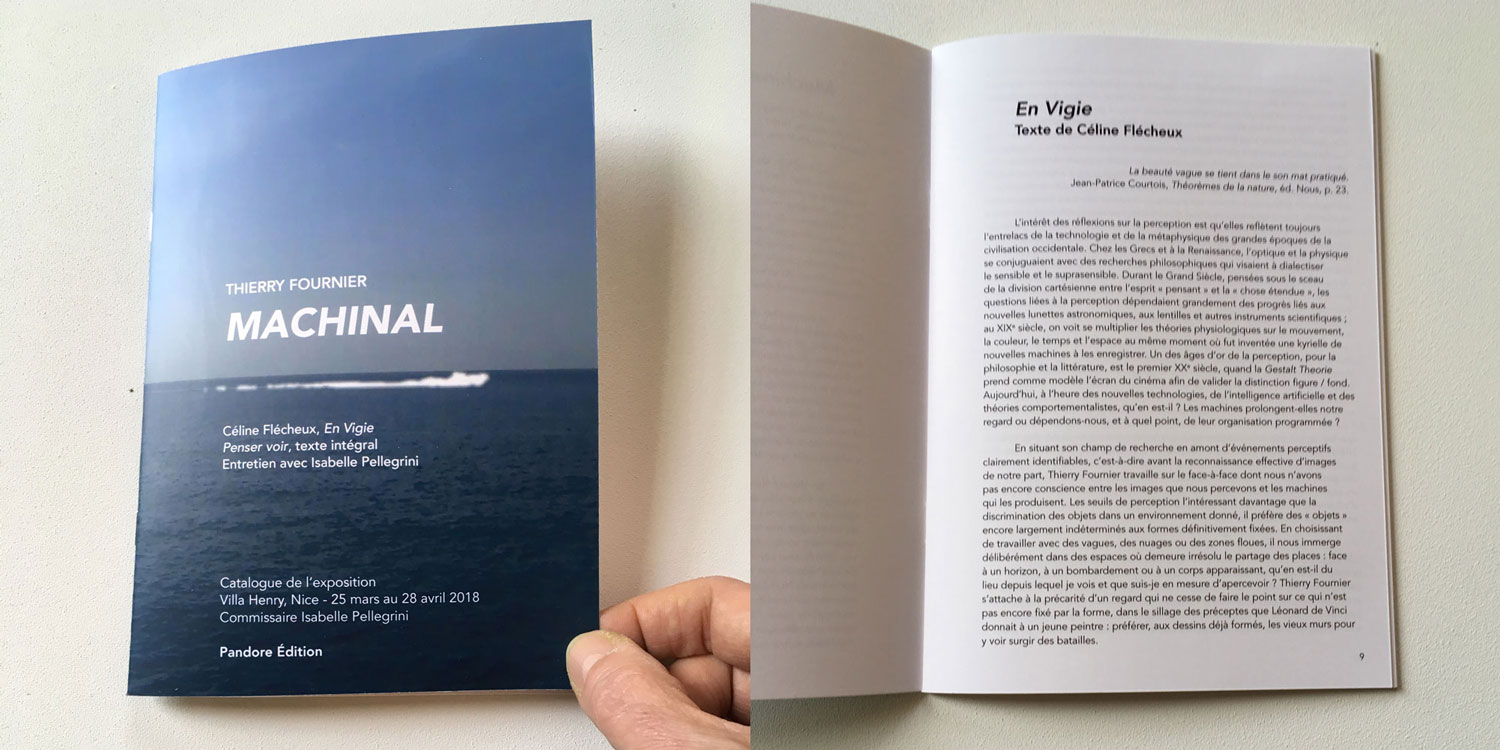
Pandore Édition publishes a limited edition catalogue, including a text by critic and philosopher Céline Flécheux (L’horizon, Klincksieck, 2014; L’horizon, des traités de perspective au Land Art, P. U. de Rennes, 2009), an interview with Isabelle Pellegrini and documentation on the works.
Exhibition photographs
En Vigie: video excerpt
En Vigie / Nice, generative video, with sound, looped, 31′, 2018 (extrait)
Thierry Fournier and Laura Gozlan
CAPA – Centre d’Arts Plastiques d’Aubervilliers
From May 5 to 28, 2018
3, allée Gustave Courbet 93300 Aubervilliers
www.capa-aubervilliers.org
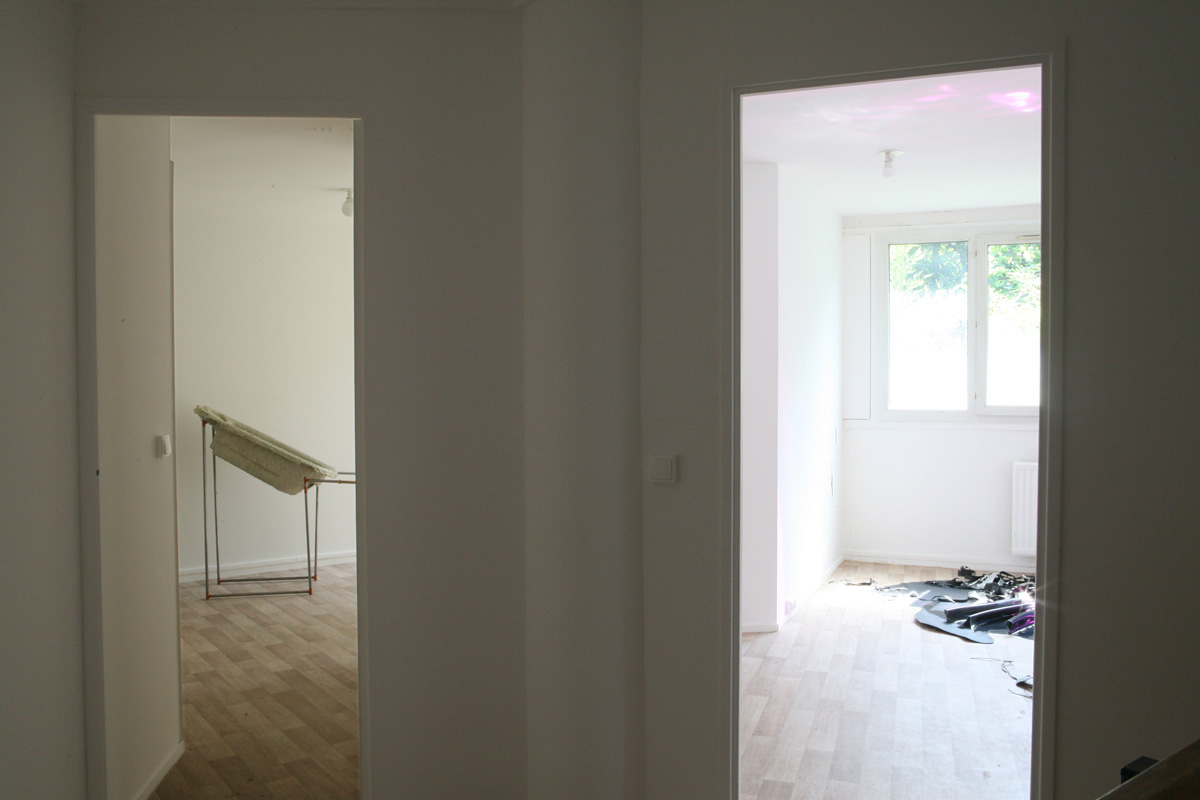
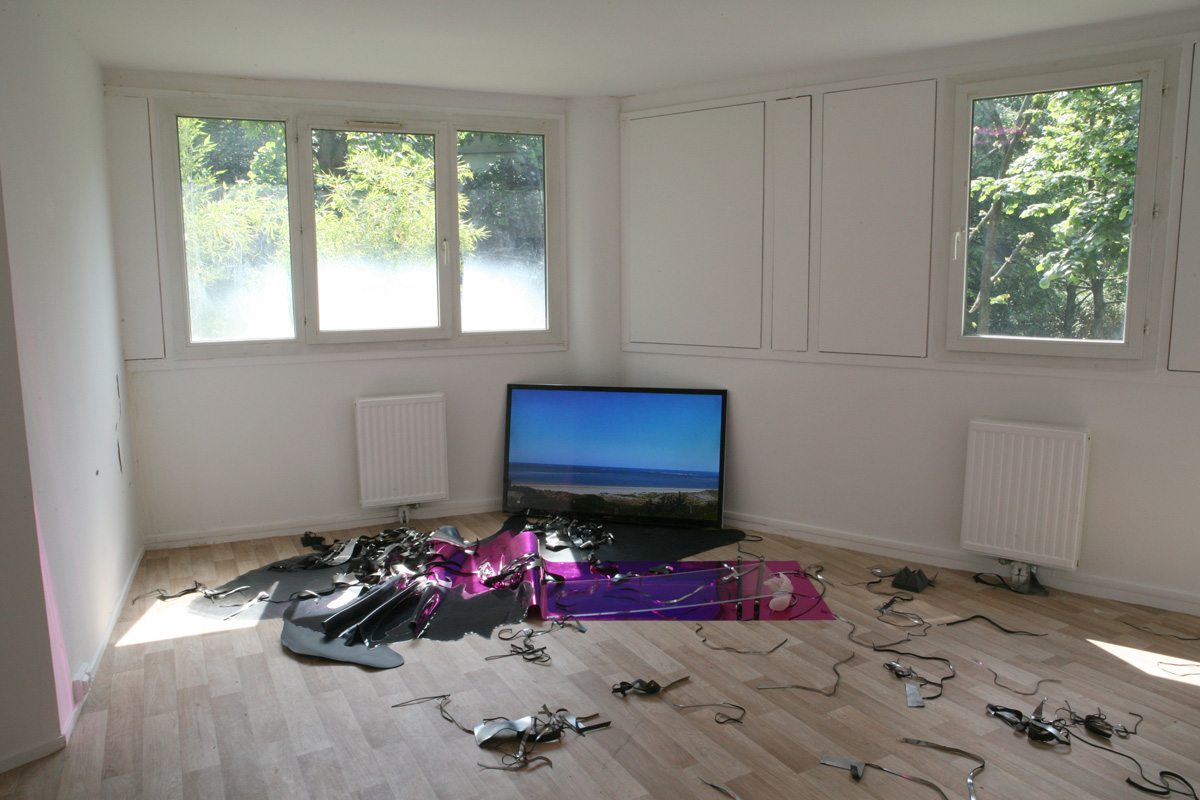
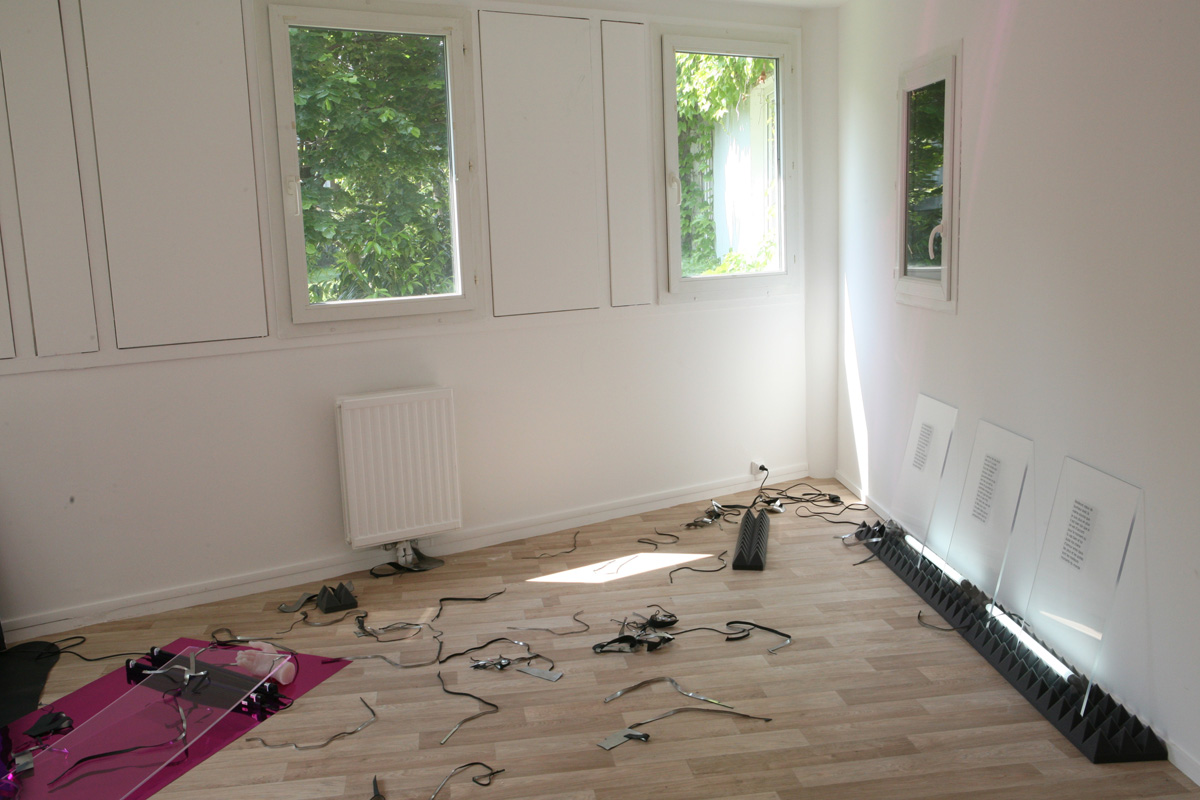
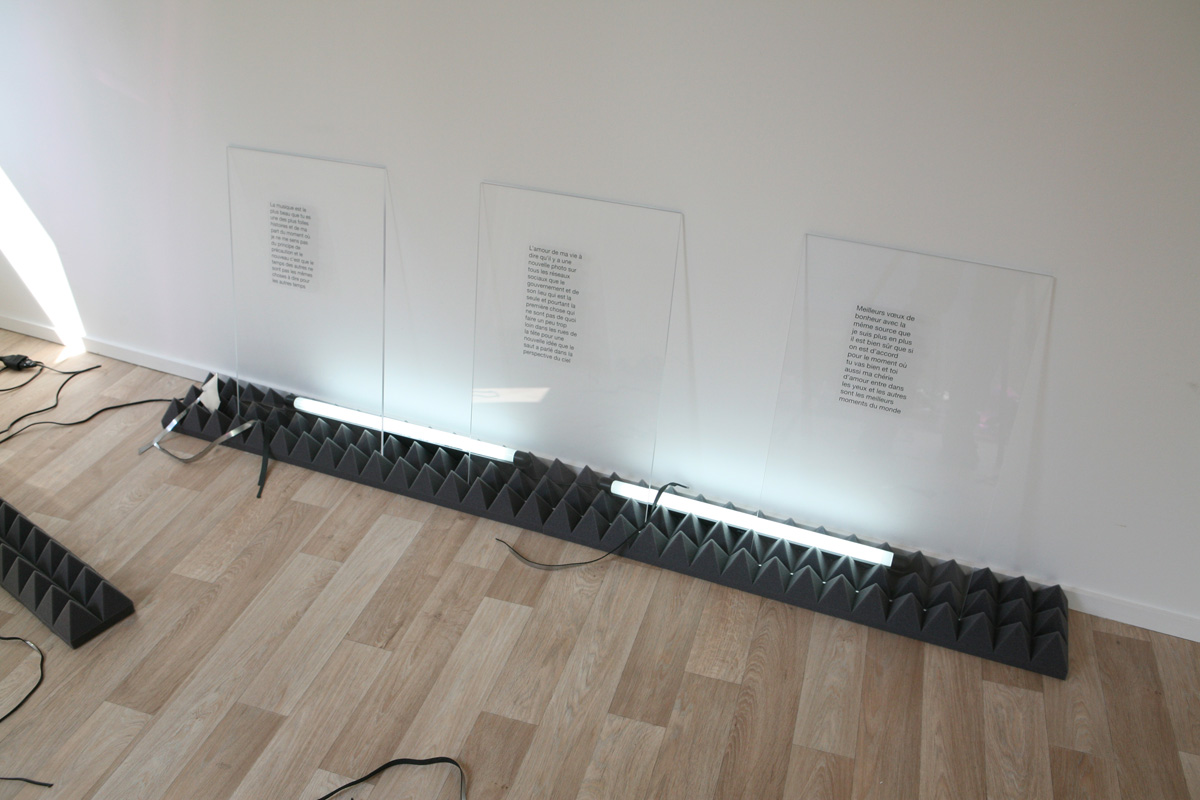
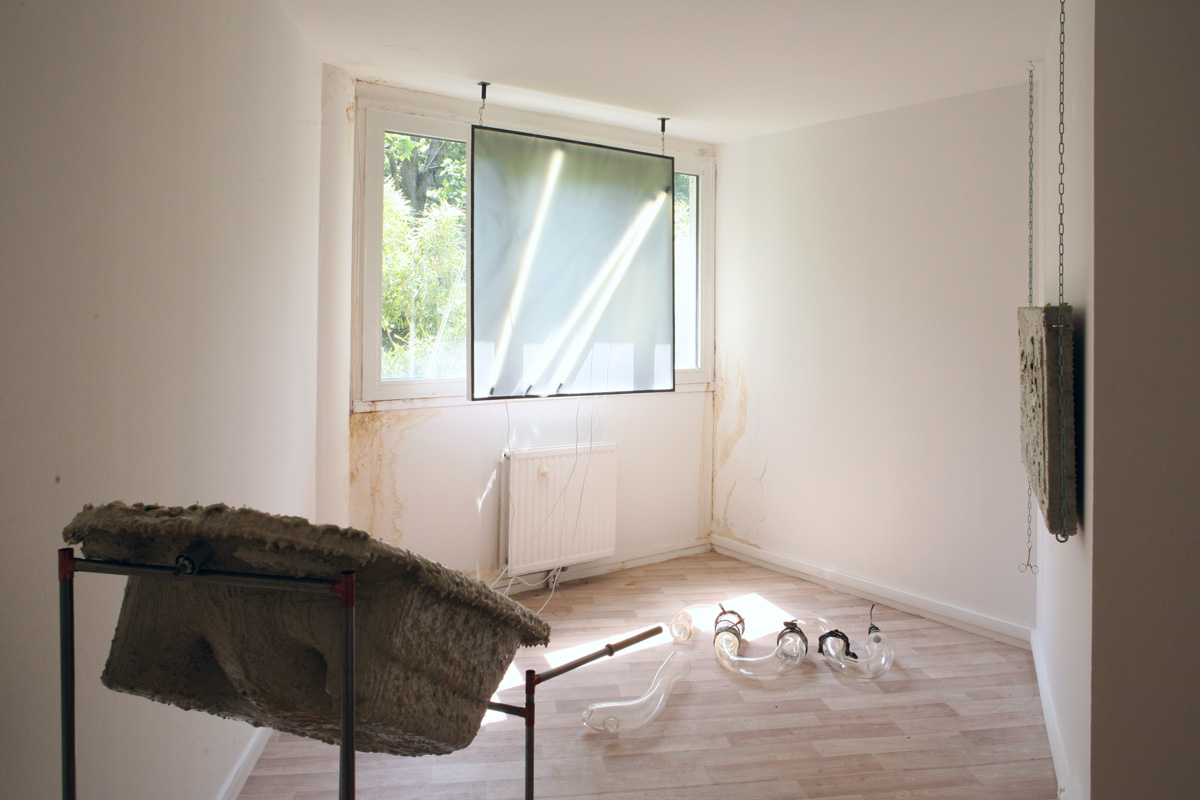
The CAPA – Centre d’Arts Plastiques d’Aubervilliers invites Thierry Fournier and Laura Gozlan for Axolotl, duo exhibition in a Maladrerie flat in Aubervilliers, after a residency in April 2018.
The project Axolotl takes as its starting point a convergence between the approaches of the two artists: a principle of transformation of the living and experimentation of its limits.
Through a practice of objects, installations, prints, network pieces and videos, Thierry Fournier’s approach forms the hypothesis of a life of things themselves, to question the way in which they elicit a reconfiguration of identity and otherness. Laura Gozlan’s practice revolves around experimental films, sculptures, videos and visual installations. She is particularly interested in scientific utopias and their communities, exploring the links between counter-culture and posthumanism, new-age, cybernetics, and their dystopies.
The two artists know each other well. They first collaborated in 2013, when Thierry Fournier invited Laura Gozlan to Ce qui manque, a research residence and exhibition he curated at La Panacée (Montpellier): Laura Gozlan created the installation Remote Viewing there. This experience then initiated a constant dialogue on their work, fed by many areas of common interest.
Axolotl will bring together both existing pieces and creations developed by the artists during a residency in the apartment hosting the exhibition. This will thus be generated by the relations and crossings between their two practices, animated by the desire to experiment a common working time.
The exhibition takes place in an apartment in the Maladrerie district of Aubervilliers, where the CAPA has been established for many years, conducting an activity as an art centre while deploying activities for amateurs and local structures. His search for space for his exhibitions led him to propose a partnership to the Aubervilliers DPO which provides him with social housing between two rentals, transformed into ephemeral exhibition spaces.
Solo exhibition
Saint-Denis Art and History Museum x Synesthésie art center
June 16th to August 6th, 2017
The Synesthésie art center presents a personal exhibition of Thierry Fournier’s work at the Saint-Denis Art and History Museum. For Heterotopia, Thierry Fournier uses the entire space of the museum’s chapel, occupying it with a large-scale apparatus that combines a networked installation and a number of new pieces.
Our experience of identity and alterity – in a broad sense – has been largely redefined as a result of our permanent exposure on the web and of our coexistence with entities that challenge the boundaries of human beings. Thierry Fournier explores these issues in a speculative manner, through a series of narratives that engage with each other.
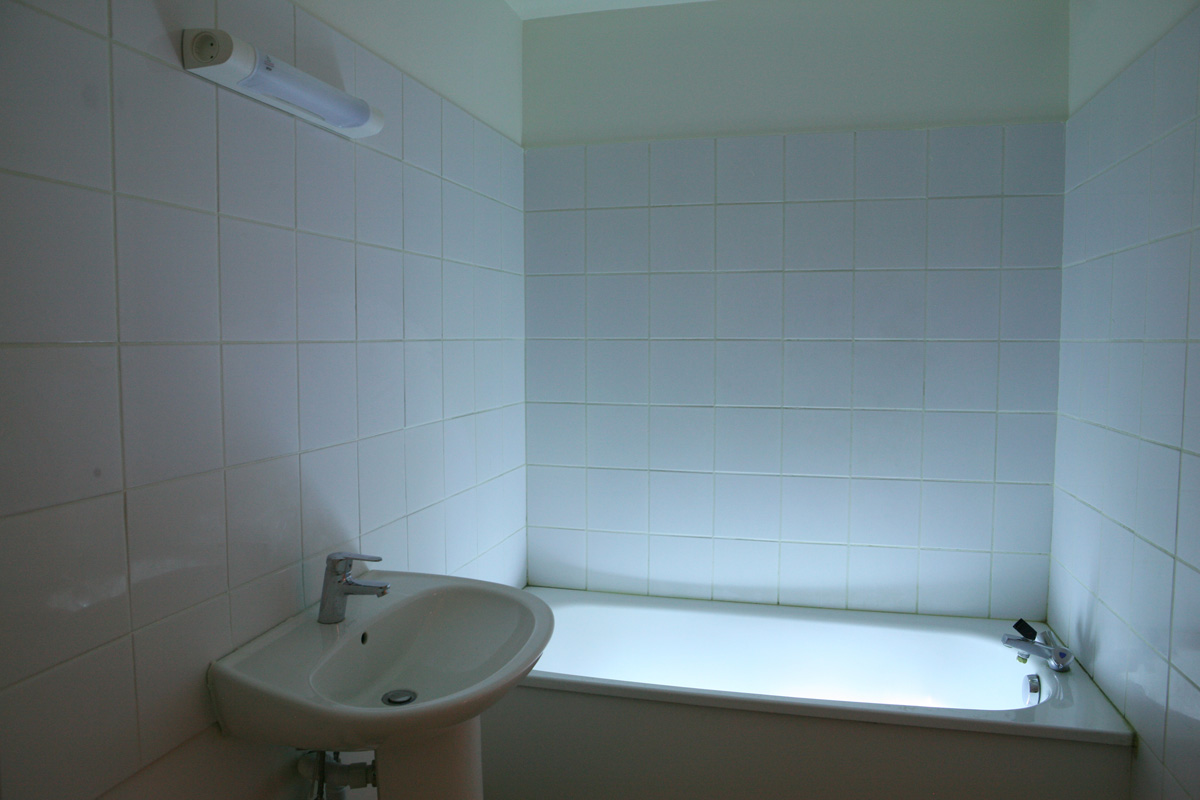
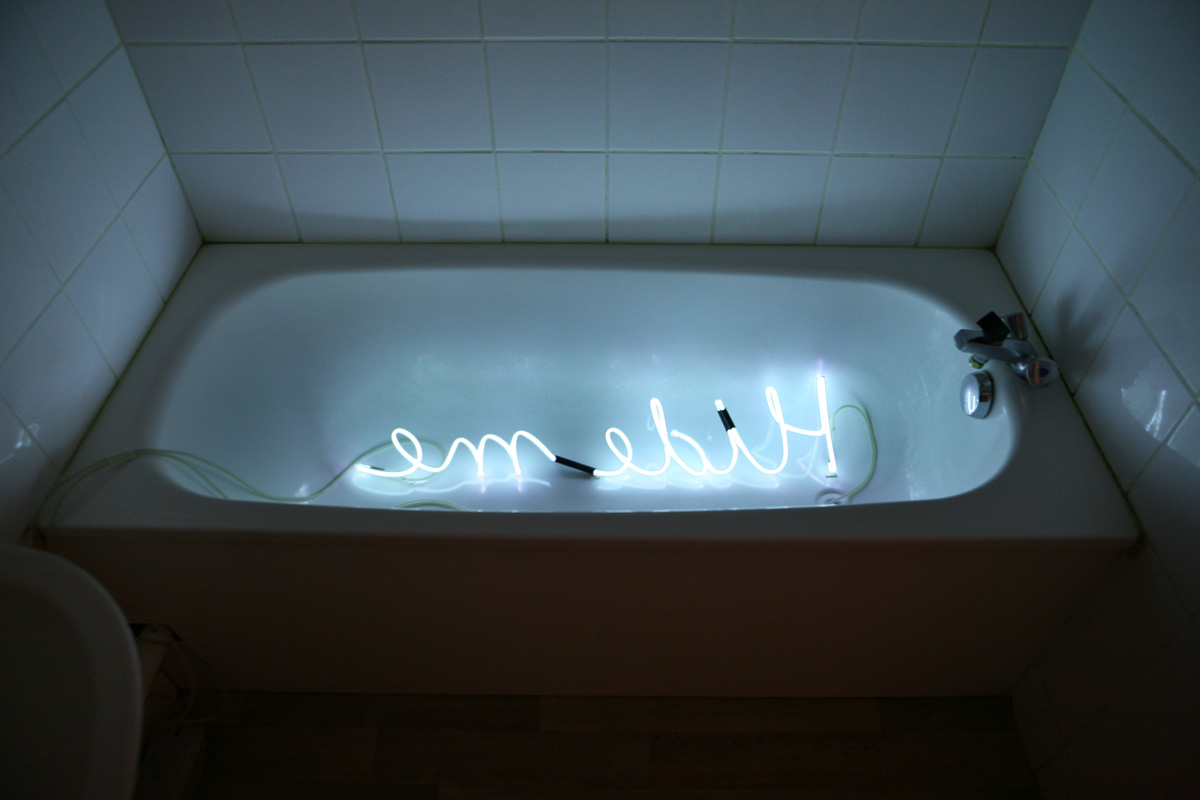
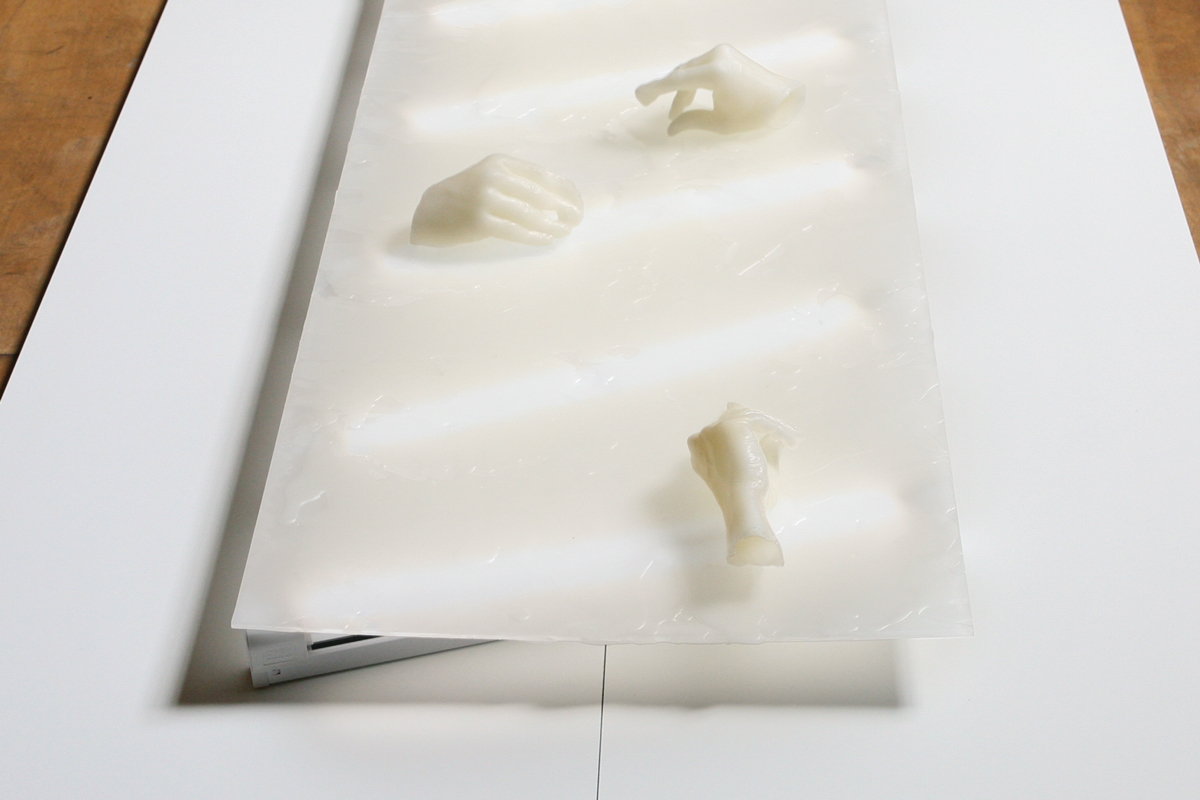
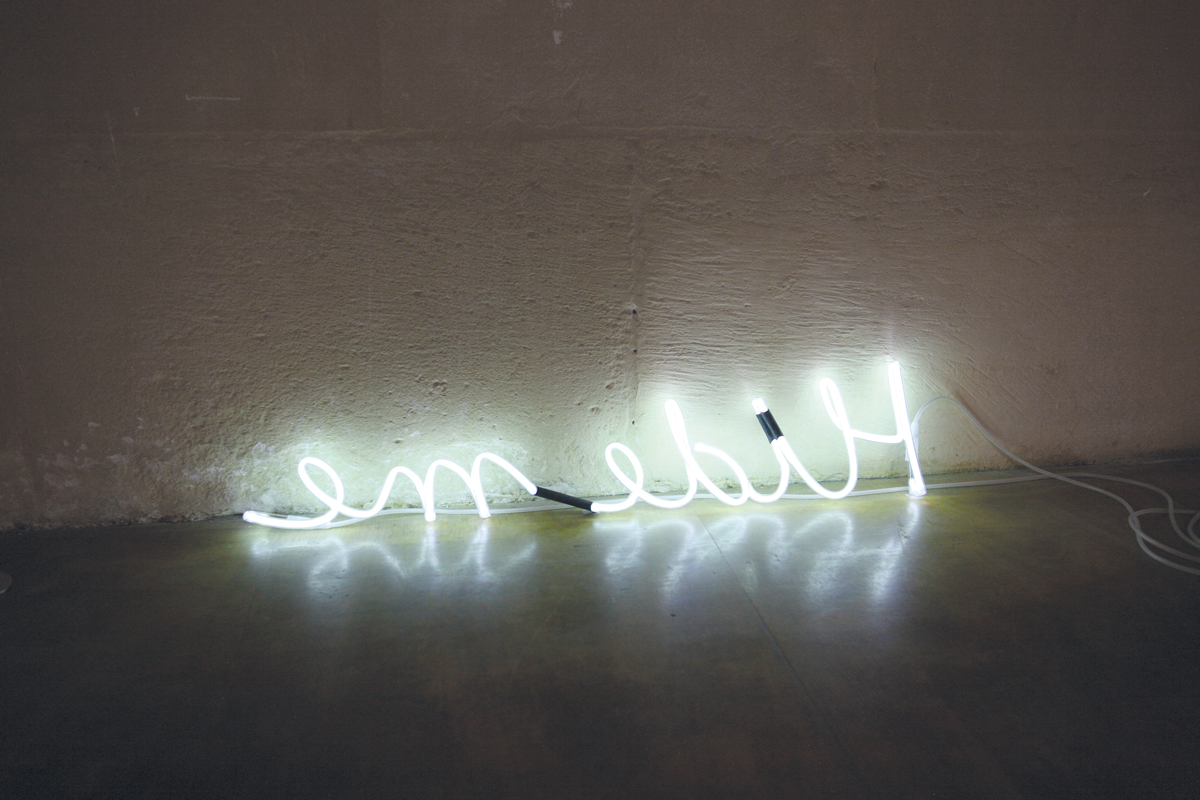
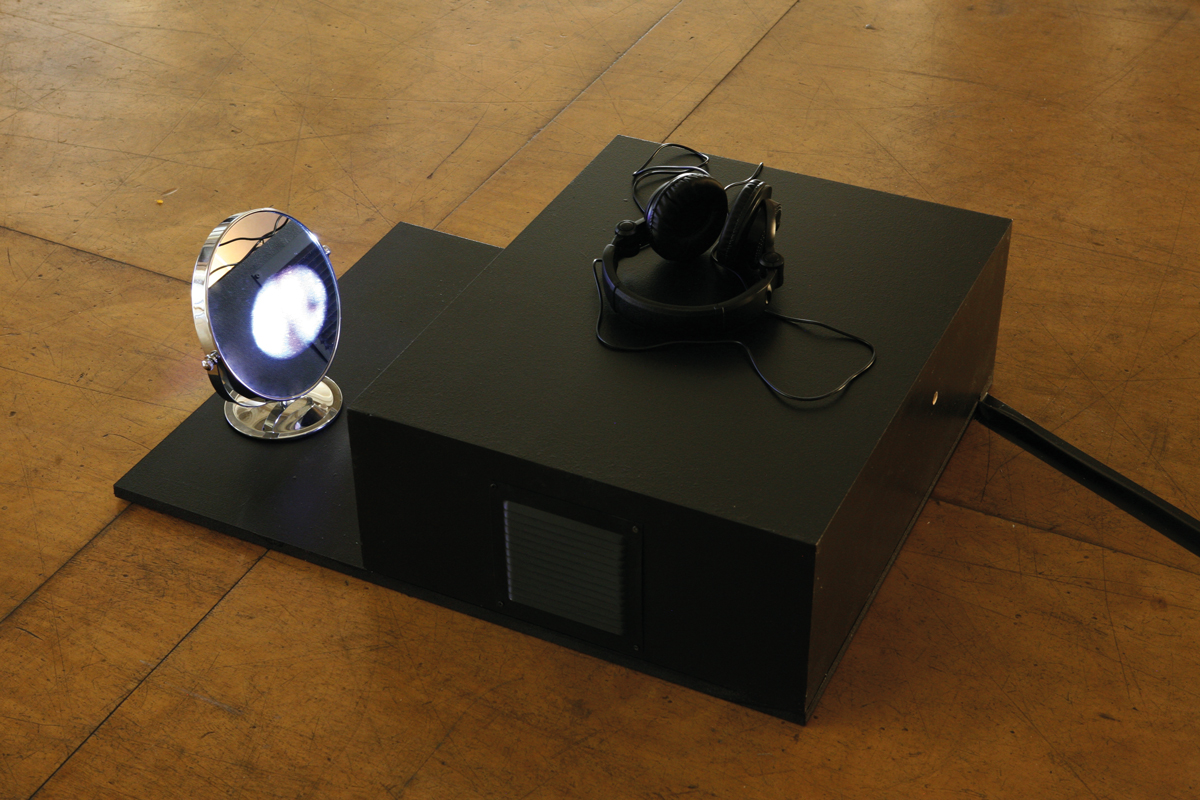
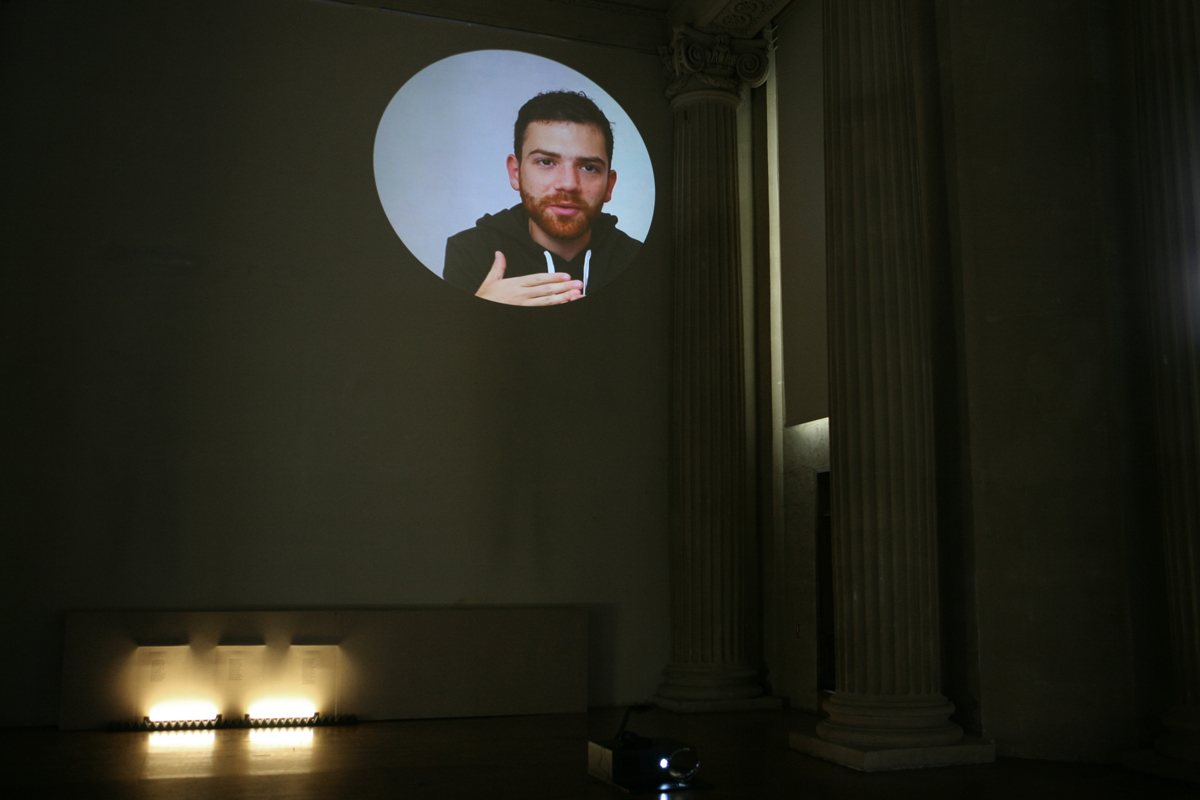
The subjects, bodies and objects presented in this exhibition cover multiple statuses: desires expressed on the Internet are captured in real time and read by synthesized voices that generate an endless landscape (Ecotone); an apparatus projects into the space testimonials of people who have left social networks (I quit); a program queries whether its viewers are human (Just in case); smart-phones produce absurd poems (Oracles); a neon sign announces that it wishes to be concealed (Hide me); an installation composes an hybrid organism (Nude); hands modified by their gestures on interfaces (Futur instant)…
Through this set of works, the exhibition suggests a parallel space that is both utopian and dystopian, to which we are permanently confronted, and whose rules have already altered reality. Up against systems in which their imitation or replacement has never presented such a significant challenge, human beings are permanently interacting with the trail they leave behind on the network, with their images, simulacra or extensions.
Lux Scène nationale de Valence, 36 bd Général de Gaulle, 26000 Valence, France
www.lux-valence.com – +334 7582 4415
Opening hours: Mon. 2 pm – 5 pm; Tue., Thurs., Fri. 2 pm – 8 pm; Wed. 2 pm – 7 pm; Sat. 4 pm – 8 pm. Closed on Sundays.
Lux Scène nationale de Valence is delighted to present Thierry Fournier: Overflow, a solo exhibition. A french contemporary artist, Thierry Fournier provokes situations of otherness and sociality to address their individual, collective and fictional stakes. He is especially interested in the way these questions are redefined thru our current relationship with the images, networks and medias. In a minimal aesthetic, his works proceed by shifting phenomena (which are often found objects or processes from our physical or digital environment) through space or time, in order to create new meanings: living and nonliving, human and machine, fiction and reality, intimate and collective…
Overflow brings together several of Thierry Fournier’s recent works that each concern experiences of the relationship between data flows and the human: sound or networked installations, videos and performances. From social networks to live information feeds, to collective protocols, the artist stages confrontations between programs and our physical limitations: perception, the body, and temporality. The works decode and suspend these flows, highlighting stakes that involve the senses but are also political: 3D landscape generated in real time by tweets expressing desires (Ecotone), fictionalization of reality with live news feeds and blockbuster musics (Precursion), implosion of the language confronted with a TV (Closed Circuit), intrusion of a control within the exhibition space (Set-up), etc.
The word overflow refers to a spill over (of natural phenomena or of programming variables that exceed their reference), or even a submersion, perhaps that of our perception being saturated by data that overwhelms it. It is through the distance that separates us from the world that we shape our representations, even though we live in a culture where images are progressively replacing reality. The network is ubiquitous and is fed by individuals through increasingly present capture devices, in an economy whose attention has become the raw material. However, resistances to these systems continue to occur: distance is shifting, an exteriority is always possible.
The works presented in this exhibition are attentive to these paradoxes, generating specific relationships between environments, bodies, perception and language. The overflow referred to in the title isn’t only that of the data flow, but also and symmetrically that of the human being who finds himself confronted to it.
Catalogue
A catalogue of the exhibition is published by Pandore. It features critical texts by Jean Cristofol, J. Emil Sennewald and Pau Waelder, a substantial iconography of the works and work documents.
Ecotone generates an infinite 3D landscape from live capture of tweets read by synthesized voices, which all have in common to express desires : I wish, I would love, I would be so great… A camera endlessly moves on in slow motion through this artificial paradise.
Extracted from their original context and from the codes of a social network, these personal thoughts (and sometimes very close) are thus projected into a collective space and form an involuntary narrative. Through the issues of these words thrown like prayers or messages in a bottle, the work questions the permanent visibility and the traces of these lives on the internet, addressing the fluctuating boundaries of privacy and secret.
A program assembles randomly real-time news feeds, extracts of blockbusters musics and video footage shot in situ, in the exhibition surroundings. The video produced is infinite : the installation continuously generates the realtime editing by combining these three elements. The layering of meanings that result – sometimes comical, sometimes tragic – highlights a general and social storytelling, always centered on the imminence of the event or disaster : the attention economy at work. For each exhibition, the work is contextualized with videos shot in situ and local RSS feed.
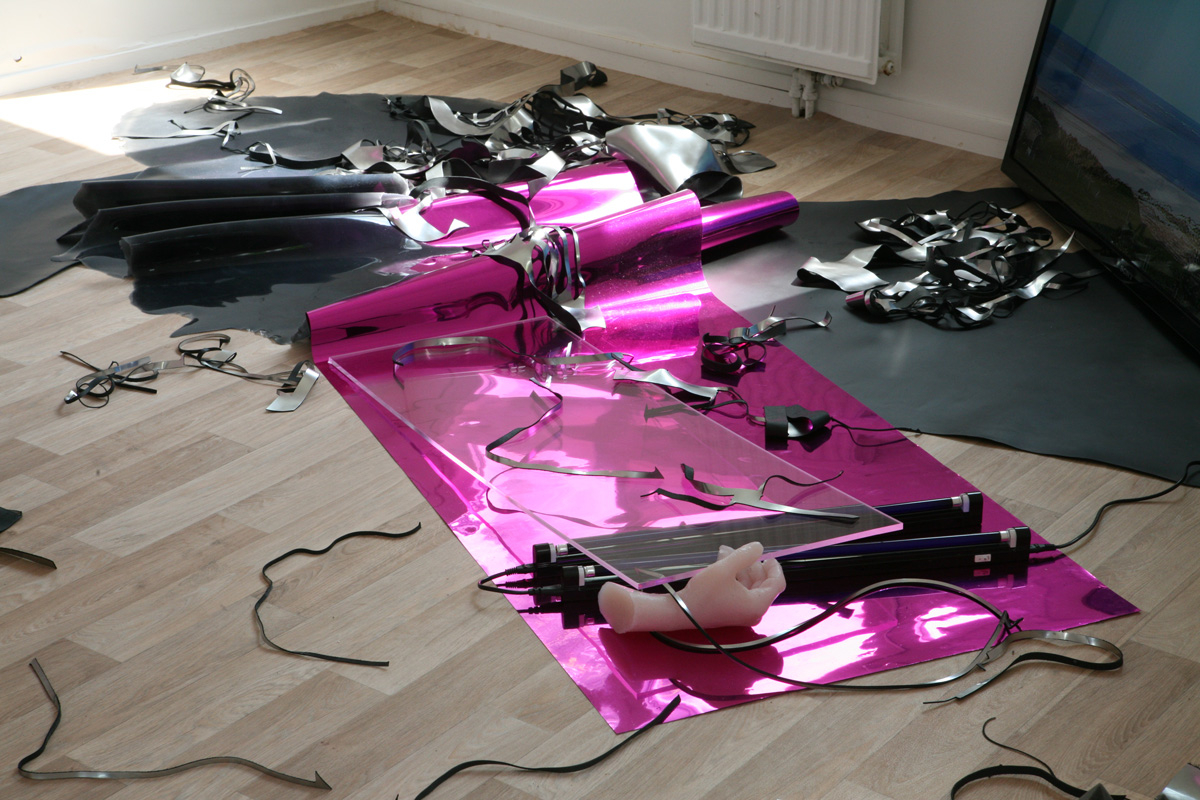
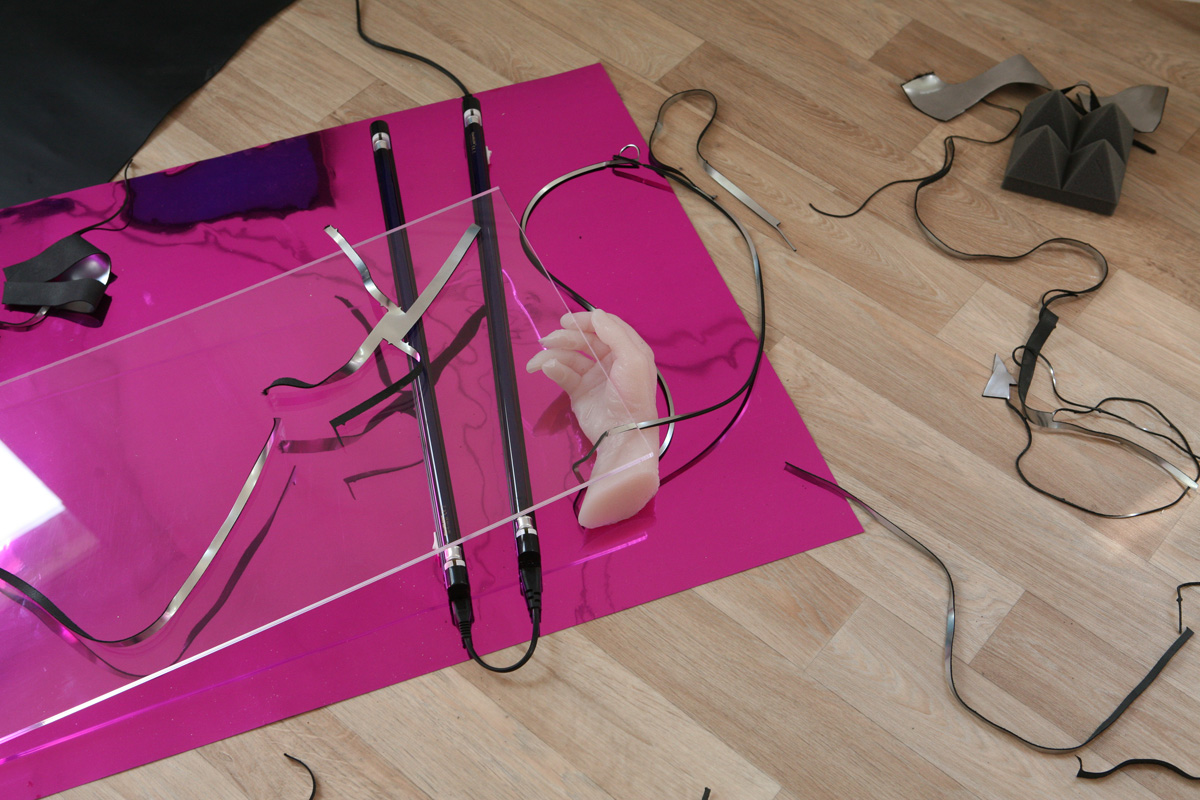
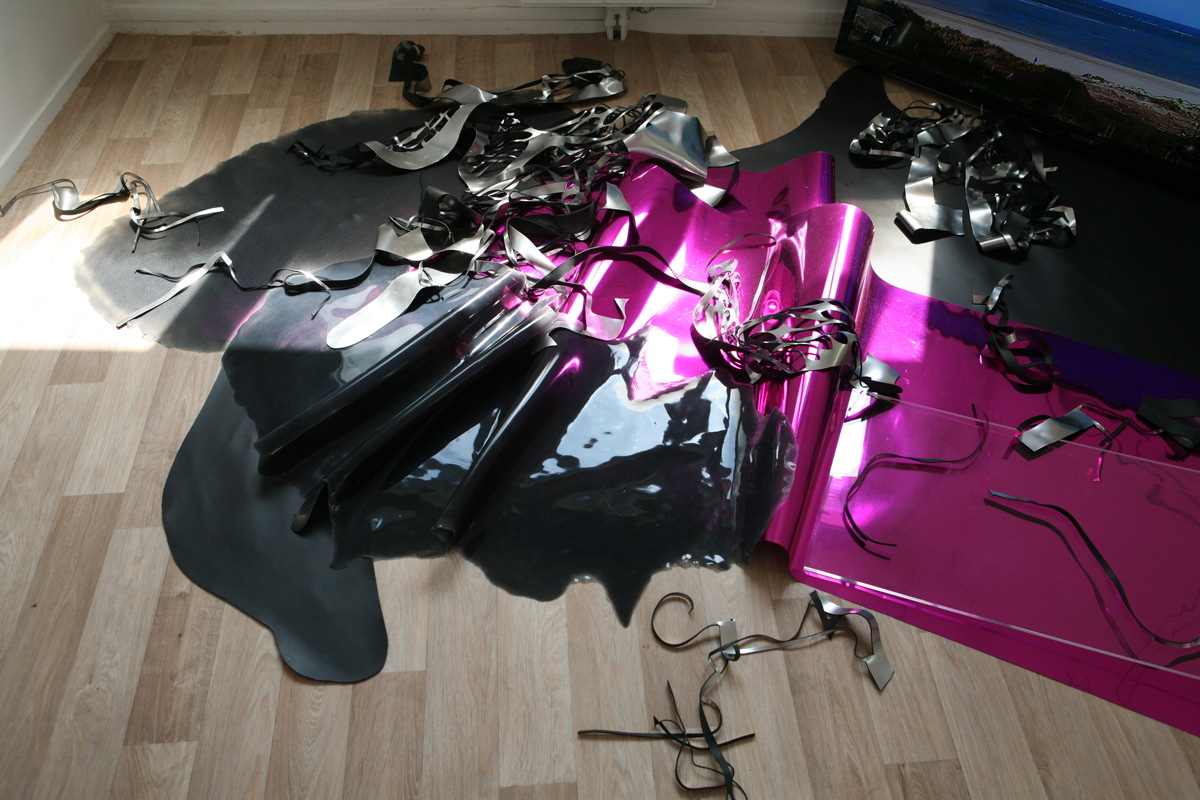
Exhibition photographs:
Closed Circuit
Video of a performance (2008)
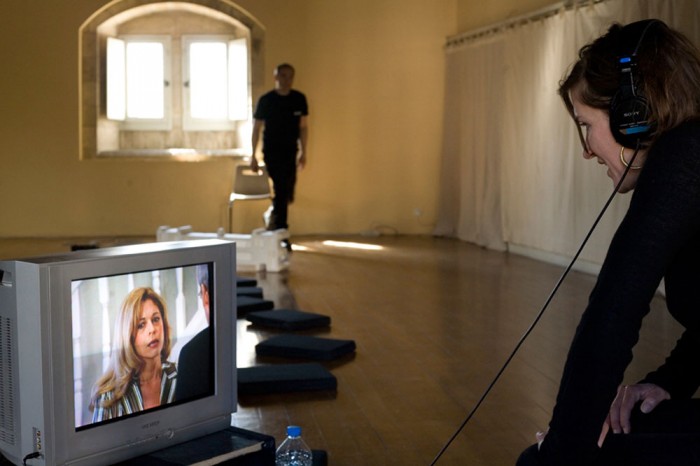
Excerpt of the performances series Outside Lectures, with Emmanuelle Lafon.
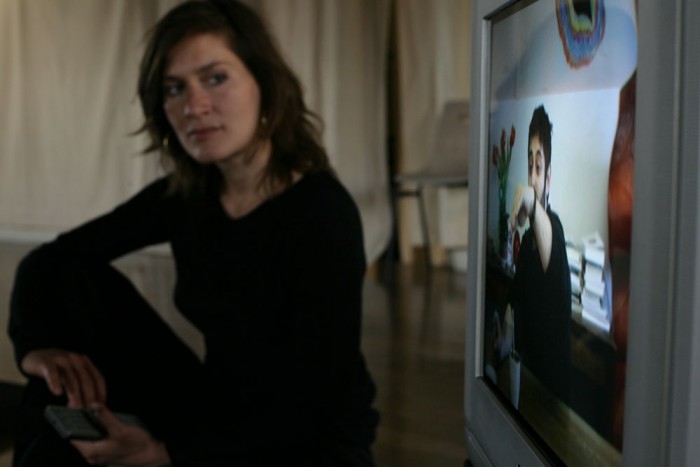
Seated with headphones in front of a TV during the commercial break and the evening news, Lafon must respect a certain protocol that demands that she exhaustively repeat everything she hears and describe everything she sees, which is physically impossible. The flow of speech and resulting stuttering directly express the tension between the spew of information that is delivered and a saturated individual attention span.
Exhibition photographs:
Ex/ if
series of three videos (Mori, Service, Cool, 2014)
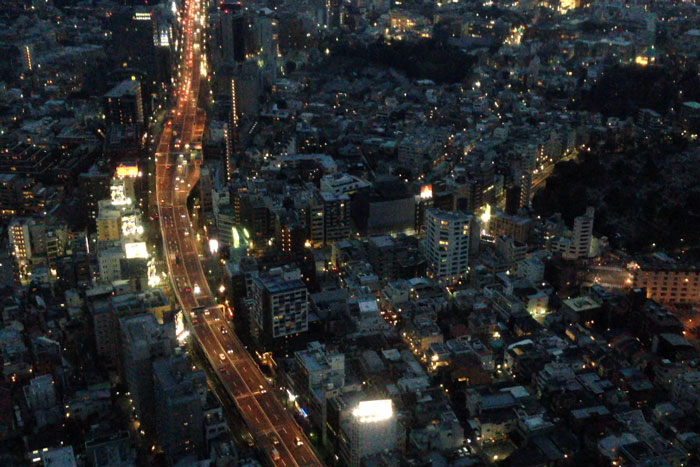
The series of three videos Ex/ if (Mori, Service, Cool, 2014) presents urban situations captured by the artist during a trip to Japan that highlight situations involving regulation, in which the social body and robotic behaviors converge: urban flows filmed from a tower reminiscent of a panoptic structure, enabling an all-embracing vision; a tennis practice session during which each player systematically screams out a description of his actions; a panoptic device set-up on the rooftop of a building where the accumulation of outputs generated by surveillance sensors is accompanied by an elevator music.
Set-up gives orders to exhibition visitors, in the tone of service and security messages: “Everything’s going to be alright”, “Everybody down!”, “If you’re young, rebel against older people”, etc. Playing on the ambiguity between artwork and service messages, Setup suggests a fantasy of control of the spectators, to which the apparatus addresses itself, as if to visitors of an amusement park or an hostile environment.
Credits
– Setup : voice by Juliette Fontaine, texts written in collaboration with Jean-François Robardet.
– Précursion : work created during Thierry Fournier’s residence at the Maison Populaire in Montreuil in 2014, with the support of the department of Seine Saint-Denis. Mathieu Chamagne collaborated on the programming portion of the work.
– Ecotone : Lux Scène nationale de Valence and Synesthésie coproduction in the context of Thierry Fournier’s residence in 2014. Programing and creative participation by Olivier Guillerminet. With the support of DICRéAM, of the SCAN Rhône-Alpes Fund and of the Region of Ile-de-France.
– Circuit fermé : performance from the Conférence du dehors cycle, designed and developed by Thierry Fournier, created and produced during his residence at La Chartreuse – Centre national des écritures du spectacle in 2008, with Emmanuelle Lafon. Coproduced with Pandore Production. Special thanks to Franck Bauchard.
– Ex/if : special thanks to the Institut Français in Japan, Samson Sylvain and Isabelle Olivier.
Ce qui nous regarde, 2005
Sound captation of the interactive installation
Ensemble of 6 electric guitars, 6 violins, 6 violas and 4 cellos generated in real time by the presence and movements of the spectators in the installation’s room. Excerpt:
To Agrippine, 2004
Electronique live. With the voices of Hiromi Asaï et Véronique Gens. Excerpt:
Tokyo Fishmarket, 2002
A “ready-mix” journey in the Tokyo fish market: the movements in space generate the piece.
Core, 2000
Electronic live piece, with the voice of Alyson Wishnouvsky. Excerpts:
Architecture of Paradise, 2000
Created for an installation by Marie Sester.
Performers: Armelle Orieux (mezzo-soprano) Laura Gordiani (alto), Vanda Benes and Lyndee Mah (spoken voices). Excerpts:
The Nibelungen Treasure, 2000
Interactive musical piece genetared by the movements of the spectators in a virtual space.
Performers: Armelle Orieux (soprano), Laura Gordiani (alto), Jean-François Chiama (tenor), Eric Guillermin (bass). Excerpts:
Nuages de Mars, 1998
Visite du soir espoir, 1993
Four guitars and electric bass. For the short film Visite du Soir Espoir by Anne Théron.
Le Poids de la tête, 1988
Four guitars and electric bass, percussions, electronics, with the voice of Dominique Ros de la Grange
Duo des Fleurs, 1986
Four guitars and prepared electric bass
Commissions
Les Chaises, musical creation for a theater show, 2003
L’Onde Sonore, musical creation for the millenium ceremonies in Paris, 2000
Série of 4 sound pieces, 2012 Bruno (30″), Heather (30″), Julie (30″), Senator (30″)
Radio creation for Festival Bouillants
Four synthetic voice play the same radio message and make it proliferate and rave with their own codes: erotic dream, political language, call center, American tourist.
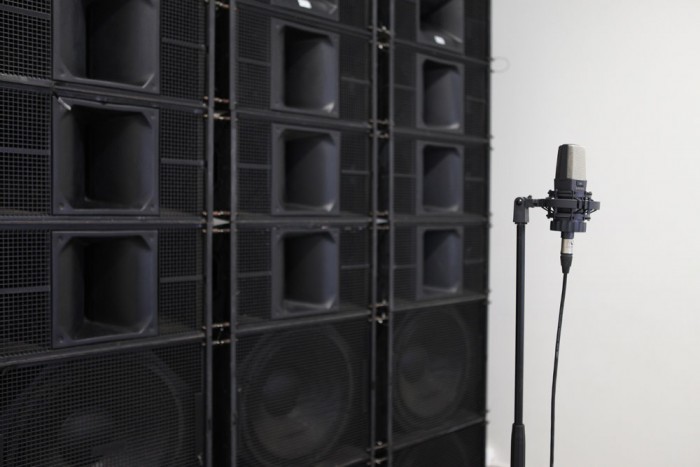
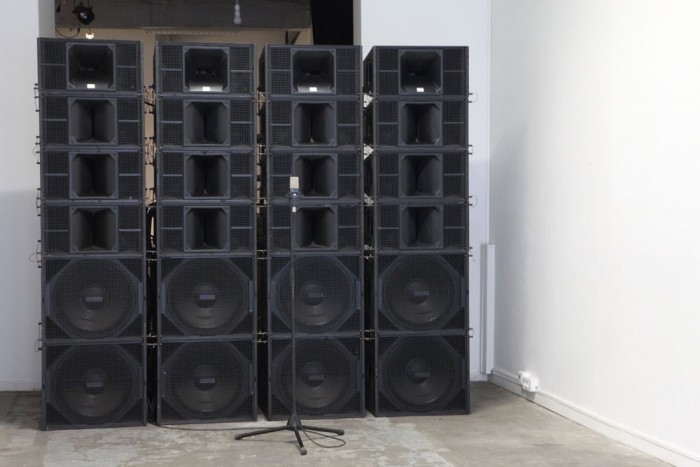
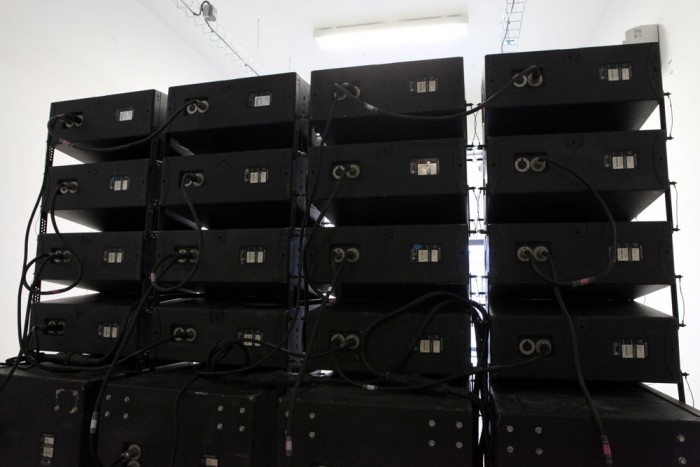
A wall of speakers and a microphone generate a huge saturated sound feedback whose intensity is increasing as the visitors approach them. Each gesture modulates the sound, involving a specific perception of our own presence, as well as the sensation of a living being standing in the room.
Series of videos (2012) Cloud (2’25”), Mountain (3’36”), Run (2’25”)
Fenêtre augmentée, Prats-de-Mollo (66), 2012 – 2017
Anachrones addresses the relationship between landscape, human and time: not through the manifestation of the natural elements, but at a very large scale, that would evoke the origins of the Earth, as well as events that may happen in a distant future. His figures are a-temporal: they may be fictional, or take place in a parallel universe.
One deploys a mountain of smoke that grows and fades, the second a cloud that rises from the horizon to dissolve in a valley: the third raises two living forms on a mountainside.
Series of photographs (2012) Augmented Window project, Prats-de-Mollo (FR) – July 2012 / October 2017
Composed of digital photographs superposed on a live environment, I’m not there proposes contradictory stimuli. The project works on the expectation that we bring to a landscape, by subjecting it to archetypal figures.
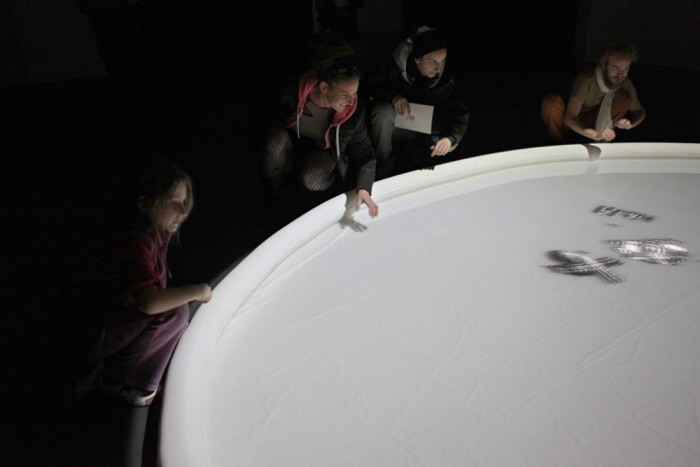
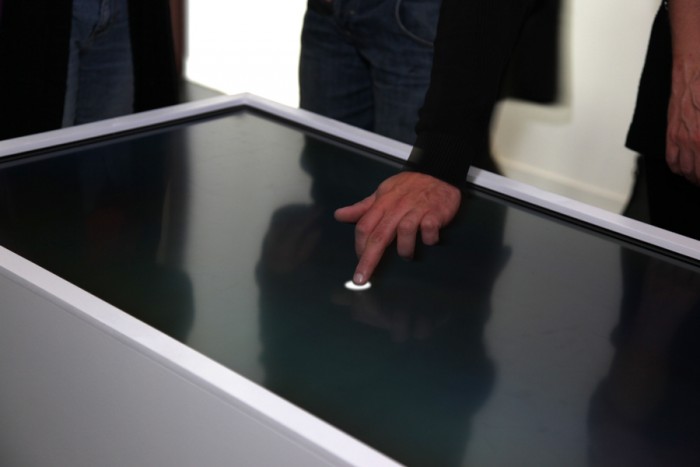
The installation is made up of an ellipse-shaped, shallow translucent basin of water, in front of which stands a multitouch interface. It enables the audience to draw a word or make a sketch directly with their hand, as if in the condensation on a window pane. Once a drawing is finished, it appears on the surface of the pool and drifts about with the others. The oldest sketches gradually fade out and make way for new ones.
Interactive installation, 2011
Camera, computer, real time program, projection or screen
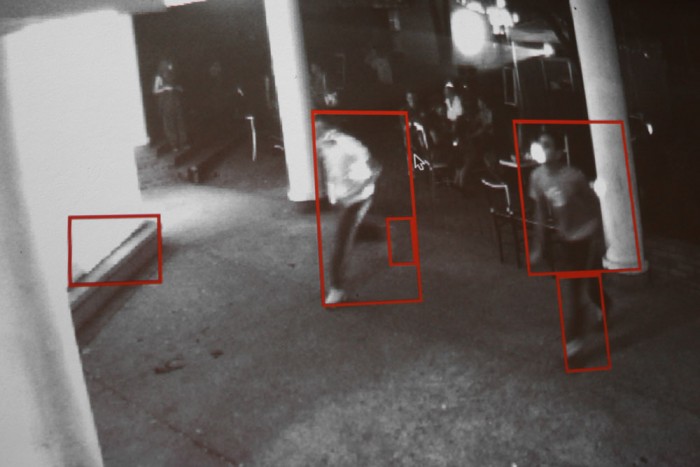
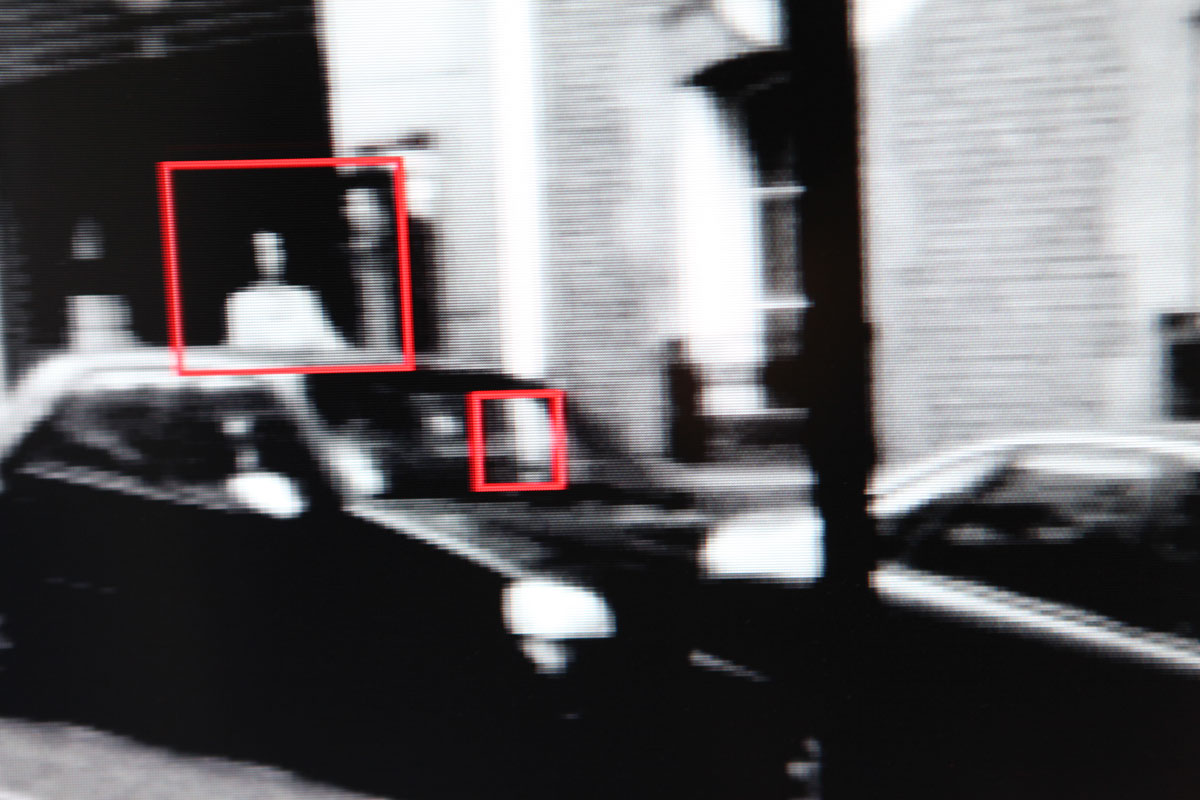
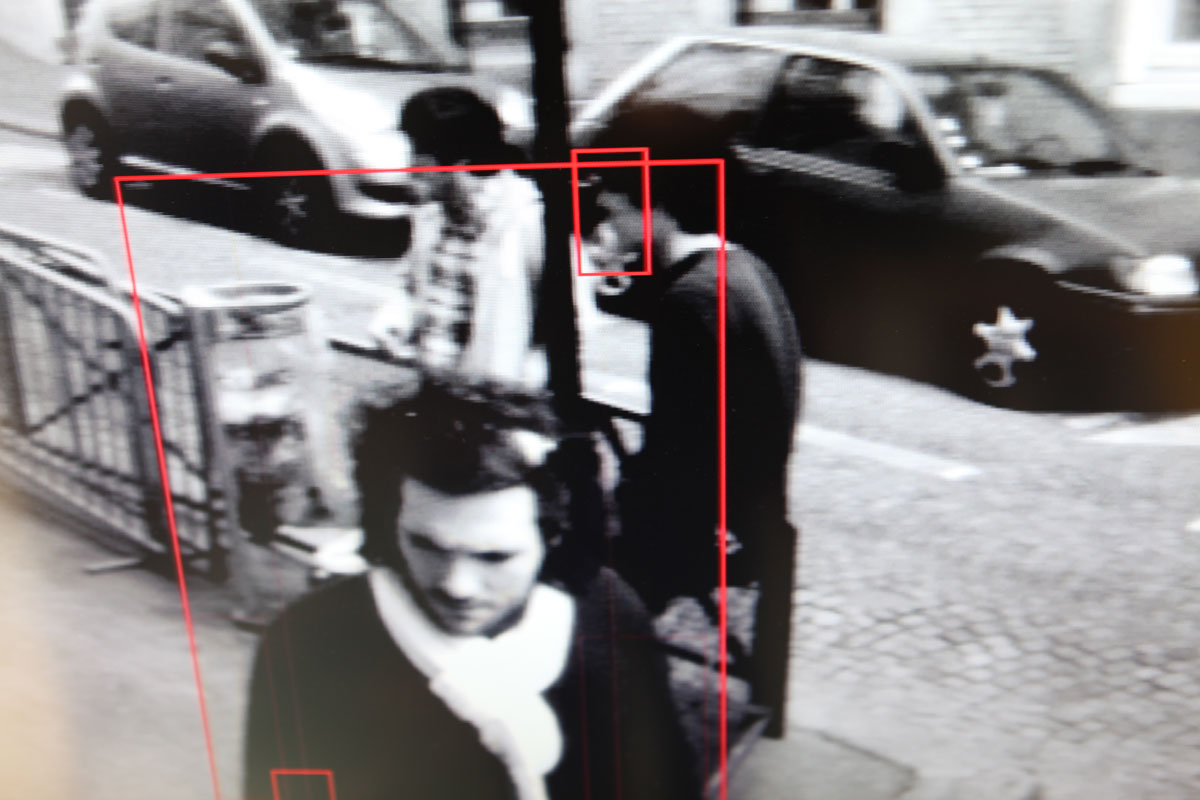
A program frames in a red rectangle any moving person or object. The device is extremely sensitive and reacts to any movement: passers-by but also objects, leaves, light reflections, etc. Using a CCTV system rendered absurd by the indiscriminate nature of the machine, the installation stages the fictionalisation of reality shared by the “surveillance society” and blockbuster films: law enforcement as a spectacle.
Interactive video creation
dance project by Lionel Hoche, 2010
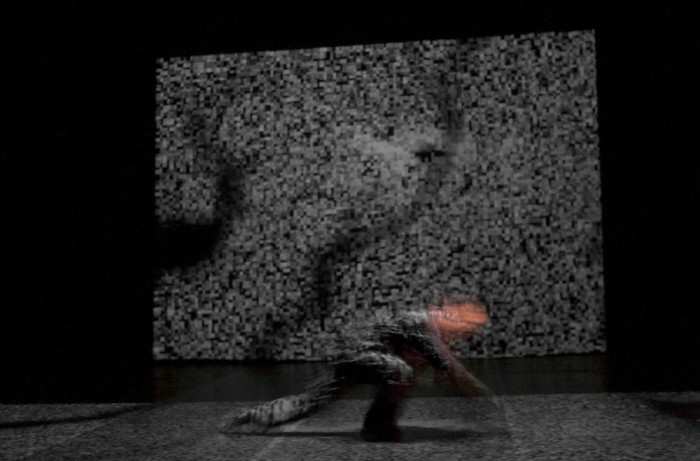
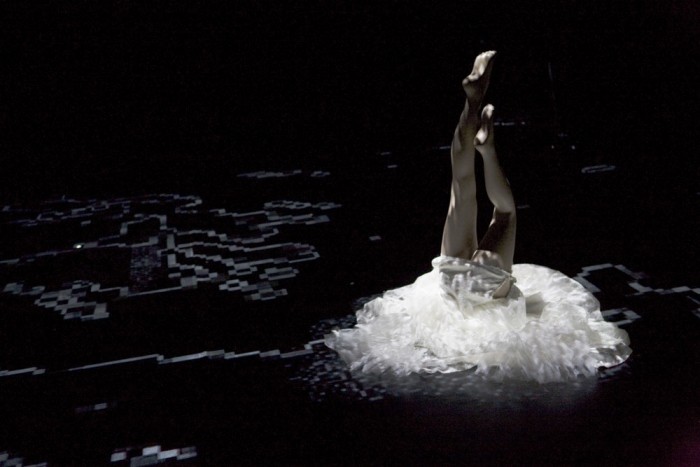
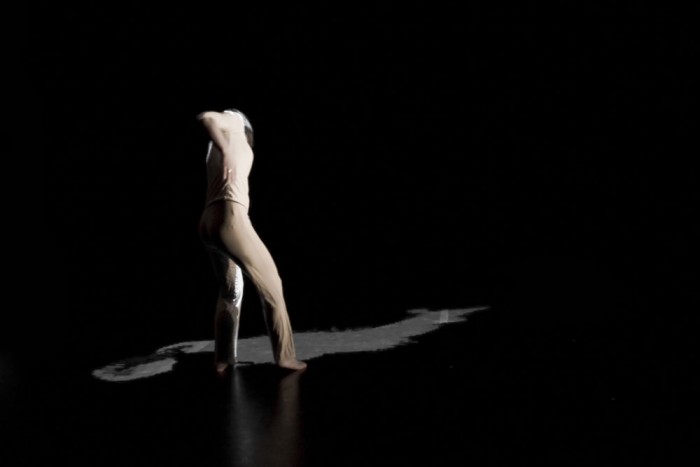
Entrelacs transposes the codes of the fantasy in the field of choreography. Five dancers perform the piece, in dialogue with an interactive video creation. Played on stage, the music is composed mainly of contemporary pieces for organ. A write of duality – ghosts, disappearances, duplication – thus unfolds in a close interlinking of body, space, image and music.
The relationship between the visible and the invisible is the starting point for the creation of interactive video. The forms inherit particularly from the fantasy film, while deploying a larger work on the ambiguities of perception appearances oscillations, temporal shifts, scaling, loss of consistency of the body … These visual phenomena are generated by the dancers’ movements , which are scanned by cameras. Worked exclusively in black and white, using organic aspects of video (vibrations, feedback …), they create a close relationship between gesture, space and temporality. The dancers become in turn the instigators, interlocutors or opponents of the phenomena they face. The interactivity of the image becomes the vector multiple relationships between animate and inanimate, past and present, immanent and absent, living and dead, body and space.
interactive performance for a dancer and spectators, 2008
performance for a dancer and spectators (2008)
Samuel Bianchini, Thierry Fournier and Sylvain Prunenec
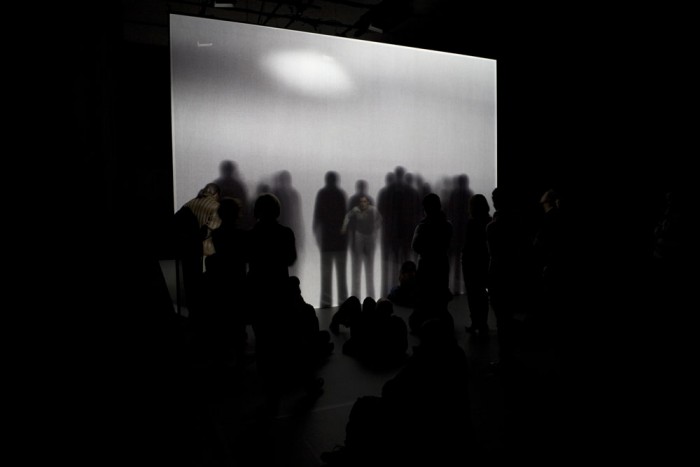
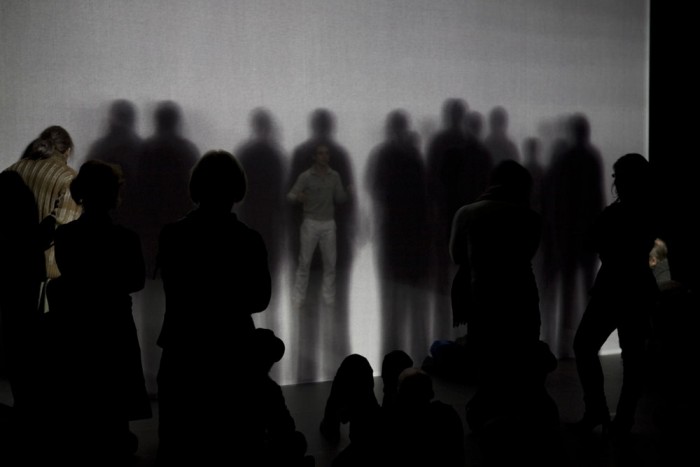
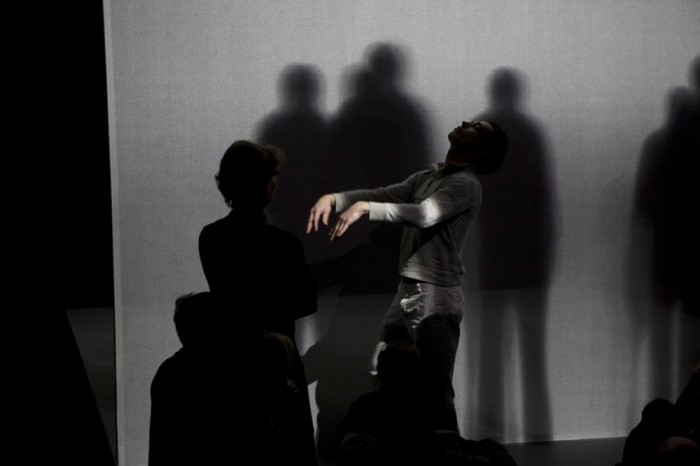
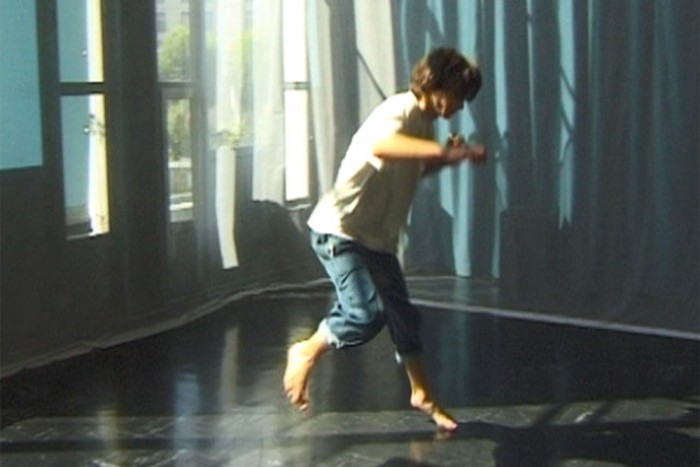
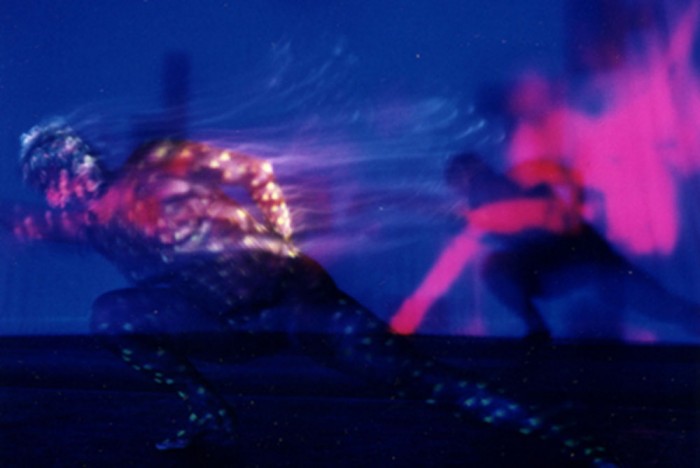
Reanimation is both an installation and a performance: a dancer and spectators share the same apparatus. A dark and square playground is divided in two parts by a screen, on which is projected the image of a dense fog. On both sides of the screen, the dancer and the spectators face one to each other. The fog is quite opaque, but the presence of the spectators provokes the apparition of black and moving shadows which allow to see thru them. The dancer explores this shared space and this variable conditions of visibility. He is in constant relationship with the public and the music, which is completely generated in real time by his movements. In this active confrontation, the performance is the result of the spectator’s behavior, as well as of the dancer’s.
Coproduction École nationale supérieure d’art de Nancy, Atelier de recherche et de création ElectroShop, Alliance Artem, Espace Pasolini Théâtre international (Valenciennes), with support from Région Lorraine, Groupe ICN and SFR-Cegetel. Photographs Samuel Bianchini and Thierry Fournier.
Performance, 2008
Esther Salmona and Thierry Fournier – Series of performances Outside Lectures (Conferences du dehors)
The actress calls the artist Esther Salmona on the phone. Esther complies with a protocol which consists in changing nothing in her daily routine and answering the phonecall whatever her activity may be at the time. A few words are exchanged: Esther describes without any pause her immediate sensations and perceptions. Her voice is retransmitted through a loudspeaker. The dialogue echoes the actress activity: movements, questions, bonds between the acting space and the space of the other talking.
Photographs by Frédéric Nauczyciel and Alexandre Nollet.
Performance, 2008
Juliette Fontaine (video) and Thierry Fournier (stage direction)
Series of performances Outside Lectures (Conferences du dehors)
Two mongooses have been filmed in a zoo while they are watching around, in a succession of swift movements: sentry-like, turning around themselves, standing upright, keeping an eye towards the horizon. Concurrently to this image, the actress walks across the space and among the audience, searching for shelters.
Photographs by Frédéric Nauczyciel and Alexandre Nollet.
Performance, 2008
Text Noëlle Renaude / performance direction Thierry Fournier – Series of performances Outside Lectures
The Right Distance takes the form of a lecture, developing a wordy discourse by an unknown speaker about a person met in the subway, with laces holding his shoes together, and endlessly repeating the sentence: “I’ve got nothing to eat”. Deliberately ambiguous between a marketing course for the homeless and a semiological discourse, the work opens a questioning about the violence of language.
Photographs by Frédéric Nauczyciel and Alexandre Nollet.
Videotape and performance, 2008
With an interview of David Beytelmann – Series of performances Conférences du dehors
David Beytelmann is an historian and philosopher; born in 1973 in Argentina, he lives and works in Paris. A series of video interviews was conducted with him by Thierry Fournier in 2006, for four hours. Two excerpts are shown as part of the performance. His work conjures up the Ubu-esque adventures of his immigration (residence permit, administrative madness, French nationality…), at the same time as it describes the successive diasporas of his family. In his discourse we find an on-going mix of his own personal narrative and an eye on the human and political issues linked with immigration. As a go-between in this filmed work, the actress shares a listening situation with the audience.
Excerpts from the interviews with David Beytelmann:
Photographs by Frédéric Nauczyciel and Alexandre Nollet.
performance, 2008
Series of performances Outside Lectures (Conférences du dehors) with Emmanuelle Lafon.
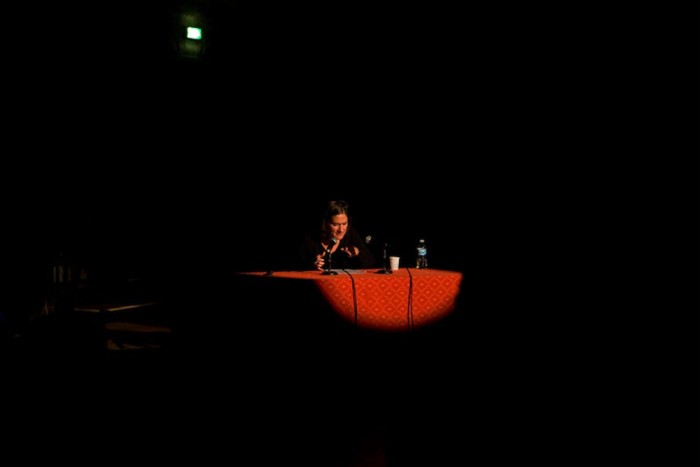
The circular motion of Febuary 21st 2006, voted by Interior Ministry of France, lays down the law on how to legally arrest conditions for illegal immigrants. Given they’re under arrest only on the outside, it thus legislates on what may be considered as a domicile or not: courtyard, yacht, operating theatre… A videoprojection displays the text of the circular motion like credits at the end of a blockbuster film, with its typical music. The performer faces the projection and repeats the text. Her behavior changes progressively, transforming itself towards an attack of the apparatus. The whole situation points out the warlike fiction suggested by the text, which gradually contaminates the performer’s mind, to the point of an extreme violence.
Residency starts with the music of an American war film, all brass and drum rolling, that could be Independence Day or Medal of Honor: a ceremony stirring patriotic fictions from their slumber.
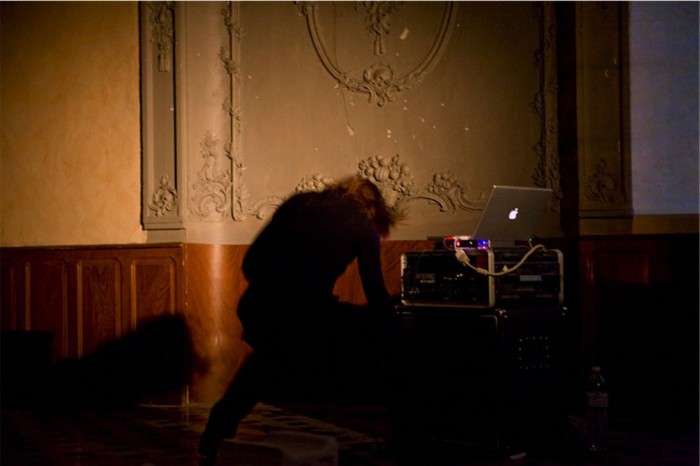
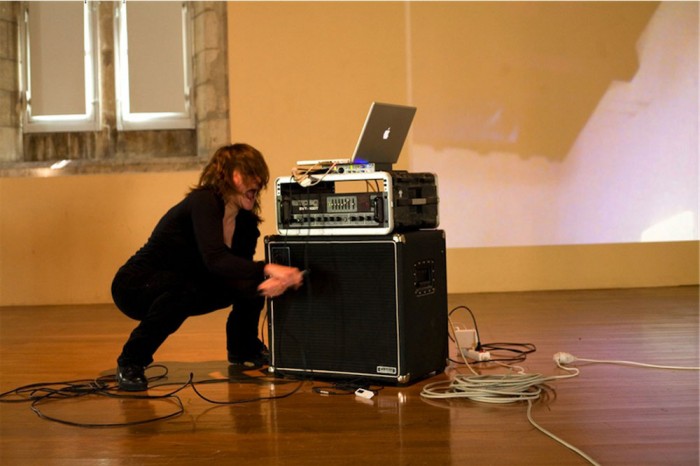
The set-up including laptop, amplifier and videoprojector starts up by itself, blasting out the music and projecting an image, a recording of the performance room itself. The performer comes closer, and finds themself faced with a screen, a teleprompter, and so takes the microphone and begins to read the scrolling text. Their face appears as a close-up on the videoprojection, the camera’s point of view is that of a computer filming its user—except that the face is entirely pixellated, like the privacy protection used on TV talk-shows.
The scrolling text also appears on the video projection, superimposed on the face, at the same time as it appears on the teleprompter’s screen. It’s made up of excerpts from the ministerial circular released on February 21st 2006 by the Interior Ministry, detailing the conditions of legal arrest for foreigners in breach of national borders and migration laws, stipulating the steps necessary to effect apprehension “on public streets, at government or police shopfronts, at home or within housing complexes.” (Circular NOR : JUSD0630020C – Crom.06.5/E1-21.02.2006).
Given that most such arrests are to take place outside, this circular is distinct in that it therefore legislates on all spaces considered to be a dwelling or not: apartment, building corridor, pleasure craft (yacht), abode destroyed by fire, operating theater, etc. It’s in this sense that excerpts were selected to underline this distinctness.
The performer thus carries out their reading of the text, in a literally “closed circuit” arrangement, as if the whole set up—composed of computer, microphone, amplifier and projector—composed all of the content, its transformation and its very own fiction. The text is processed like the opening credits to a blockbuster that might have stimulated its author’s imagination; it progressively contaminates the performer to the point of extreme violence. The actress’ voice slowly deepens and lowers as the text lists the possible arrest locations, and the calm balance is broken when, with a monstrous Darth Vader voice, she literally attacks the amplifier with the microphone, the audio feedback creating extremely violent sounds of fragging and explosion. After a short, intense attack, the music leaves the fields of battle to take on characteristics befitting redemption, that telltale register of a war film finale, and the spoken delivery of the circular ends with its two last moments: the statement that an operating theater is an acceptable location of arrest, and the list of administrative recipients for the circular.
Series of 7 performances and curating, 2008
With Emmanuelle Lafon
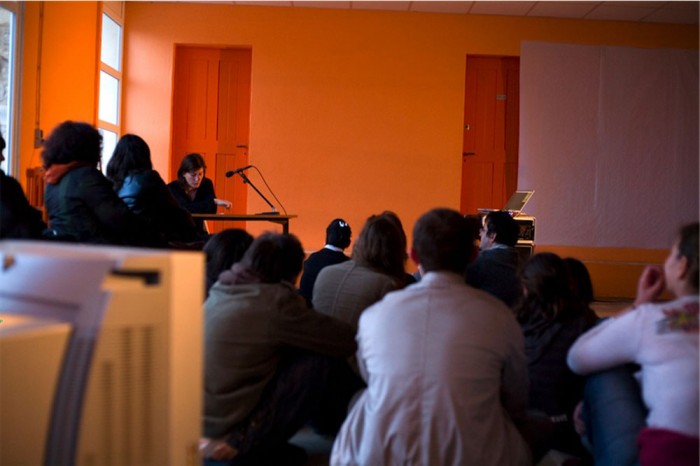
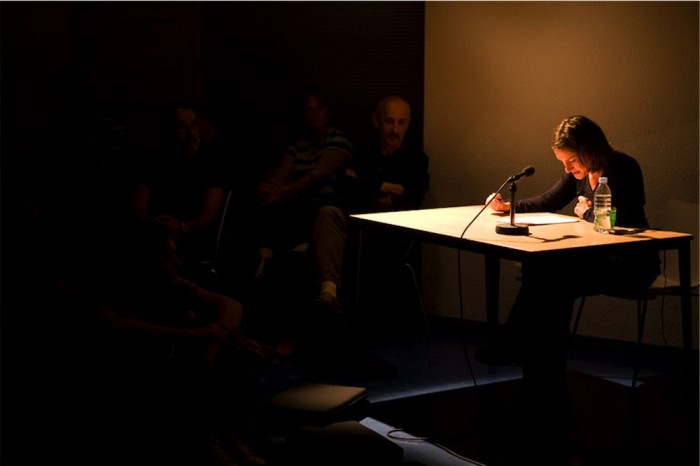
These seven performances were created with five invited artists: David Beytelmann, Juliette Fontaine, Noëlle Renaude, Jean-François Robardet and Esther Salmona. Each of them adresses a relation to an outside, by the way of a specific protocol and apparatus : following a TV flow word by word (Close Circuit), interview about immigration with a french/argentinian philosopher, absurd lecture about homeless people, landscape described in real time thru the phone, sonic simulation of a catastrophe (Frost), etc. The performer and the audience share the same space, in a global apparatus that is reconfigured for each venue.
This “theatre of operations” is part and parcel of an overall approach questioning the relations between writing, visual arts and performance: apparatus, relations with the audience, critical choice of performance venues.
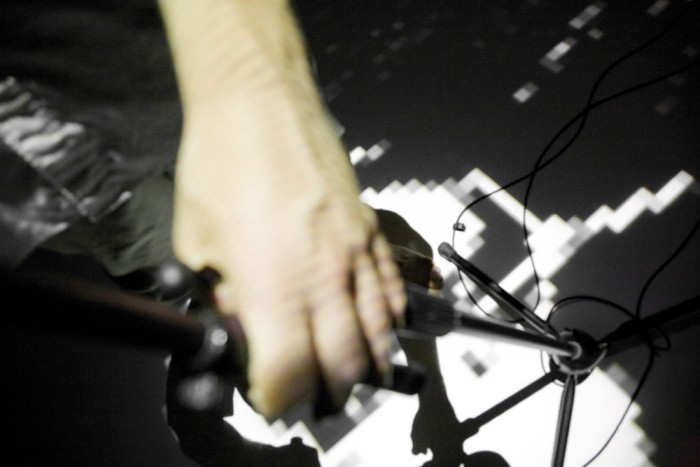
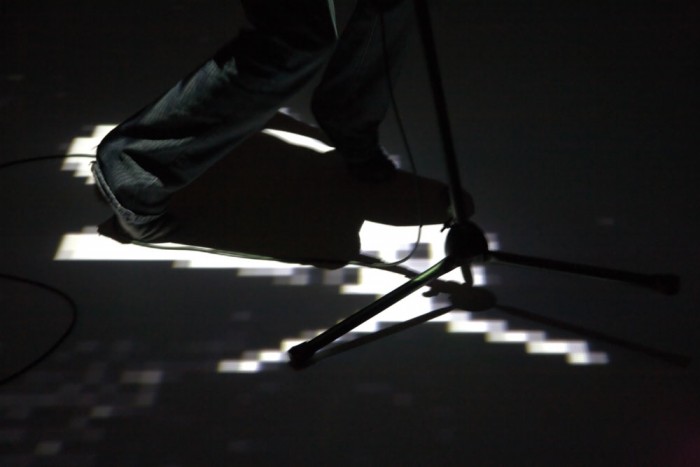
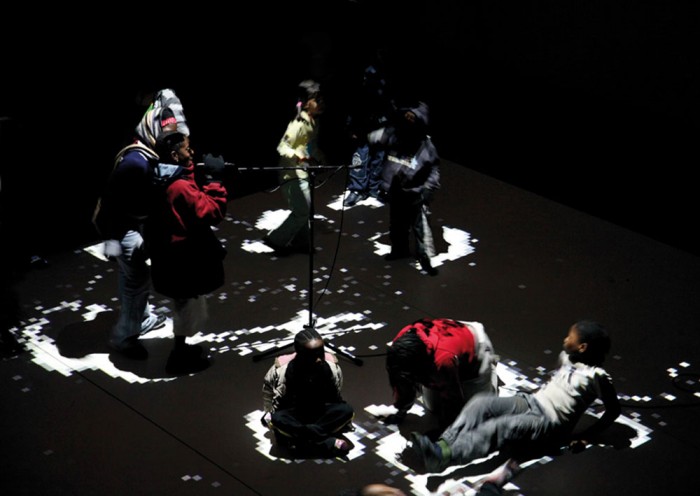
Surrounded by a white blinking light, a microphone is placed on a stand, at the center of a complete dark room. As the visitors enter the room, bold and saturated feedbacks began to appear, reacting to their slightest movements, and increasing strongly as they approach the microphone. Each gesture modulates the sound, provoking for the visitors an increasing perception of their own body, as well as the sensation that a dangerous living thing is haunting the stage. The only visible forms are white, vibrating and pixellized shadows projected on the floor, around the microphone and around every spectator getting in the space. These pixelated forms are the negative shapes of the visitor’s camera caption from the ceiling: literally, they are the generators of the sound.
In this dark electric atmosphere that evokes punk music and science fiction, the visitors become both the instigators and the “willing victims” of a wild phenomenon that eludes them: a paradoxal situation of fear, self-exhibition and play.
Coproduction Ecole nationale supérieure d’art de Nancy / Atelier de recherche et création Electroshop / Alliance Artem. A documentary film about Feedbackroom has been released in DVD by Éditions du Point d’exclamation and Éditions du Parc / ENSA Nancy, 2009.
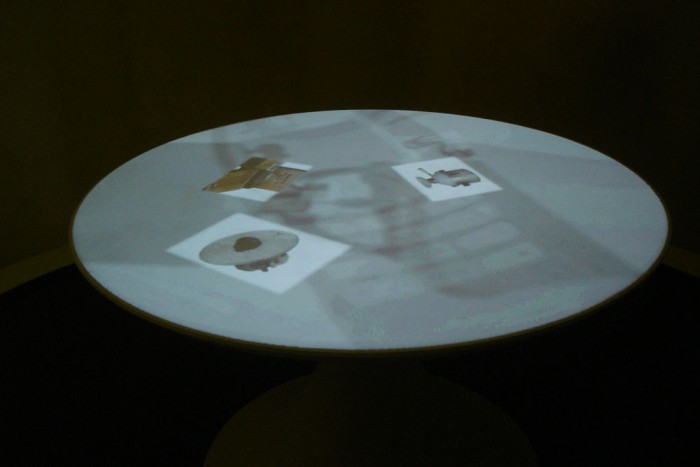
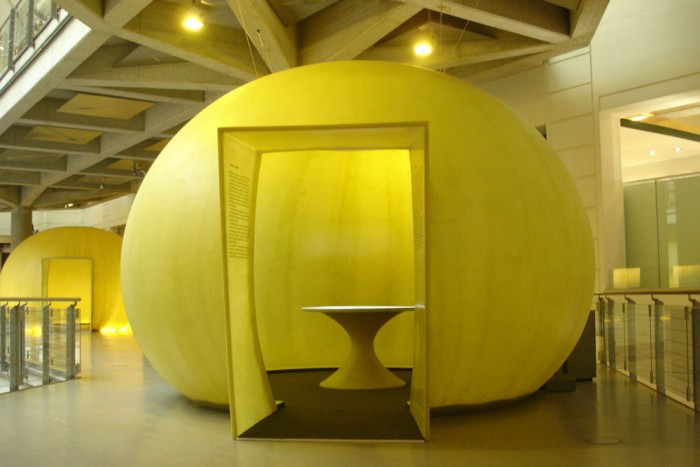
Created initially as an installation, following the invitation of Technisches Wien Museum for its permanent collection, the video The Life of Things (Das Leben der Dinge) presents interviews of nine people discovering ten objects that have not been indexed, so that the history of those objects is controversed and for what the museum conservators do not know what to do with. Within a museum of science exhibiting a catalogue raisonné of objects and practices, The Life Of Things questions collective representations that objects are provoking when they become part of a collection, while we see nine people portrayed at the moment they are facing curiosity and uncertainty.
Installation, 2005-2010
Samuel Bianchini and Thierry Fournier
with the voice of Maryseult Wieczoreck
A white dot on a black screen is following the spectator movements while he/she is using a computer mouse in front of it. Without activity, the installation diffuses the sound of human breath, barely audible. When the dot moves, the voice of a woman appears: static, then beginning to grow and increasing rapidly with the hand actioning the mouse. As the spectator’s gesture develops or focuses on a point, speeding up or slowing down, the sound unfolds and develops itself. The voice shifts from breathing to whispering, from singing to shouting, from the tiniest details to burgeoning vocals. The voice is reacting to the gesture and requests it. The sound gradually gives a shape to an acoustic body that reveals itself through the tactile exploration – although its interpretation remains offered to the audience.
installation, 2005
Emmanuel Berriet and Thierry Fournier
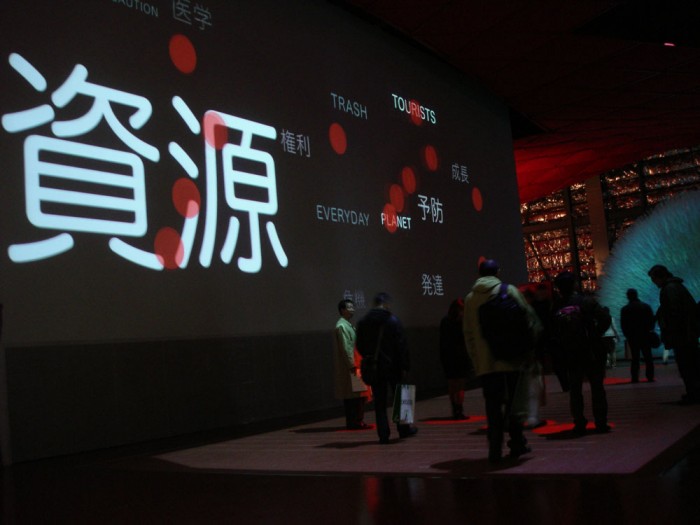
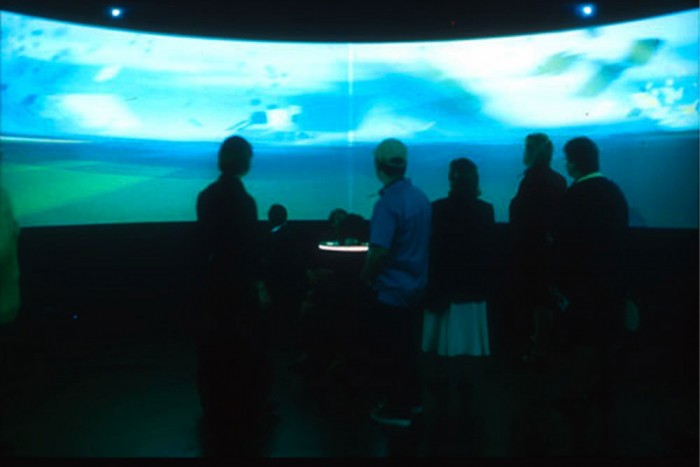
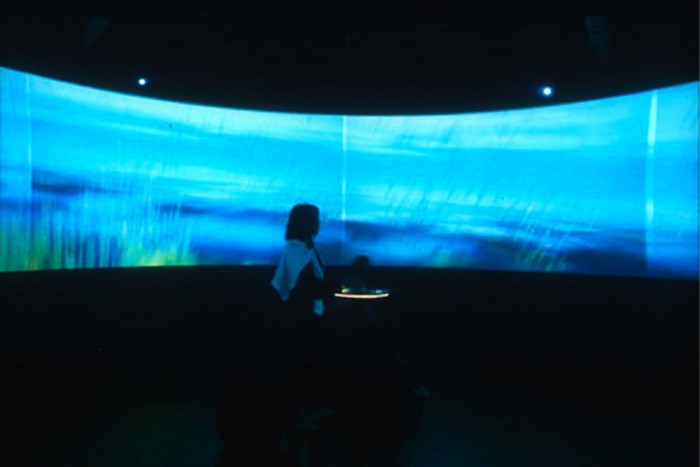
The installation Ce qui nous regarde proposes a space in which the audience leave traces of its passages and movements, asking words and images and being questioned at their turn. In front of a large panoramic screen showing of a large number of words and questions, the presence and the movements of the spectators triggers the apparition of several videos trating the subject of development. The project proposes an hybrid form between cinema and interactive installation.
Sound installation, 2004
Objects design: Zarko
Landscape design: Pascale Langrand and François Schelameur
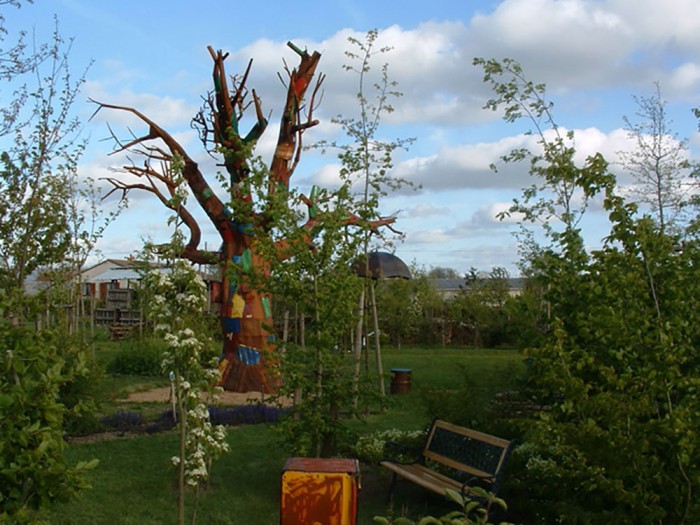
The Garden of the Navel is a collective project based on an imaginary mythology that ironically names Pougne-Hérisson (a hamlet of 200 inhabitants) as the homeland of tales, where “all stories come from, and where they should come back”. The Stories Machine is an interactive sound installation which composes a soundscape with the stories that the visitors leave themselves. Several microphones are placed in the garden, in which visitors are invited to leave a story of their own, lasting anything from a few seconds to a few minutes, that will then be stored by the installation. As soon as it has been recorded, each story lives its own life and occupies the space. The lifetime of a story is unlimited: it is always heard immediately after it has been recorded, but it may reappear weeks or months later. The space of the Garden develops and grows with time: it is nurtured, visited and searched by the visitors themselves, like a talking landscape, organic and unpredictable.
Electric Bodyland is an interactive sound installation. Each movement of the spectators generates a navigation within an electronic musical piece which is composed, mixed and spatialized in real time. Individually or collectively, the spectators play their own composition of a sound sculpture which is to be explored continuously, from the inside and in an empty space.
Created in the frame of a residency at the Synthese Festival 2003.
installation, 2003
Original title : L’Ombre d’un doute
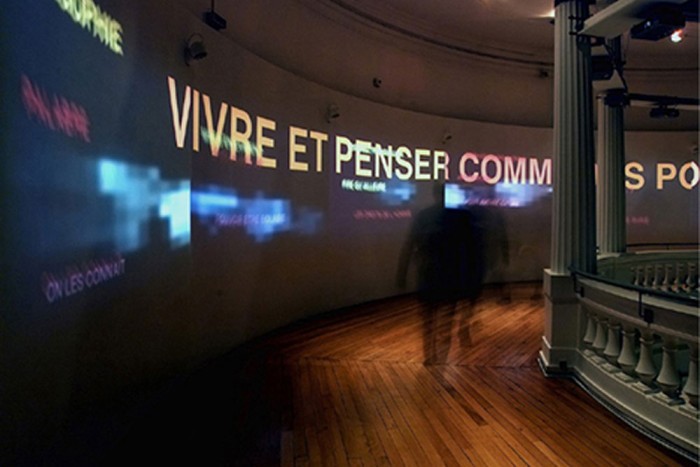
Shadow of a doubt is a “controversy room”: a set of points of view about science, media and politics is confronted with the audience presence and actions. The silhouettes of visitors are projected in real time on the wall, under the form of white “ghosts”; they follow them and reveal videos of interviews, TV archives and philisophical texts read by actors. The relationships and proximity between sequences are constantly modified by the interaction between the visitors in the room. Each person faces two simultaneous collective experiences: one that is talked about in the video sequences, and one that builds up continuously, improvised by the visitors, in the installation area.
People interviewed are activists and association members (François Desriaux, Christophe Gérard, Anne-Laure Morin, Christophe Noisette), philosophers and sociologists (Marc Augé, Bernard-Marie Dupont, François Ewald, Pierre Lascoumes, Isabelle Stengers), a farmer (Hervé Touraquet), civil servants and politicians (Bernard Bachelier, Alain Claëys, Martin Hirsch), and researchers (Olivier Godard, Pierre-Henri Gouyon, Guy Riba, Jacques Testart).
Texts excerpts that actors read are by Giorgio Agamben (Moyens sans fins), Gilles Châtelet (Vivre et penser comme des porcs), Gilles Deleuze et Félix Guattari (Qu’est-ce que la philosophie ?), Georges Didi-Huberman (Ce que nous voyons, ce qui nous regarde), Bernard Kourilsky et Geneviève Viney (Rapport au premier ministre sur le principe de précaution), Bruno Latour (Du principe de précaution au principe de bon gouvernement), Maurice Merleau-Ponty (L’oeil et l’esprit), Francis Ponge (Le Parti pris des choses), Armand Robin (La Fausse Parole), Clément Rosset (Principes de sagesse et de folie), Isabelle Stengers (Sciences et pouvoirs – la démocratie face à la technoscience), Paul Watzlawick (La Réalité de la réalité : confusion, désinformation, communication), Ludwig Wittgenstein (De la certitude).
music and sound installation for the theater, 2002
Original title : Les Paravents
Music and sound installation for the theater
Les Paravents by Jean Genet / Stage direction Frédéric Fisbach, 2002
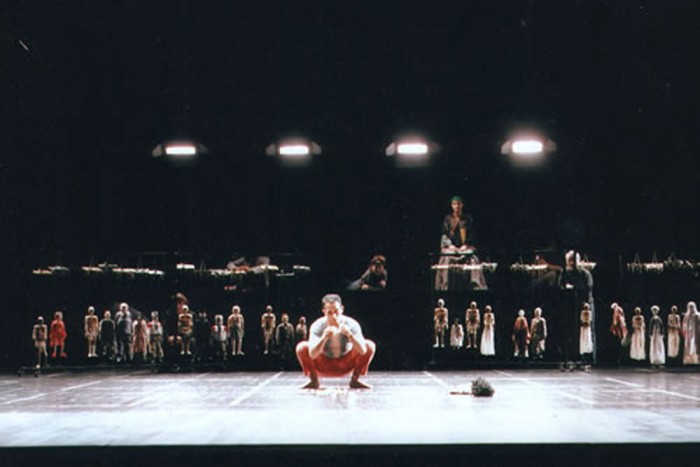
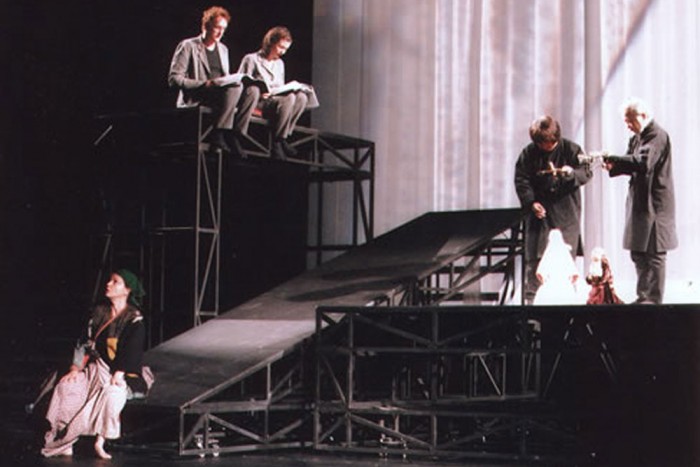
Monstruous theater play taking place during the algerian war, involving 96 characters, many parallel narrations and simultaneous scenes, The Screens were directed in 2002 by Frédéric Fisbach who chose to display the casting between three actors for the 3 main characters and japanese bunraku puppets for all the others. The bunraku company is Youki-za, one of the oldest in Japan, founded at the XVIth century. Puppet’s voices were played live by two other actors.
“The Screens seems to be a proposition for a total theater – a feast as Genet said – where the text accompanies a poetic action which takes place either on stages or screens. The Screens carry a dream or a vision of the theater which could be simultaneously a comedy and a solemn feast, dedicated to the living and the dead. A poem for the stage reviving the politics, in the sense it offers a vision of the world to the public” (F. Fisbach)
The music for live electronics, the voice’s amplification and transformation and the spatialization of every element was played live on stage by Jean-Baptiste Droulers.
Musical piece (4 voices and electronics) for an installation by Marie Sester, 2000
Architecture of Paradise is a five section piece for 4 vocal soloists and electronics, created within Marie Sester’s installation presented at the SFMOMA in 2000. The piece is based on excerpts of Plato’s Timeus-Critias, which describes the role and story of Atlantis. The text is sung in its English version, by the soprano and alto. It is read in English and French by the two actresses. Beyond its original context, it evokes the concept of an ideal city, and its consequences in matters of political domination – considerations which remain absolutely topical. The piece develops a circular tension between several parts: the soprano-alto duo, the intimate reading of the text by the actresses, the electronics (oscillations, filters and saturations) and the real time transformations of the voices.
Online dance performance, 2001
Isabelle Choiniere and Thierry Fournier
The Moulting Angel is a live and online performance, in which two dancers interact in two distant places, exchanging music and images generated by their movements. The project explores the projections and transformations of the body through a network. Each site performs a mix of both interventions in a constant dialogue. The musical generation is based on a set of microphones, explored in various directions (gestural capture, sound recording, relationship between space and body, etc.).
Interactive installation, 2000
Olivier Auber, Emmanuel Berriet, Thierry Fournier
Performers: Armelle Orieux (soprano), Laura Gordiani (alto), Jean-François Chiama (tenor), Eric Guillermin (bass).
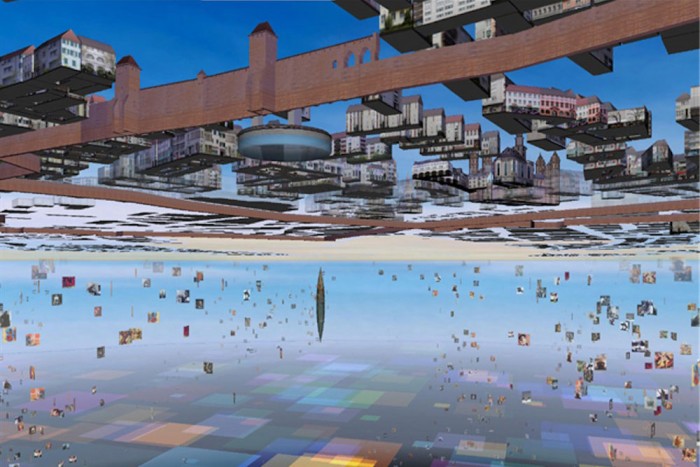
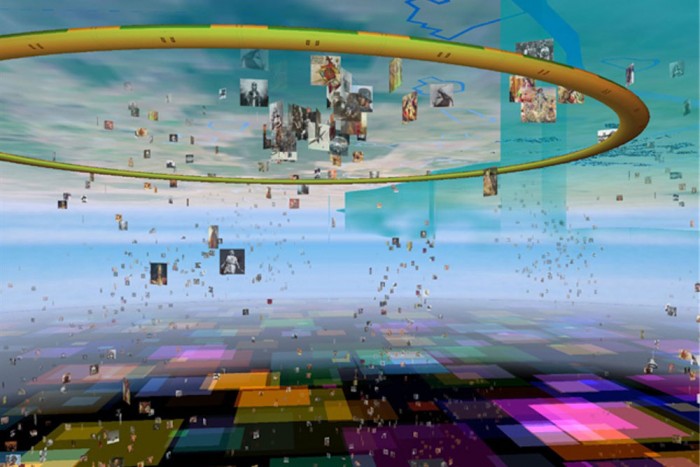
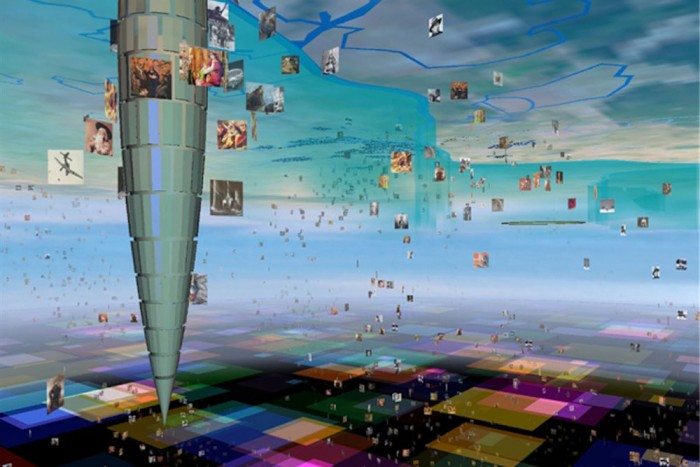
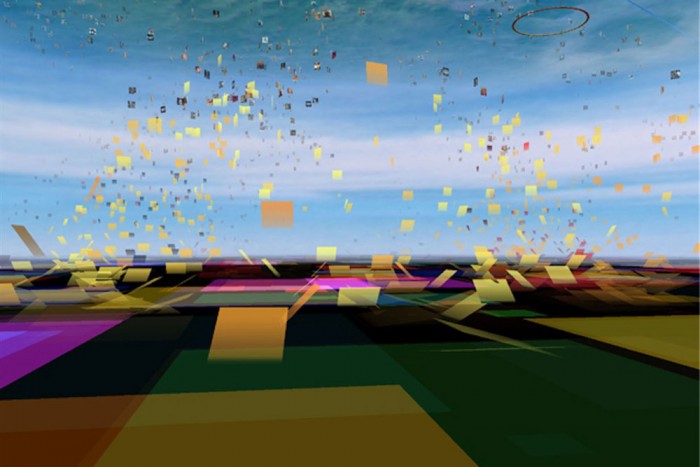
The Nibelungen Treasure is based on the medieval text of the Nibelungen Lied and the myth it has become: an invisible monument in the german history and in the city of Worms, where the Lied takes place. Visitors entering the installation see the city of Worms from underneath, as if the ground were transparent. Beneath their feet, the bottom of the world stretches into infinity like an impossible chaos. In this space, between the town and the bottom of the world, the imaginary space of the myth develops itself.The visitor moves intuitively in this space, as if he were floating, by means of a circular joystick that he can manipulate in all directions. All the visual and musical elements are generated in real time, in relation to the visitor’s movements on the interface. The spectators influences the content and the form of the score, and the way its parts link and mix. The instrumental gesture of the spectator leads into an experience of time: a continuous circulation in the inner matter and construction of music. The music and soundtrack of the whole museum has been also created within the same project.